On eBird ↗
Orinoco Goose
Live sightings near you, the range map, bar charts of when it is seen, and Macaulay Library photos and recordings.
Orinoco Goose
Oressochen jubatus
The Orinoco goose (Neochen jubata) is a member of the duck, goose and swan family Anatidae. It is in the shelduck subfamily Tadorninae, and placed in the genus Neochen. Three fossil relatives have been described from Pleistocene sites: Neochen pugil from Brazil, Neochen debilis from Argentina and Neochen barbadiana from Barbados.
From the article Orinoco goose on Wikipedia (CC BY-SA), quoted section by section
Description
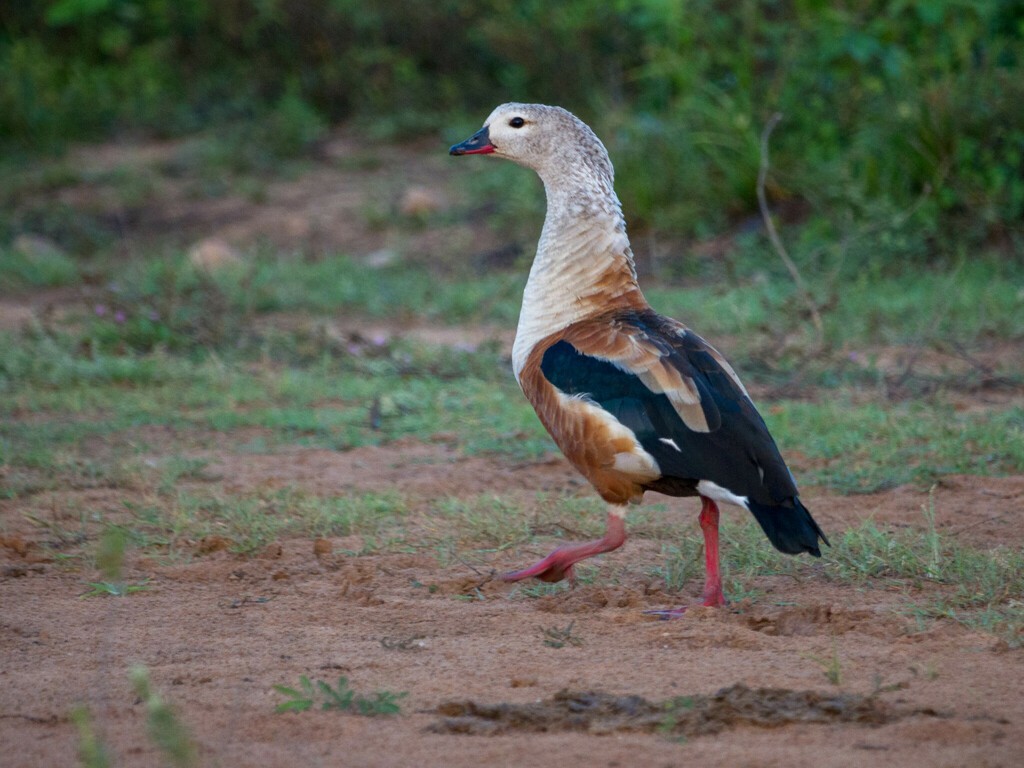
The Orinoco goose is 61 to 76 cm (24 to 30 in) long. Males weigh about 1.8 kg (4.0 lb) and females about 1.3 kg (2.9 lb). Adult males have an off-white head, neck, and breast with slight buffy streaks on the nape and buffy scalloping on the breast. Their mantle is gray with white scalloping. They have an orange band across the upper mantle and onto the sides of the breast and flanks and a crescent of dark brown behind the flanks. Their undertail coverts are white. Their wings are black with a wide white speculum. Also, their bill has a black maxilla and a mostly red mandible and their legs and feet are bright salmon red. Adult females have a similar pattern as the males but have a drab wash on their crown and nape, less orange on the flanks, and darker scalloping on the sides of the belly. Their legs and feet are more a dull orange than bright red.
Range & habitat
The Orinoco goose is found from Venezuela south through Colombia, eastern Ecuador, eastern Peru, and Bolivia into far northern Argentina and in a broad swath across central Brazil. An isolated population spans the northern Brazil–Guyana border. Though the IUCN range map includes French Guiana, Suriname, and Paraguay, the South American Classification Committee of the American Ornithological Society has no records in the first two countries and records only as a vagrant in Paraguay. The Orinoco goose inhabits wet savanna and the edges of large freshwater wetlands in the wet season and in the dry season, it is also found on river beaches and oxbow lakes in the Amazon Basin.
Wikipedia: “Distribution and habitat”
What it does
The Orinoco goose is herbivorous and feeds mainly on leaves and seed heads, especially those of grasses. It also feeds on aquatic algae in stagnant water along rivers and oxbows. It mostly forages during the day in open areas near water, although it also forages at night. Individuals move between feeding and resting areas at dawn and dusk.
Wikipedia: “Feeding”
Listen
Looking for field recordings…
Where it lives
Recorded sightings
—
geo-referenced records in GBIF, from museums, herbaria and field observers.
Drag the globe to turn it. Dots are where records exist, not a range map; darker means more records.
In the stacks
Searching the stacks…
Every page naming Oressochen jubatus in the Biodiversity Heritage Library →
This page is assembled live from iNaturalist, GBIF, Wikipedia, the Source Library and the Internet Archive. It is not yet part of the hand-edited codex. iNaturalist taxon 514125.