On eBird ↗
Knobbed Hornbill
Live sightings near you, the range map, bar charts of when it is seen, and Macaulay Library photos and recordings.
Knobbed Hornbill
Rhyticeros cassidix
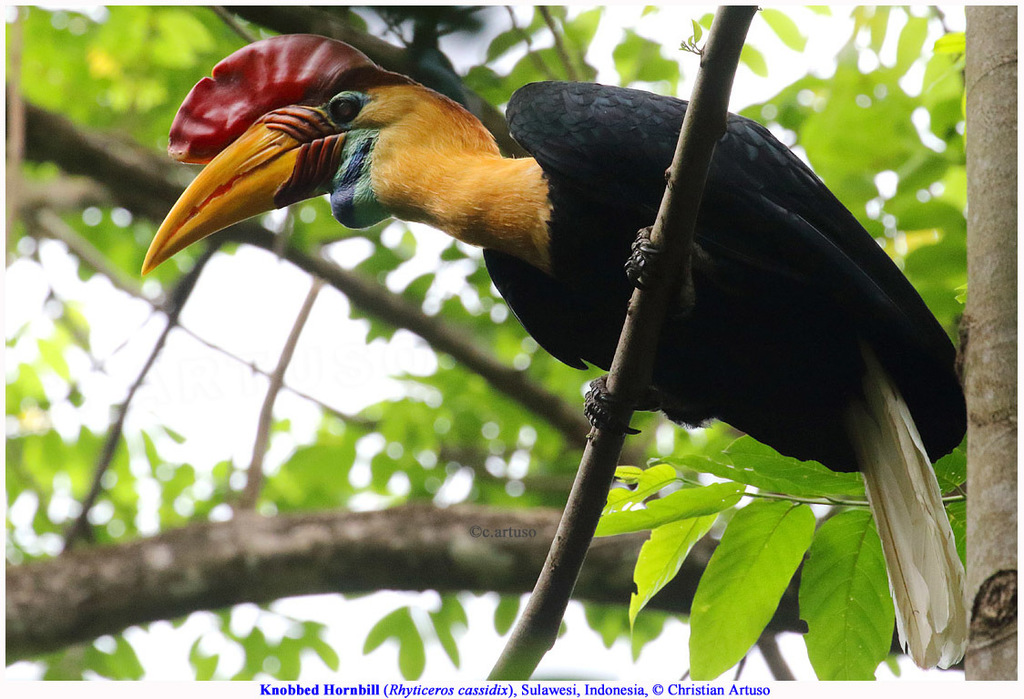
The knobbed hornbill (Rhyticeros cassidix), also known as Sulawesi wrinkled hornbill, is a colourful hornbill native to Indonesia. The species is sometimes placed in the genus Aceros. The knobbed hornbill is the faunal symbol of South Sulawesi province.
From the article Knobbed hornbill on Wikipedia (CC BY-SA), quoted section by section
Description
The knobbed hornbill is a large black hornbill with a yellow bill, white tail feathers, pale blue skin around eye, blackish feet and bare dark blue throat. Like other hornbills, the species is sexually dimorphic. The male has a rufous/buff face and neck, orange-red eyes, and a high red casque on the top of his bill. The female has a black face and neck, a yellow casque, and brownish eyes.
Range & habitat
An Indonesian endemic, the knobbed hornbill is found in Sulawesi, Buton, Lembeh, Togian and Muna Island. It inhabits evergreen forest at an elevation of up to 1,800 m and also makes use of secondary forest, woodland and plantations for foraging.
Wikipedia: “Distribution and habitat”
What it does
As with other hornbills, the knobbed hornbill is believed to be monogamous. Its diet consists mainly of fruits, but it will also take insects and small vertebrates. Breeding season spans 27–30 weeks and appears to be triggered by a dramatic reduction in rainfall. The female seals itself inside a tree hole for egg-laying using its own feces. During this time, the male will provide foods for the female and the young through a slit in the seal. Knobbed hornbills are important seed dispersers in their habitat and influence the initial fate of seeds of several tropical forest tree species.
Wikipedia: “Ecology”
Listen
Looking for field recordings…
Where it lives
Recorded sightings
—
geo-referenced records in GBIF, from museums, herbaria and field observers.
Drag the globe to turn it. Dots are where records exist, not a range map; darker means more records.
In the stacks
Searching the stacks…
Every page naming Rhyticeros cassidix in the Biodiversity Heritage Library →
This page is assembled live from iNaturalist, GBIF, Wikipedia, the Source Library and the Internet Archive. It is not yet part of the hand-edited codex. iNaturalist taxon 514334.