- Animals
- ›Chordates
- ›Vertebrates
- ›Cartilaginous Fishes
- ›Sharks and Rays
- ›Rays
- ›Stingrays
- ›Eagle Rays
- ›Myliobatis
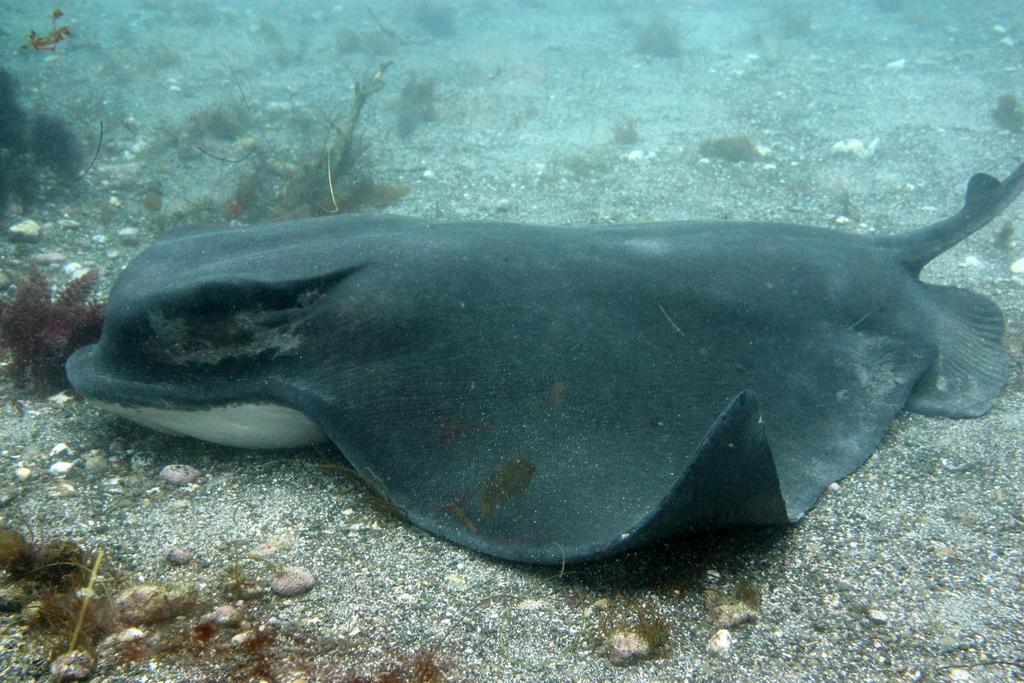
Bat Ray
Myliobatis californica
The bat ray (Myliobatis californica) is an eagle ray that has a diamond ray-like form that consists of pectoral fins that are wing-like and end in blunt points. The head is broad and raised higher than the pectoral fins. The eyes are laterally situated on the broad head. Below the front of the head projection is a horizontal depression. This means that instead of the head being flat, there is a slight indent in the top of the head in between the eyes. The tail is whip-like and is typically incomplete with at least one venomous spine at the base of the tail. The incomplete aspect means that the tail consists of cartilage instead of bone. The dorsal side is black or a dark brown while the ventral side is white with the exception of the areas close to the tips or disk.
The largest specimens can grow to a wingspan of 1.8 m (5 ft 11 in) and a mass of 91 kg (201 lb). There is a record of this species reaching 240 pounds, however large specimens are typically closer to 200 pounds. They typically range from 9.07–13.61 kg (20.0–30.0 lb). The size of the bat ray is dependent on many factors, such as habitat alterations and different oceanographic and environmental conditions. Some bat rays are solitary, while others form schools numbering in the thousands.
From the article Bat ray on Wikipedia (CC BY-SA), quoted section by section
Range & habitat
The Bat Ray can be found in both tropical and temperate oceans from central Oregon in the USA to Mexico in the Gulf of California. The bat ray (Myliobatis californica) is found in muddy or sandy sloughs, estuaries and bays, kelp beds and rocky-bottomed shoreline. It is also found in the area around the Galápagos Islands. This species can typically be found in flat sections of water with a sand patch in between rocks or with a rocky bottom. They are commonly found in bays and sloughs within the shore area. They can be commonly found around offshore islands including San Clemente, Anacapa, and Santa Rosa. They have been observed during the summer and spring at San Clemente. During March and April they are common in the shallow waters of Santa Rosa. During the summer, they are common in the shallow water around Anacapa Island. Bat rays can live anywhere from the surface to up to 150 feet below the surface and are primarily concentrated within 8 to 100 feet below the surface.
Wikipedia: “Distribution”
What it does
Bat ray reproduction is ovoviviparous. This means that the eggs are retained by the female and hatch inside of the female in a process that resembles a live birth. They mate annually, in the spring or summer, and have a gestation period of nine to twelve months. After this gestation period finishes, the pups are born. Litter sizes range from two to ten — pups emerge tail first with their pectoral fins wrapped around the body, and the venomous spine is flexible and covered in a sheath which sloughs off within hours of birth. Bat rays live up to 23 years. Bat rays copulate while swimming with synchronized wingbeats—the male under the female. The male inserts a clasper into the female's cloaca, channeling semen into the orifice to fertilize her eggs. The sexual maturity size of the female Bat Ray (Myliobatis california) is often greater than the male one. They have histotrophic viviparity with the embryo number in pregnant females ranging from two to five pups. Histotrophic viviparity is when the embryos inside the oviduct get their nutrition from uterine secretions instead of a yolk sac in order to grow throughout gestation without the need of a placenta. For males, sexual maturity occurs at a disc width of 622 mm and a weight of about 3.7 kg around 2–3 years of age. Disc width is from tip to tip of each of the wings. …
Wikipedia: “Reproduction”
Where it lives
Recorded sightings
—
geo-referenced records in GBIF, from museums, herbaria and field observers.
Drag the globe to turn it. Dots are where records exist, not a range map; darker means more records.
In the stacks
Searching the stacks…
Every page naming Myliobatis californica in the Biodiversity Heritage Library →
This page is assembled live from iNaturalist, GBIF, Wikipedia, the Source Library and the Internet Archive. It is not yet part of the hand-edited codex. iNaturalist taxon 51491.