- Animals
- ›Chordates
- ›Vertebrates
- ›Birds
- ›Perching Birds
- ›Vireos, Shrike-Babblers, and Erpornis
- ›Pachysylvia
On eBird ↗
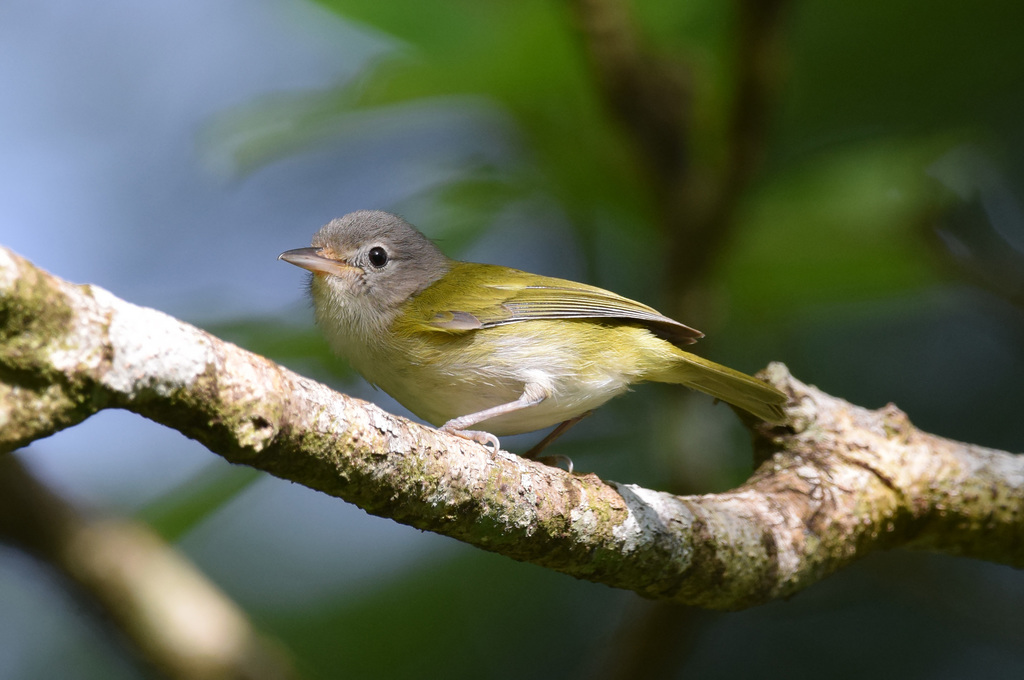
Lesser Greenlet
Live sightings near you, the range map, bar charts of when it is seen, and Macaulay Library photos and recordings.
Lesser Greenlet
Pachysylvia decurtata
The lesser greenlet (Pachysylvia decurtata) is a small passerine bird in the family Vireonidae, the vireos, greenlets, and shrike-babblers. It is found in Mexico, every Central American country, Colombia, Ecuador, and Peru.
From the article Lesser greenlet on Wikipedia (CC BY-SA), quoted section by section
Description
The lesser greenlet is 9.4 to 10.2 cm (3.7 to 4.0 in) long and weighs 6.6 to 10.3 g (0.23 to 0.36 oz). The sexes have the same plumage. Adults of the nominate subspecies have a gray-blue crown and upper face. They have grayish lores, a whitish eye-ring, and often a pale stripe above the lores. Their upperparts are olive-green that is lighter on the rump. Their wings' primaries and secondaries are dark grayish with bright greenish outer webs. Their tail is grayish green. Their chin is whitish, their throat pale gray, their breast very pale lemon-yellow, their belly whitish, and their flanks and vent greenish yellow. Their underwing coverts are yellow. The other subspecies of the lesser greenlet differ from the nominate and each other thus:
P. d. brevipennis: pure gray crown, pale lores and ear coverts, grass-green back, and brighter green flanks than nominate P. d. dickermani: darker duller green back than nominate with white throat, little or no white on underparts, and much green on flanks P. d. phillipsi: crown sometimes tinged brown, duller and grayer upperparts than nominate with paler flanks and undertail coverts P. d. darienensis: olive wash on crown (similar color to its and nominate's back) P. d. …
Range & habitat
The subspecies of the lesser greenlet are found thus:
P. d. brevipennis: eastern Mexico from southeastern San Luis Potosí P. d. dickermani: southeastern Mexico except the Yucatán Peninsula P. d. phillipsi: Mexico's Yucatán Peninsula and northern Belize P. d. decurtata: from Guatemala and southern Belize south on both slopes through Central America to the Panama Canal area P. d. darienensis: from the Canal area east into northwestern Colombia as far east as Santander Department P. d. minor: Pacific slope of western Colombia south through Ecuador just into far northwestern Peru's Tumbes Department The lesser greenlet inhabits a variety of landscapes in the tropical zone. These include evergreen and deciduous forest, gallery forest, and secondary forest. In elevation it ranges from sea level to 1,400 m (4,600 ft) in northern Central America, 1,500 m (4,900 ft) in Costa Rica, 800 m (2,600 ft) in Colombia, 1,100 m (3,600 ft) in Ecuador, and 400 m (1,300 ft) in Peru.
Wikipedia: “Distribution and habitat”
What it does
The lesser greenlet feeds mostly on invertebrates and includes seeds in its diet as well. It forages in pairs or family groups and frequently joins mixed-species feeding flocks. It hunts actively, usually in the forest canopy though sometimes lower, taking prey mostly from live foliage but also dead leaf clusters. It sometimes hangs upside-down to feed.
Wikipedia: “Feeding”
Listen
Looking for field recordings…
Where it lives
Recorded sightings
—
geo-referenced records in GBIF, from museums, herbaria and field observers.
Drag the globe to turn it. Dots are where records exist, not a range map; darker means more records.
In the stacks
Searching the stacks…
Every page naming Pachysylvia decurtata in the Biodiversity Heritage Library →
This page is assembled live from iNaturalist, GBIF, Wikipedia, the Source Library and the Internet Archive. It is not yet part of the hand-edited codex. iNaturalist taxon 515240.