- Animals
- ›Chordates
- ›Vertebrates
- ›Ray-finned Fishes
- ›Spiny-rayed fishes
- ›Perches, Scorpionfishes, Sticklebacks, and Allies
- ›Scorpionfishes and Allies
- ›Typical Flatheads
- ›Platycephalus
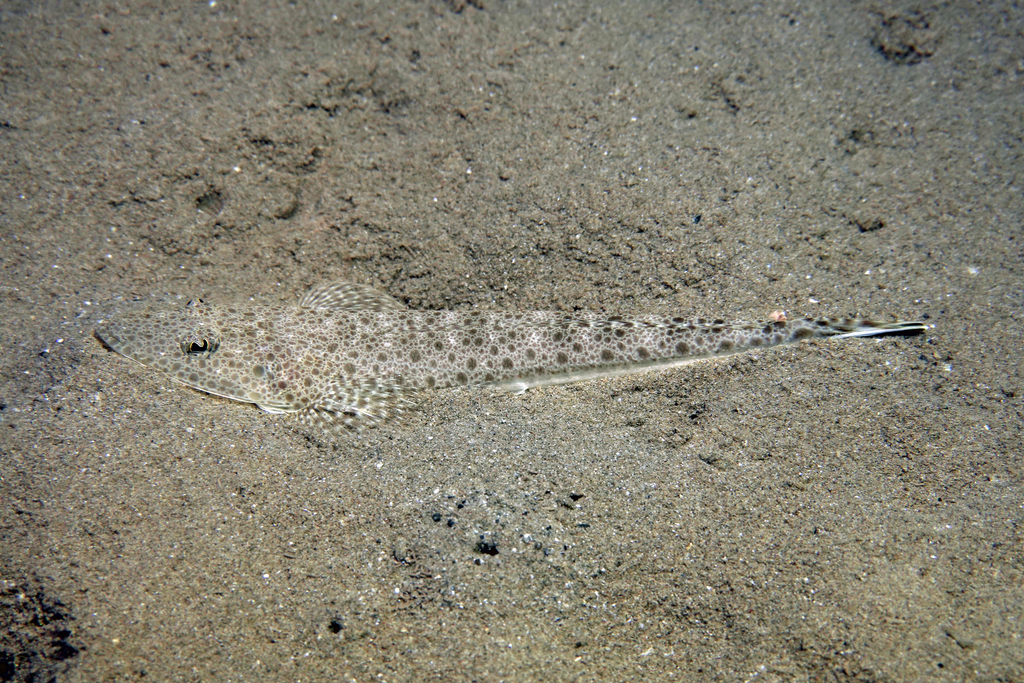
Northern Sand Flathead
Platycephalus endrachtensis
Platycephalus endrachtensis, or the bar-tailed flathead, bar-tail flathead, flag-tail flathead, northern sand flathead, northern-flag tailed flathead, sand flathead, western estuary flathead, is a predatory fish in the family Platycephalidae. It is found from the eastern Indian Ocean to the western Pacific, including in Australian and Indonesian waters up to 60 m (200 ft) deep over sand, at temperatures between 17 and 18 °C (63 and 64 °F). The maximum length of the species is 62 cm (24 in), and its weight up to 5 kg (11 lb). A popular angling species, the specific epithet endrachtensis refers to Eendrachtsland, an early Dutch name for Australia, with the suffix -ensis, meaning "place". Venomous spines are hazardous for safe handling.
From the article Platycephalus endrachtensis on Wikipedia (CC BY-SA), quoted section by section
Description
Platycephalus endrachtensis has a sandy pale brown to tan colouration for camouflage. It is recognised by the black spots on its tail. The species can be differentiated from the similar P. australis from the two dark horizontal bars on the caudal fin and the yellow blotch on the middle fin, and from P. westraliae by a triangular lappet above the upper iris. It is found from the eastern Indian Ocean to the western Pacific, including in Australian and Indonesian waters up to 60 m (200 ft) deep over sand, at temperatures between 17 and 18 °C (63 and 64 °F). The maximum length of the species is 62 cm (24 in), and its weight up to 5 kg (11 lb). Unlike their relatives, they are not protandrous hermaphrodites.
Behaviour. P. endrachtensis is harmless to humans, is normally seen on the ocean floor, and if provoked, will burst from the sand quickly and settle again nearby.
Range & habitat
The species ranges in Australian waters from Hamelin Bay, Western Australia, to St Helens, Tasmania, with the type locality in Shark Bay; it spawns in the Swan River estuary from late spring to the start of autumn. It is also found in Indonesia. They can be seen drifting on sand flats.
Wikipedia: “Range and habitat”
What it does
The fish is an ambush predator, altering its skin colouring by "arranging [its] pigments within chromatophores" ( A.J. Hirst, 2014) and feeds on fish and sometimes large benthic crustaceans.
Wikipedia: “Diet”
Where it lives
Recorded sightings
—
geo-referenced records in GBIF, from museums, herbaria and field observers.
Drag the globe to turn it. Dots are where records exist, not a range map; darker means more records.
In the stacks
Searching the stacks…
Every page naming Platycephalus endrachtensis in the Biodiversity Heritage Library →
This page is assembled live from iNaturalist, GBIF, Wikipedia, the Source Library and the Internet Archive. It is not yet part of the hand-edited codex. iNaturalist taxon 516143.