- Animals
- ›Chordates
- ›Vertebrates
- ›Ray-finned Fishes
- ›Carps, Characins, Catfishes and Allies
- ›Characins
- ›Characoidei
- ›Iguana Tetras
- ›Bryconops
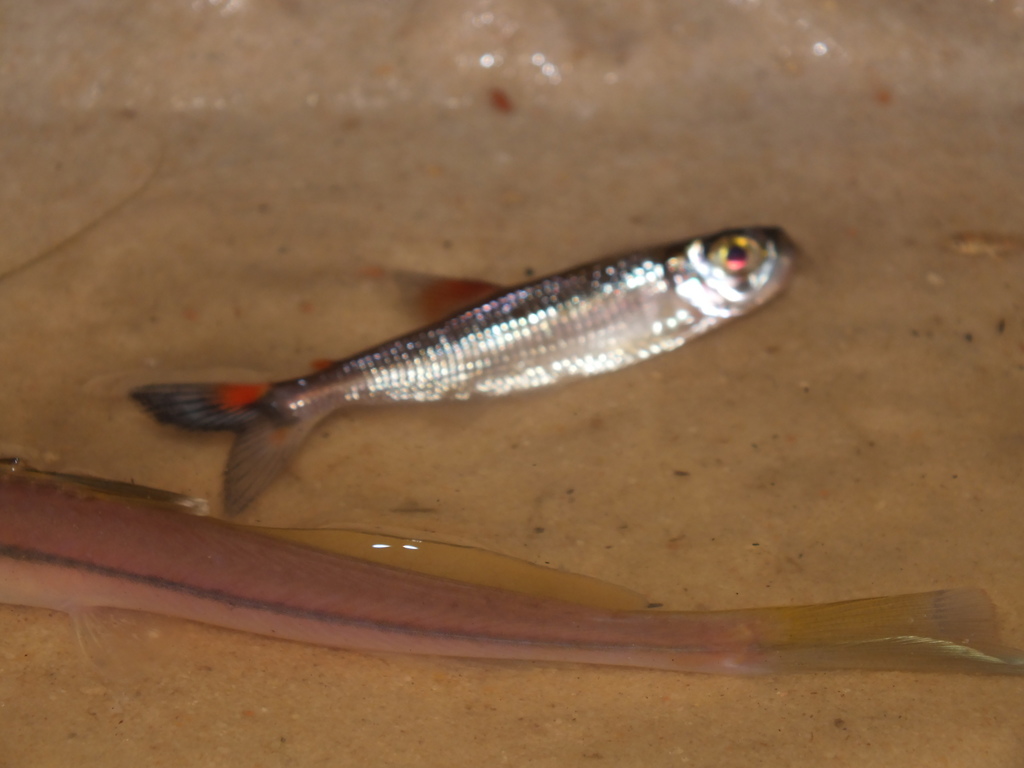
Tailspot Tetra
Bryconops caudomaculatus
The tailspot tetra (Bryconops caudomaculatus) is a small species of freshwater ray-finned fish belonging to the family Iguanodectidae. This fish is found in the coastal river regions of upper South America. Both its common and scientific names reference the distinct spot of color present on the tail fin, which is one of its defining characteristics. It is a small fish, reaching 4.8 in (12.4 cm) at its longest. Despite its small size, it is an active swimmer, with a preference for fast-flowing waters.
From the article Tailspot tetra on Wikipedia (CC BY-SA), quoted section by section
Description
The tailspot tetra, like the rest of the genus Bryconops, has a slender body described as "smelt-like", similar to members of sister genus Piabucus. It reaches 4.8 in (12.4 cm) in total length (with the tail fin included), and a corresponding weight of 20.1 grams. Its back scales are tinted orange to dark-orange, fading into silver on the belly when the fish is alive. Upon close inspection, the scales are also revealed to have a scattering of minute dots. The spot of bright orange on the basal half of the caudal fin is what gives the tailspot tetra its common name. The scientific name also reflects this - "caudo-" is in reference to the caudal fin (the tail fin), and "-maculatus" means "spotted" (compare with the word "immaculate", which means "without blemishes"). Though it is more vivid in life, this spot of color may turn pale upon preservation of a given specimen. Visually, the tailspot tetra is easy to confuse with congeners B. magoi and B. collettei, which means that they have often been misidentified as B. caudomaculatus. (This is part of the reason they are considered to be in the same species complex.) Recent congener B. florenceae was also previously misidentified as B. caudomaculatus before its distinction as a separate species. The lateral line is usually incomplete. Some specimens of B. …
Range & habitat
The tailspot tetra is an active swimmer, with a physiology that reflects this despite its small size. Its chosen habitat is also linked to its swimming strength, as it has a noted preference for fast-flowing waters with rocky substrate. It is also not an uncommon sight in a contrasting home - slow-moving blackwater environments. Its morphology differs based upon where it lives (in a running water channel as opposed to a lagoon); studies have shown that examination based upon physical aspects can correctly classify at least 75% of any given specimens' habitats. More of the body weight is shifted backwards for tailspot tetras that live in lagoon habitats, and the mouth is slightly more upturned for channel-dwelling tetras. A study in January 2022 tested the effects of aluminum in the tailspot tetra's environment, as aluminum is soluble in acidic waters and has been linked to cardiotoxic damage after prolonged exposure. Researchers determined that an aluminum concentration of 3.0 mg/L has a high likelihood of leading to an atrioventricular block in B. caudomaculatus, meaning that the heart's ability to beat effectively gets compromised due to interruption (blockage) of the responsible electrical impulse.
Prey and predators. As part of its omnivorous diet, the tailspot tetra will actively leap from the water to target flying insects, especially during the twilight hours. …
Wikipedia: “Habitat and ecology”
Where it lives
Recorded sightings
—
geo-referenced records in GBIF, from museums, herbaria and field observers.
Drag the globe to turn it. Dots are where records exist, not a range map; darker means more records.
In the stacks
Searching the stacks…
Every page naming Bryconops caudomaculatus in the Biodiversity Heritage Library →
This page is assembled live from iNaturalist, GBIF, Wikipedia, the Source Library and the Internet Archive. It is not yet part of the hand-edited codex. iNaturalist taxon 516352.