- Animals
- ›Chordates
- ›Vertebrates
- ›Birds
- ›Hawks, Eagles, Kites, and Allies
- ›Hawks, Eagles, and Kites
- ›Typical Hawks and Harriers
- ›Circus
On eBird ↗
Black Harrier
Live sightings near you, the range map, bar charts of when it is seen, and Macaulay Library photos and recordings.
Black Harrier
Circus maurus
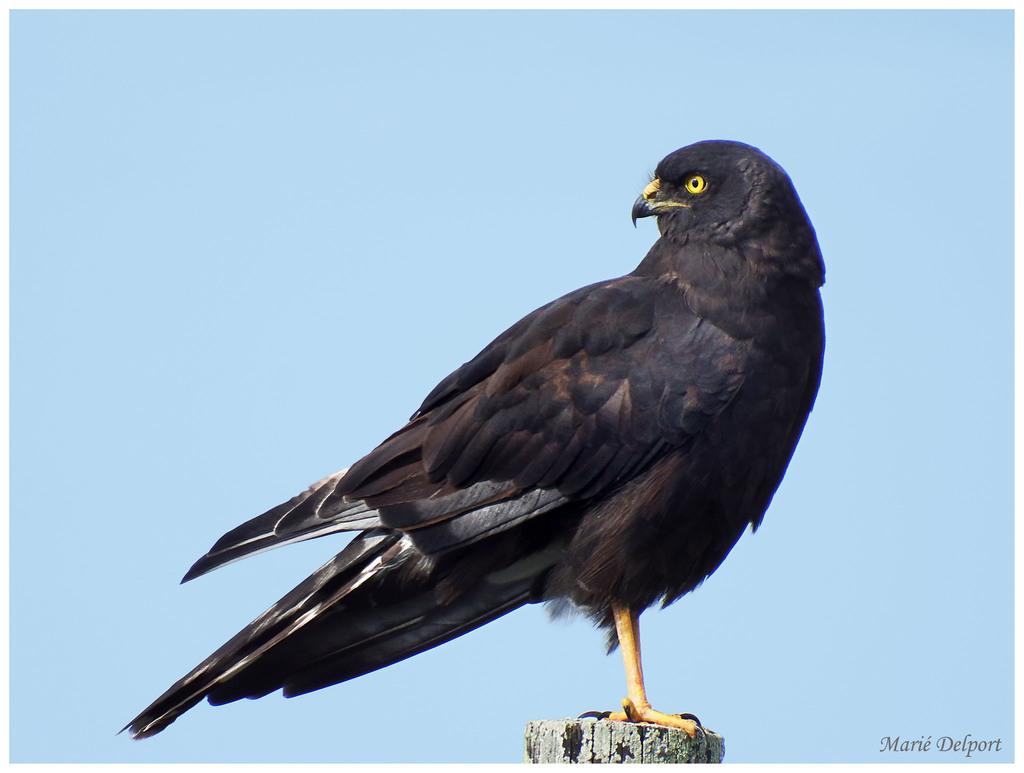
The black harrier (Circus maurus) is a medium-sized African harrier whose range extends from South Africa to Botswana and Namibia. It has a wingspan of 105–115 cm (41–45 in) and a body length of 44–50 cm (17–20 in). When perched, this bird appears all black. However, in flight, a white rump and flight feathers becomes visible. Its morphology is comparable to that of other harriers, with narrow wings, a slim body, and a long tail. Male and female plumages are similar, while juveniles have buff underparts and heavily spotted breasts.
From the article Black harrier on Wikipedia (CC BY-SA), quoted section by section
Range & habitat
In South Africa, the distribution of the black harrier is distinctly polarised in both the Western and Southern coastal plains. Nests are concentrated either along the coastal strip or inland in a more montane habitat. Nests are generally absent from transformed and cultivated lands. There is, however, some evidence from sightings and prey remains that the black harriers do forage in these environments even if they do not breed there. Black harriers are migratory birds and their annual movements cover the southern half of the land surface of South Africa (including Lesotho) however, there is great individual variability. The majority of these birds undertake an unusual west–east migration. They begin from their breeding areas in south-western South Africa and migrate towards the Eastern Cape, the south-west region of Kwa-Zulu Natal, the south-west region of Mpumalanga and the north-east region of Lesotho during the summer months. Pair members do not travel together and they don't use the same non-breeding areas either. It has been suggested that black harriers migrate in order to deal with food scarcity. Unusually, black harriers travel almost twice as fast during their summer post-breeding migration as during their winter/spring pre-breeding migration. In many other species, this is often reported the other way round. …
Wikipedia: “Distribution and Migration”
What it does
The black harrier is a small mammal specialist which feed mostly on small rodents and birds and will occasionally take reptiles, catching them while flying low over its hunting grounds. The Four- striped Mouse, Rhabdomys pumilio, is the main prey. Regional differences in diet have also been recorded with a greater consumption of birds inland than at the coast Variation in diet is thought to be associated with local weather conditions. Early in September the diets are similar however, this then shifts with seasonal changes. Inland, during hot temperatures the proportion of small mammals in the harrier's diet declines, because the hotter temperatures reduce the activity of South African small mammals during the day. Higher temperatures may also lead to poorer environmental conditions for breeding resulting in a decreased abundance of small mammals. The breeding season of the four-striped mouse is only three months in the Karoo (where the inland black harriers are located) rather than six months as in the fynbos (where the coastal black harriers are located). In the Karoo, temperatures can reach almost 40 degrees Celsius during the day in summer. Whilst in coastal regions the proportion of small mammals in the diet increased with higher winter rainfall. This is because the winter rainfall promotes the reproduction of small mammals.
Wikipedia: “Diet”
Listen
Looking for field recordings…
Where it lives
Recorded sightings
—
geo-referenced records in GBIF, from museums, herbaria and field observers.
Drag the globe to turn it. Dots are where records exist, not a range map; darker means more records.
In the stacks
Searching the stacks…
Every page naming Circus maurus in the Biodiversity Heritage Library →
This page is assembled live from iNaturalist, GBIF, Wikipedia, the Source Library and the Internet Archive. It is not yet part of the hand-edited codex. iNaturalist taxon 5174.