- Animals
- ›Chordates
- ›Vertebrates
- ›Birds
- ›Hawks, Eagles, Kites, and Allies
- ›Hawks, Eagles, and Kites
- ›Typical Hawks and Harriers
- ›Circus
On eBird ↗
Spotted Harrier
Live sightings near you, the range map, bar charts of when it is seen, and Macaulay Library photos and recordings.
Spotted Harrier
Circus assimilis
The spotted harrier (Circus assimilis) also known as the smoke hawk, is a large Australasian bird of prey belonging to the family Accipitridae.
From the article Spotted harrier on Wikipedia (CC BY-SA), quoted section by section
Description
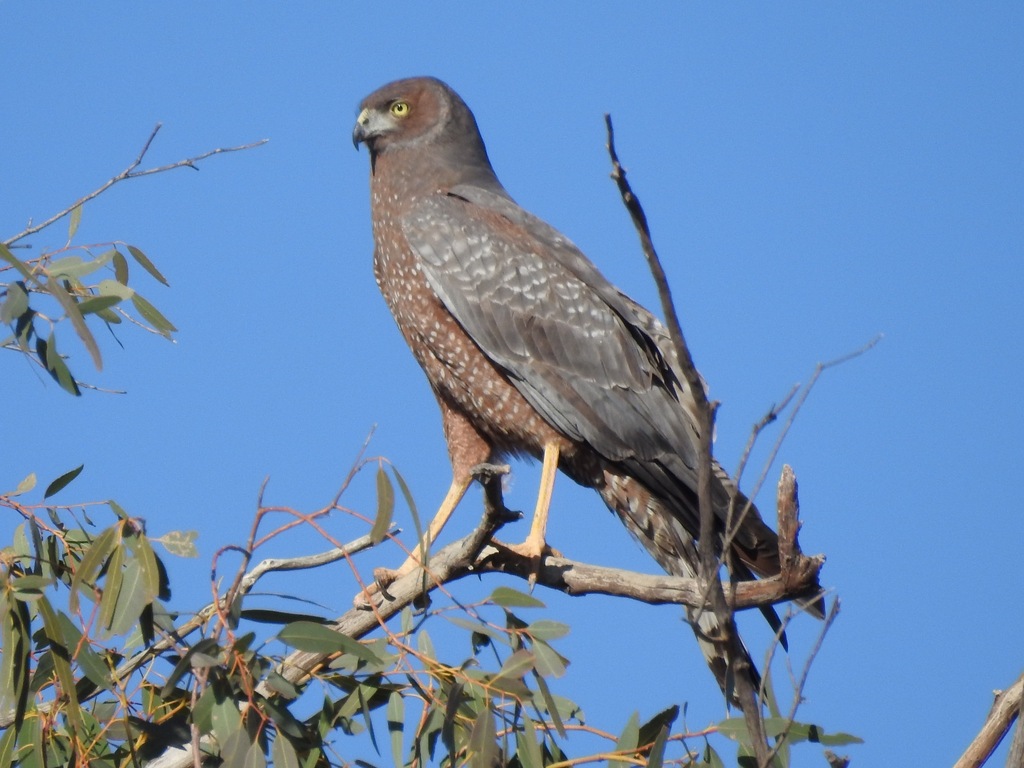
The spotted harrier is a medium-sized, slender bird of prey with adult females reaching 58–61 cm. Both adults and juvenile birds have an owl-like facial ruff that creates the appearance of a short, broad head as well as long yellow legs. The spotted harrier's wings feature prominent black tips and the tail is prominently barred and slightly wedge shaped. Adult males are much smaller than the females only growing to 50–55 cm. Adult birds have blue to grey upper parts with a chestnut face and underparts that feature numerous white spots. Juvenile birds in their first year of life are mostly a dark brown and buff on their upperparts with pale buff underparts that feature brown streaks across the chest and stomach. During the second year of their life the spotted harrier takes on almost adult colouring with white streaks across their underparts instead of the prominent spots that can be seen on adults.
Range & habitat
The spotted harrier is native to Australia and Indonesia, however vagrant populations have been seen in Timor-Leste. It has a geographic range of more than 20,000km2 (Birdlife International, 2012). Spotted harriers can be seen throughout most of Australia's mainland, except in densely forested or woodland habitats of the coast, escarpments and ranges, and rarely in Tasmania. In NSW individuals are widely dispersed, comprising a single population. The spotted harrier is a terrestrial bird residing in open grasslands, open woodland including acacia and mallee, inland riparian woodland, grassland and shrubland. It can be most commonly found in native grassland however it is also seen in agricultural land and inland wetlands for the purpose of foraging.
Wikipedia: “Distribution and habitat”
What it does
The spotted harrier is a carnivorous bird of prey feeding mostly on terrestrial mammals such as bandicoots, bettongs and rodents as well as small birds and reptiles and occasionally large insects. Formerly the species was heavily dependent on rabbits however the rapid spread of rabbit calicivirus disease led to a significant decline in rabbit numbers in arid and semi arid zones (by up to 65-85%). Due to this the spotted harrier is increasingly dependent of native prey however many of its former native mammalian prey species are extinct in inland NSW and many of its remaining key prey species such as terrestrial grassland birds are threatened by grazing as they require ground cover and are sensitive to habitat degradation. The spotted harrier soars with elevated wings when hunting.
Wikipedia: “Diet”
Listen
Looking for field recordings…
Where it lives
Recorded sightings
—
geo-referenced records in GBIF, from museums, herbaria and field observers.
Drag the globe to turn it. Dots are where records exist, not a range map; darker means more records.
In the stacks
Searching the stacks…
Every page naming Circus assimilis in the Biodiversity Heritage Library →
This page is assembled live from iNaturalist, GBIF, Wikipedia, the Source Library and the Internet Archive. It is not yet part of the hand-edited codex. iNaturalist taxon 5175.