On eBird ↗
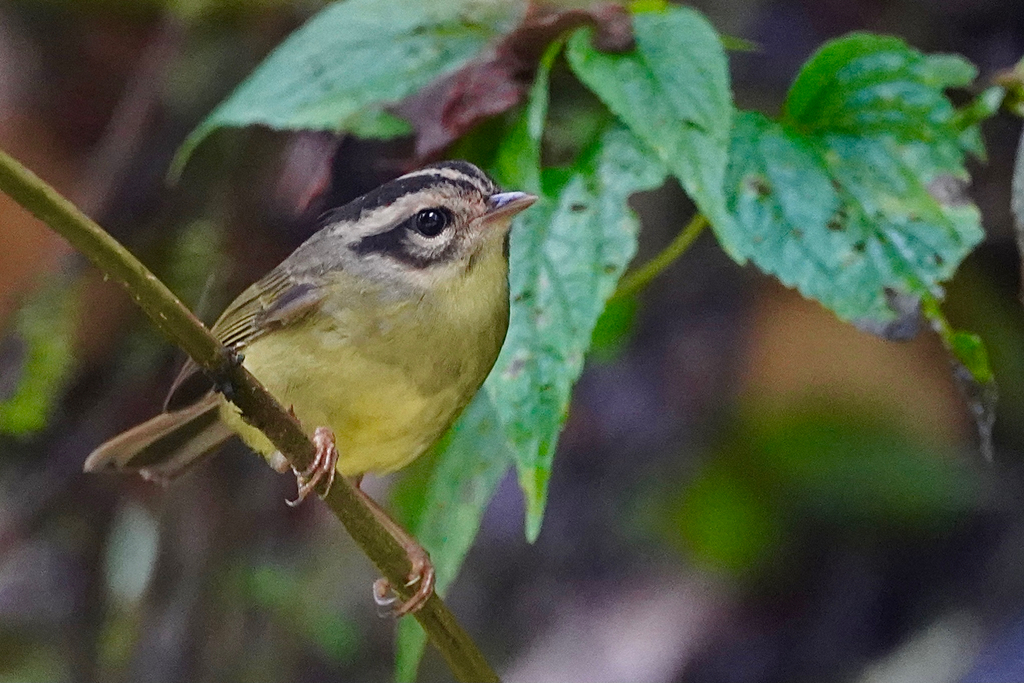
Costa Rican Warbler
Live sightings near you, the range map, bar charts of when it is seen, and Macaulay Library photos and recordings.
Costa Rican Warbler
Basileuterus melanotis
The black-eared warbler or Costa Rican warbler (Basileuterus melanotis) is a species of bird in the Parulidae family. It was previously considered conspecific with the three-striped warbler and the Tacarcuna warbler.
From the article Black-eared warbler on Wikipedia (CC BY-SA), quoted section by section
Description
The black-eared warbler is about 13 cm (5.1 in) long. The sexes have the same plumage. Adults have a buff-orange crown stripe, a long and wide black stripe below it, and a long pale grayish white supercilium with a buff tinge below that. Their lores and ear coverts are blackish and they have a pale buffy white arc under the eye. Their ear coverts have pale yellow bottom and rear edges. Their upperparts, wings, and tail are olive-gray. Their throat is whitish that becomes mostly pale olive-buff on the breast and a yellower olive-buff on the belly. The sides of their breast and their flanks have an olive-gray wash. Juveniles have a dusky olive-brown head with a hint of the adult's pattern. Their upperparts are dusky olive-brown; their greater and median upperwing coverts have buffy tips that show as two faint wing bars. Their underparts are mostly dusky brown with a paler buffish brown belly.
Range & habitat
The black-eared warbler is found from the Cordillera de Tilarán in Costa Rica's Alajuela Province south through the Corillera Central and Cordillera de Talamanca into western Panama as far as Veraguas Province. It inhabits primary and mature secondary montane evergreen forest in the upper tropical and subtropical zones. In elevation it ranges between 800 and 2,500 m (2,600 and 8,200 ft) overall and between 1,000 and 2,200 m (3,300 and 7,200 ft) in Costa Rica.
Wikipedia: “Distribution and habitat”
What it does
The black-eared warbler's diet has not been studied but is thought to be primarily or solely invertebrates. Pairs or small family groups forage actively in the forest's understory, taking most food by gleaning from vegetation. It also takes prey in mid-air with short sallies.
Wikipedia: “Feeding”
Listen
Looking for field recordings…
Where it lives
Recorded sightings
—
geo-referenced records in GBIF, from museums, herbaria and field observers.
Drag the globe to turn it. Dots are where records exist, not a range map; darker means more records.
In the stacks
Searching the stacks…
Every page naming Basileuterus melanotis in the Biodiversity Heritage Library →
This page is assembled live from iNaturalist, GBIF, Wikipedia, the Source Library and the Internet Archive. It is not yet part of the hand-edited codex. iNaturalist taxon 518302.