
Velvet Worms
Onychophora
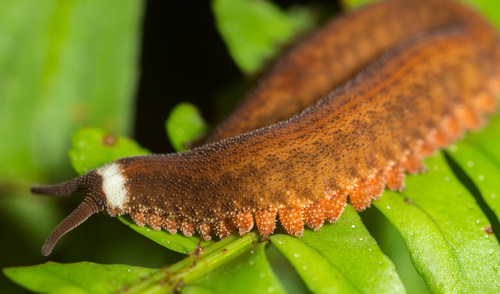
Onychophora (from Ancient Greek: ονυχής, onyches, "claws"; and φέρειν, pherein, "to carry"), commonly known as velvet worms (for their velvety texture and somewhat worm-like appearance), is a phylum of long, soft-bodied, many-legged animals. In appearance, they have variously been compared to worms with legs, caterpillars, and slugs. All living onychophorans prey upon other invertebrates, which they catch by ejecting an adhesive slime. Approximately 232 species of velvet worms have been described, although the true number is likely to be much greater.
The two extant families of velvet worms are Peripatidae and Peripatopsidae. They show a peculiar distribution, with the peripatids being predominantly equatorial and tropical, while the peripatopsids are all found south of the equator. Onychophora is the only phylum of animal that is wholly endemic to terrestrial environments, at least among extant members. Velvet worms are considered close relatives of arthropods and tardigrades, with which they form the clade Panarthropoda. This makes them of paleontological interest, as they can help reconstruct the ancestral arthropod body plan. Only three fossil species are confidently assigned as onychophorans or close relatives: Antennacanthopodia from the Early Cambrian, Antennipatus from the Late Carboniferous, and Cretoperipatus from the Late Cretaceous (the latter belonging to Peripatidae). In modern zoology, velvet worms are known for their mating behaviors, and in some species, bearing live young.
2 branches of this phylum, most-observed first
See this branch on the Wheel of Life →
Where it lives
Recorded sightings
—
geo-referenced records in GBIF, from museums, herbaria and field observers.
Drag the globe to turn it. Dots are where records exist, not a range map; darker means more records.
In the stacks
Searching the stacks…
Every page naming Onychophora in the Biodiversity Heritage Library →
This page is assembled live from iNaturalist, GBIF, Wikipedia, the Source Library and the Internet Archive. It is not yet part of the hand-edited codex. iNaturalist taxon 51836.