- Animals
- ›Chordates
- ›Vertebrates
- ›Birds
- ›Hawks, Eagles, Kites, and Allies
- ›Hawks, Eagles, and Kites
- ›Buteonine Hawks, Kites, and allies
- ›Buteo
On eBird ↗
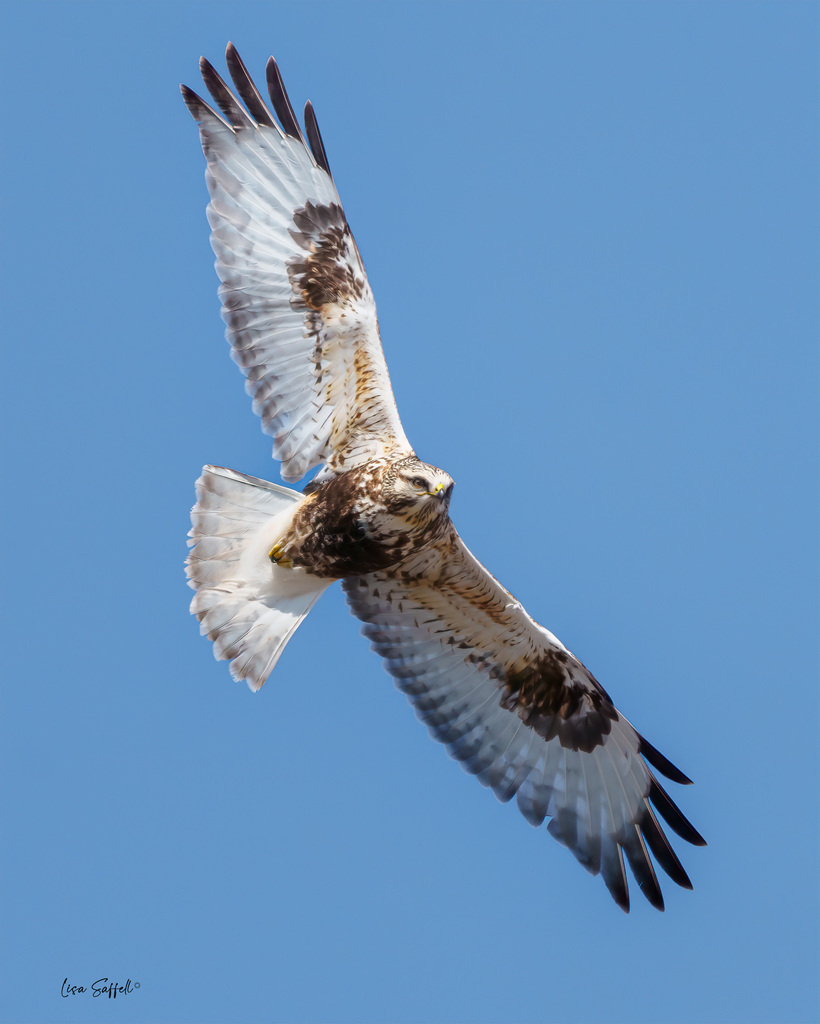
Rough-legged Hawk
Live sightings near you, the range map, bar charts of when it is seen, and Macaulay Library photos and recordings.
Rough-legged Hawk
Buteo lagopus
The rough-legged buzzard (Europe) or rough-legged hawk (North America) (Buteo lagopus) is a medium-large bird of prey. It is found in arctic and subarctic regions of North America, Europe, and Asia during the breeding season, and migrates south for the winter. Historically, it was also known as "rough-legged falcon" in such works as John James Audubon's The Birds of America.
Nests are typically located on cliffs, bluffs or in trees. The clutch sizes are variable with food availability, but usually three to five eggs are laid. They hunt over open land, feeding primarily on small mammals, mainly lemmings and voles. Along with the kestrels, kites, and osprey, this is one of the few birds of prey to hover regularly.
From the article Rough-legged buzzard on Wikipedia (CC BY-SA), quoted section by section
Description
This fairly large raptorial species is 46–68 cm (18–27 in) with wingspan ranging from 120 to 153 cm (47 to 60 in). Individuals can weigh from 600 to 1,660 g (1.32 to 3.66 lb) with females typically being larger and heavier than males. Weights appear to increase from summer to winter in adults, going from an average of 822 to 1,027 g (1.812 to 2.264 lb) in males and from 1,080 to 1,278 g (2.381 to 2.818 lb) in females. Among the members of the genus Buteo, it is sixth heaviest, the fifth longest, and the fourth longest winged. Among standard measurements in adults, the wing chord is 37.2–48.3 cm (14.6–19.0 in), the tail is 18.6–25.5 cm (7.3–10.0 in), culmen is 3.2–4.5 cm (1.3–1.8 in) and the tarsus is 5.8–7.8 cm (2.3–3.1 in). The plumage is predominantly brown and white, and often shows a high degree of speckling. A broad brown chest-band is present in most plumages and a square dark carpal patch contrasting with the white under-wing is an easily identifiable characteristic in light morph individuals. A wide variety of plumage patterns are exhibited in light vs. dark morphs, males vs. females, and adults vs. juveniles. Extensive field experience is required to distinguish between certain plumage variations. …
Range & habitat
The rough-legged buzzard breeds in tundra and taiga habitats of North America and Eurasia between the latitudes of 61° (locally south to 48° in Newfoundland and 58° N in southern Norway) and 76° N. Those occurring in North America migrate to southern Canada and into the central United States for the winter, while Eurasian birds migrate to central Europe and Asia, with small numbers west to eastern parts of Great Britain; most winter between latitudes of 43° and 58° N. It is the only member of its diverse genus found in all three of the northern continents, having a complete circumpolar distribution. During the winter months, from October to April, preferred habitats include marshes, moorland, prairies and agricultural regions where rodent prey is most abundant. Breeding sites are usually located in areas with plenty of unforested, open ground. Depending on snow conditions, migrants arrive at breeding grounds during April and May. Home ranges vary with food supply but are commonly reported to be 10–15 km2 (3.9–5.8 sq mi) during the winter, but little is known about home ranges during the breeding season. Although frequently attacked in skirmishes by other highly territorial birds such as gyrfalcons and skuas, the rough-legged buzzard is not strongly territorial. …
Wikipedia: “Habitat and distribution”
What it does
This species is carnivorous, typically feeding on small mammals, which make up 62–98% of its diet. Lemmings and voles are the major prey items of this species, seasonally comprising up to 80–90% of their prey but this varies with seasonal availability. Some evidence suggests that they may be able to see vole scent marks which are only visible in the ultraviolet range, allowing them to cue in on prey. Despite generally preying on rodents, a 2015 paper reported the species breeding on rodent-free Kolguev Island in Arctic Russia with goslings as a main prey. In northwest Russia, rough-legged buzzards may feed on small rodents in the years when rodent density is high, and shift to alternative prey (ptarmigans and hares) in the years when small rodents are scarce. The rough-legged buzzard will also supplement its diet with mice, rats, gerbils, pikas, shrews, squirrels of the genera Spermophilus and Tamias, and insects. Besides mammals, birds are the second-most favoured type of prey for rough-legged buzzards. Most avian prey species are small passerines such as snow bunting (Plectrophenax nivalis), Lapland longspur (Calcarius lapponicus), American tree sparrow (Spizelloides arborea) and thrushes (Turdus spp.). …
Wikipedia: “Diet”
Listen
Looking for field recordings…
Where it lives
Recorded sightings
—
geo-referenced records in GBIF, from museums, herbaria and field observers.
Drag the globe to turn it. Dots are where records exist, not a range map; darker means more records.
In the stacks
Searching the stacks…
Every page naming Buteo lagopus in the Biodiversity Heritage Library →
This page is assembled live from iNaturalist, GBIF, Wikipedia, the Source Library and the Internet Archive. It is not yet part of the hand-edited codex. iNaturalist taxon 5200.