- Animals
- ›Chordates
- ›Vertebrates
- ›Mammals
- ›Therians
- ›Placental Mammals
- ›Primates, Rodents, and Allies
- ›Rodents
- ›Squirrels, Dormice, and Mountain Beavers
- ›Squirrels
- ›Ground and African Tree Squirrels
- ›Chipmunks
- ›Eutamias
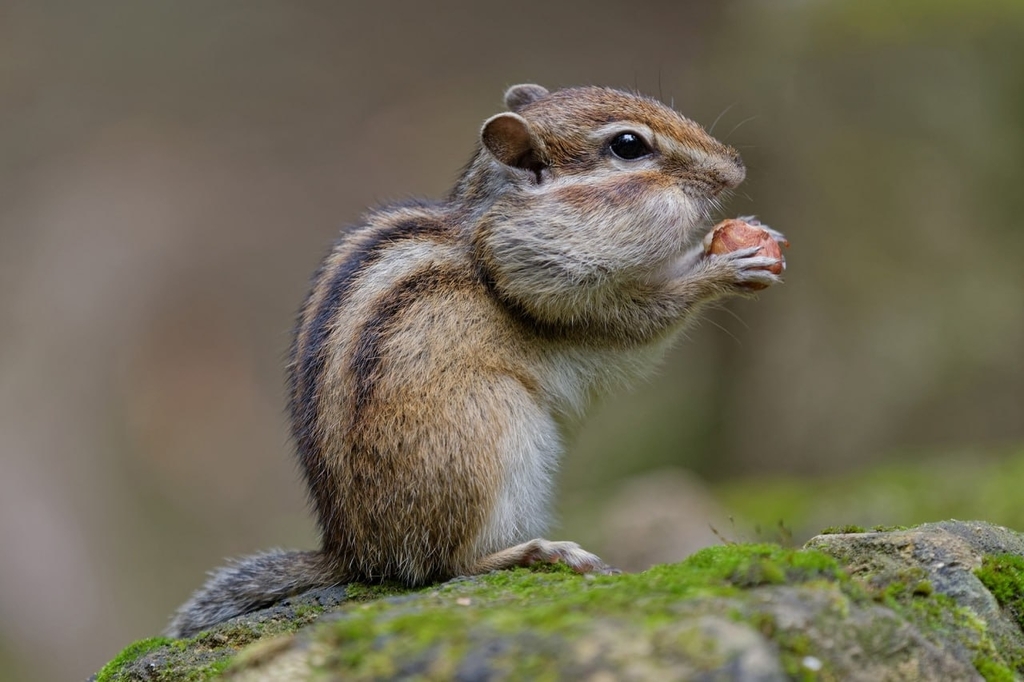
Siberian Chipmunk
Eutamias sibiricus
The Siberian chipmunk or common chipmunk (Eutamias sibiricus) appears across northern Asia from central Russia to China, Korea, and Hokkaidō in northern Japan. The Siberian chipmunk was imported from South Korea and introduced in Europe as a pet in the 1960s. It is the only chipmunk found outside North America, and this animal is classed either as the only living member of the genus Eutamias, or as a member of a genus including all chipmunks.
From the article Siberian chipmunk on Wikipedia (CC BY-SA), quoted section by section
Description
Typically the Siberian chipmunk has four white stripes and five dark stripes along the back. It is 18–25 cm (7.1–9.8 in) long, a third of which is the tail. The weight of adults depends on the time of year and food availability. It exhibits slight variations in coloration in different geographic regions. Even though the Siberian chipmunk normally grows to 50–150 g (1.8–5.3 oz). The Siberian chipmunk does not exhibit sexual dimorphism, and size and body proportions are the only way to distinguish younger chipmunks from older ones. Its small size may contribute to its relatively short life from two to five years in the wild. However, in captivity it lives up to ten years.
Range & habitat
The only species of chipmunk found outside North America, the Siberian chipmunk is native to Russia in northern European, Siberia to Sakhalin and Kunashir, extreme eastern Kazakhstan, northern Mongolia, northern and central China, Korea, and in Japan in Hokkaido, Iturup, Rishiri, Rebun, Teuri, and Yagishiri. It has been introduced at one confirmed locality, Karuizawa, on Honshu. During the 1960s, South Korea began to export these animals to Europe as pets. Between 1960 and 1980, South Korea exported more than 200,000 individuals to Europe. In the 1970s there were sightings in parks in Europe, and a number of small populations have become resident in suburban forests and urban parks in Belgium, France, Switzerland, Germany, Italy, the Netherlands, Austria and Great Britain. This is mostly caused by owners releasing these animals because they no longer wanted them as pets, or the owners purposefully freed the chipmunks to live naturally in the wild. Other Siberian chipmunks escaped from captivity and inhabited the forested areas of Europe. The Dutch chipmunks for example are escapees from a former zoo in Tilburg. When the zoo was shut down and all animals were moved away, many chipmunks got forgotten due to their underground residence. …
Wikipedia: “Distribution”
What it does
Siberian chipmunks usually live solitary lives, but during the winter they create a burrow, which they often share with another chipmunk. Its burrow, which can be 2.5 m (8 ft 2 in) long and 1.5 m (4 ft 11 in) deep, consists of a nest chamber, several storage chambers and chambers for the waste. During this winter season, these chipmunks store 3–4 kg (6.6–8.8 lb) of food in order to survive underground until April or May. In addition to pairing off during hibernation, they also use a complex voice communication system to interact. They have two vocal sounds, a fast, sharp sound for when they are frightened and a deep croak sound that is thought to be used for mating. Chipmunks with more active and curious behaviour, based on trappability of marked individuals, have a greater number of ticks.
Reproduction. It is known that they are iteroparous, viviparous, and their breeding season usually occurs after hibernation in mid April. They tend to breed only once or twice a year, and the number of offspring varies from three to eight. The young are born blind and naked, and they weigh between 3–5 g (0.11–0.18 oz). After the 28- to 35-day gestation period, the offspring open their eyes about 20 to 25 days after birth. The females are responsible for caring for the young, and they teach them how to forage around six weeks. …
Wikipedia: “Behaviour”
Listen
Looking for field recordings…
Where it lives
Recorded sightings
—
geo-referenced records in GBIF, from museums, herbaria and field observers.
Drag the globe to turn it. Dots are where records exist, not a range map; darker means more records.
In the stacks
Searching the stacks…
Every page naming Eutamias sibiricus in the Biodiversity Heritage Library →
This page is assembled live from iNaturalist, GBIF, Wikipedia, the Source Library and the Internet Archive. It is not yet part of the hand-edited codex. iNaturalist taxon 520585.