- Animals
- ›Chordates
- ›Vertebrates
- ›Cartilaginous Fishes
- ›Sharks and Rays
- ›Sharks
- ›Galean Sharks
- ›Ground Sharks
- ›Requiem Sharks
- ›Triaenodon
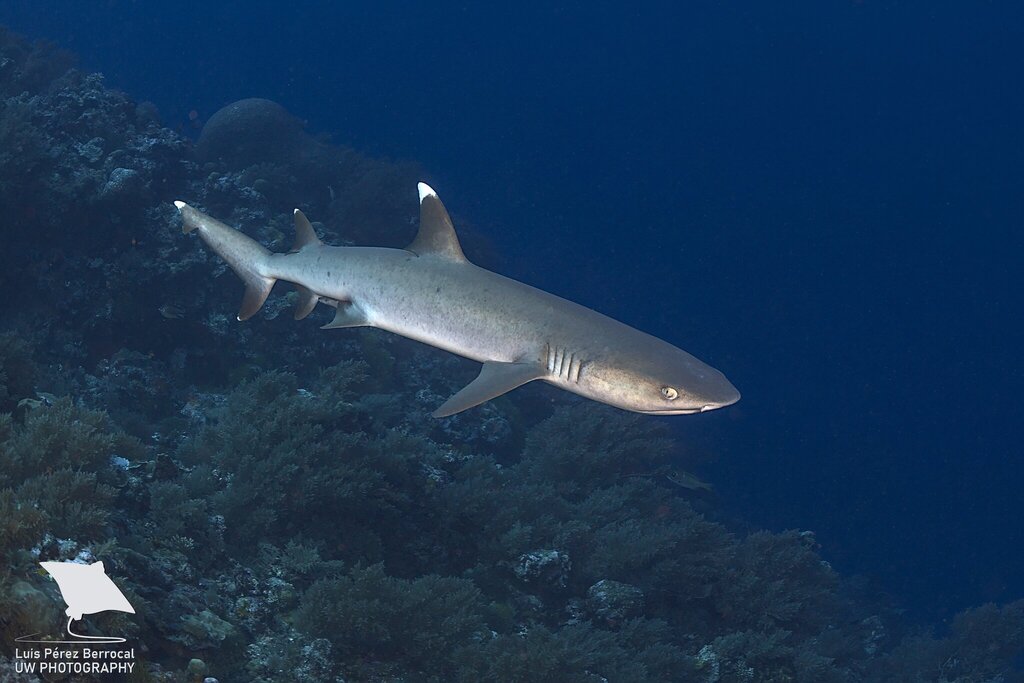
Whitetip Reef Shark
Triaenodon obesus
The whitetip reef shark (Triaenodon obesus) is a species of requiem shark, in the family Carcharhinidae. It is the only extant species of genus Triaenodon. A small shark that does not usually exceed 1.6 m (5.2 ft) in length, this species is easily recognizable by its slender body and short but broad head, as well as tubular skin flaps beside the nostrils, oval eyes with vertical pupils, and white-tipped dorsal and caudal fins. One of the most common sharks found on Indo-Pacific coral reefs, the whitetip reef shark occurs as far west as South Africa and as far east as Central America. It is typically found on or near the bottom in clear water, at a depth of 8–40 m (26–131 ft).
During the day, whitetip reef sharks spend much of their time resting inside caves. Unlike other requiem sharks, which rely on ram ventilation and must constantly swim to breathe, this shark can pump water over its gills and lie still on the bottom. At night, whitetip reef sharks emerge to hunt bony fishes, crustaceans, and octopus in groups, their elongate bodies allowing them to force their way into crevices and holes to extract hidden prey. Individuals may stay within a particular area of the reef for months or years, frequently returning to the same shelter. This species is viviparous, in which the developing embryos are sustained by a placental connection to their mother.
From the article Whitetip reef shark on Wikipedia (CC BY-SA), quoted section by section
Description
A relatively small species, few whitetip reef sharks are longer than 1.6 m (5.2 ft). The maximum length this species attains is often given as 2.1 m (6.9 ft), though this was originally based on visual observations and may be dubious. The maximum reported weight is 18.3 kg (40 lb). The whitetip reef shark has a slim body and a short, broad head. The snout is flattened and blunt, with large flaps of skin in front of the nares that are furled into tubes. The eyes are small and oval with vertical pupils and prominent ridges above, and are often followed by a small notch. The mouth has a distinct downward slant (imparting a disgruntled expression to the shark), with short furrows at the corners. There are 42–50 tooth rows in the upper jaw and 42–48 tooth rows in the lower jaw. Each tooth has a single narrow, smooth-edged cusp at the center, flanked by a pair of much smaller cusplets. The first dorsal fin is positioned well back on the body, closer to the pelvic than the pectoral fins. The second dorsal and anal fins are large, about half to three-quarters as high as the first dorsal fin. The broad, triangular pectoral fins originate at or slightly before the level of the fifth gill slit. There is no ridge between the first and second dorsal fins. The lower lobe of the caudal fin is half the length of the upper, which has a strong notch near the tip. …
Range & habitat
The whitetip reef shark is distributed widely across the entire Indo-Pacific region. It was once thought to have existed in the Atlantic Ocean, based on fossil teeth found in North Carolina dated to the Miocene epoch, although subsequent research has suggested that the teeth are of a mackerel shark, and that the whitetip has never colonized the Atlantic. In the Indian Ocean, whitetip reef sharks can be found off of northern KwaZulu-Natal, South Africa and all along the East African coast, from the Horn of Africa to the Red Sea and along the Indian subcontinent (including Sri Lanka). They are found near many major island chains as well, including Madagascar, Mauritius, Mayotte, the Comoros, the Aldabra Group, the Seychelles and the Chagos Archipelago. In the western and central Pacific Ocean, whitetips occur off South China, Taiwan, and the Ryukyu Islands, south to the Philippines and throughout the entire Coral Triangle, including the coastlines of Indonesia, East Timor and Papua New Guinea. Their range continues south to the northern Australia and the Great Barrier Reef. Whitetips are also found around numerous Pacific atolls and islands, including Melanesia, Micronesia, and Polynesia, north to Hawaii and south to the Pitcairn Islands. They have also been sighted near Midway and Johnston Atolls and Laysan. …
Wikipedia: “Distribution and habitat”
What it does
The whitetip reef shark is one of the three most common sharks inhabiting the reefs of the Indo-Pacific, the other two being the blacktip reef shark (Carcharhinus melanopterus) and the grey reef shark (Carcharhinus amblyrhynchos). The habitat preferences of this species overlap those of the other two, though it does not tend to frequent very shallow water like the blacktip reef shark, nor the outer reef like the grey reef shark. The whitetip reef shark swims with strong undulations of its body, and unlike other requiem sharks can lie motionless on the bottom and actively pump water over its gills for respiration. This species is most active at night or during slack tide, and spends much of the day resting inside caves singly or in small groups, arranged in parallel or stacked atop one another. Off Hawaii, these sharks may be found sheltering inside underwater lava tubes, while off Costa Rica they are often seen lying in the open on sandy flats. Whitetip reef sharks generally remain within a highly localized area; only rarely do they undertake long movements, wandering for a while before settling down somewhere new. One study at Johnston Atoll found that none of the sharks examined had moved more than 3 km (1.9 mi) away from their original capture location over periods of up to a year. …
Wikipedia: “Biology and ecology”
Where it lives
Recorded sightings
—
geo-referenced records in GBIF, from museums, herbaria and field observers.
Drag the globe to turn it. Dots are where records exist, not a range map; darker means more records.
In the stacks
Searching the stacks…
Every page naming Triaenodon obesus in the Biodiversity Heritage Library →
This page is assembled live from iNaturalist, GBIF, Wikipedia, the Source Library and the Internet Archive. It is not yet part of the hand-edited codex. iNaturalist taxon 52314.