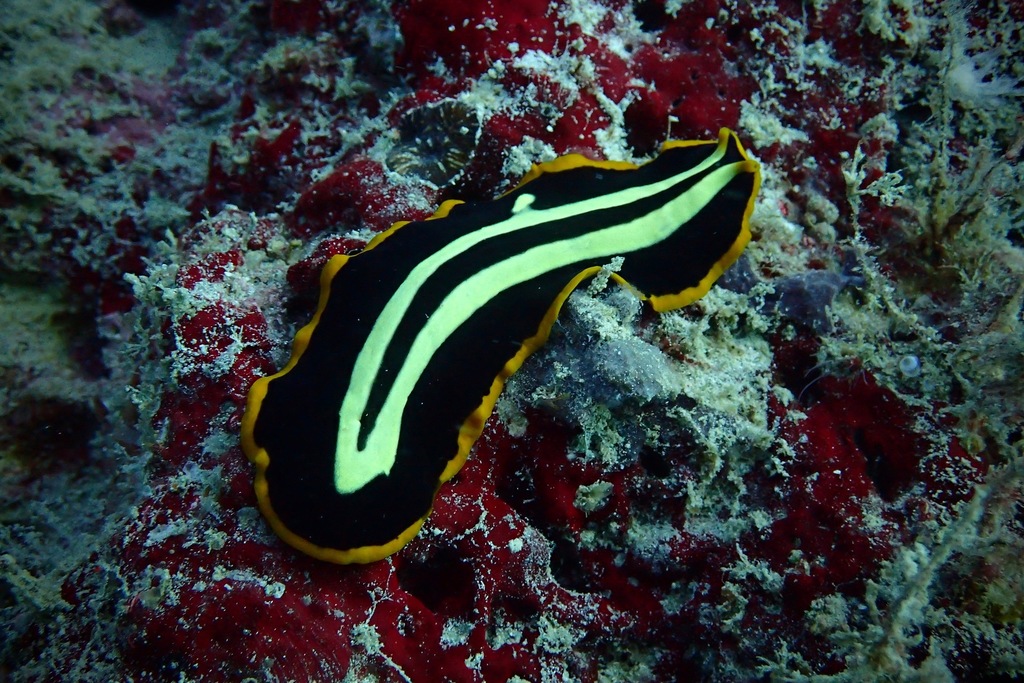
Divided Flatworm
Pseudoceros dimidiatus
Pseudoceros dimidiatus, the divided flatworm or tiger flatworm, is a species of flatworm in the genus Pseudoceros, belonging to the family Pseudocerotidae.
From the article Pseudoceros dimidiatus on Wikipedia (CC BY-SA), quoted section by section
Description
Pseudoceros dimidiatus grows to be up to 8 centimetres (3.1 in). The body is elongated and oval, with a velvety dorsal surface, a grey-black ventral side and a black body with an orange marginal band and two yellow median stripes that vary from narrow to extremely wide, usually separated by a narrow black median line. However, this species of Pseudoceros is highly variable in color and in pattern, in terms of the arrangement and width of the various transverse stripes and of the width of the longitudinal stripes. It can take at least three different types of liveries, all with the same colors, which threaten its being inedible. It has bilateral symmetry. The bright and contrasting colours serve as a warning for predators to not eat this species. These flatworms feed exclusively on colonial ascidians. They are also cold blooded.
Range & habitat
This species is widespread in the Indian Ocean from the Red Sea to Australia and in the Western Pacific Ocean.
Wikipedia: “Distribution”
What it does
The divided flatworm can reproduce both asexually, by dividing itself, and sexually. The species is a hermaphrodite, meaning that they have both male and female reproductive organs. When two flatworms reproduce they battle to decide who gets to fertilize and who is fertilized. The winner gets to act as the male, fertilizing the other.
Wikipedia: “Reproduction”
Where it lives
Recorded sightings
—
geo-referenced records in GBIF, from museums, herbaria and field observers.
Drag the globe to turn it. Dots are where records exist, not a range map; darker means more records.
In the stacks
Searching the stacks…
Every page naming Pseudoceros dimidiatus in the Biodiversity Heritage Library →
This page is assembled live from iNaturalist, GBIF, Wikipedia, the Source Library and the Internet Archive. It is not yet part of the hand-edited codex. iNaturalist taxon 52321.