- Animals
- ›Chordates
- ›Vertebrates
- ›Birds
- ›Hawks, Eagles, Kites, and Allies
- ›Hawks, Eagles, and Kites
- ›Snake-Eagles, Serpent-Eagles, and allies
- ›Circaetus
On eBird ↗
Southern Banded Snake-Eagle
Live sightings near you, the range map, bar charts of when it is seen, and Macaulay Library photos and recordings.
Southern Banded Snake Eagle
Circaetus fasciolatus
The southern banded snake eagle (Circaetus fasciolatus), also known as the East African snake eagle or fasciated snake eagle, is a species of snake eagle in the family Accipitridae which is found in eastern Sub-Saharan Africa.
From the article Southern banded snake eagle on Wikipedia (CC BY-SA), quoted section by section
Description
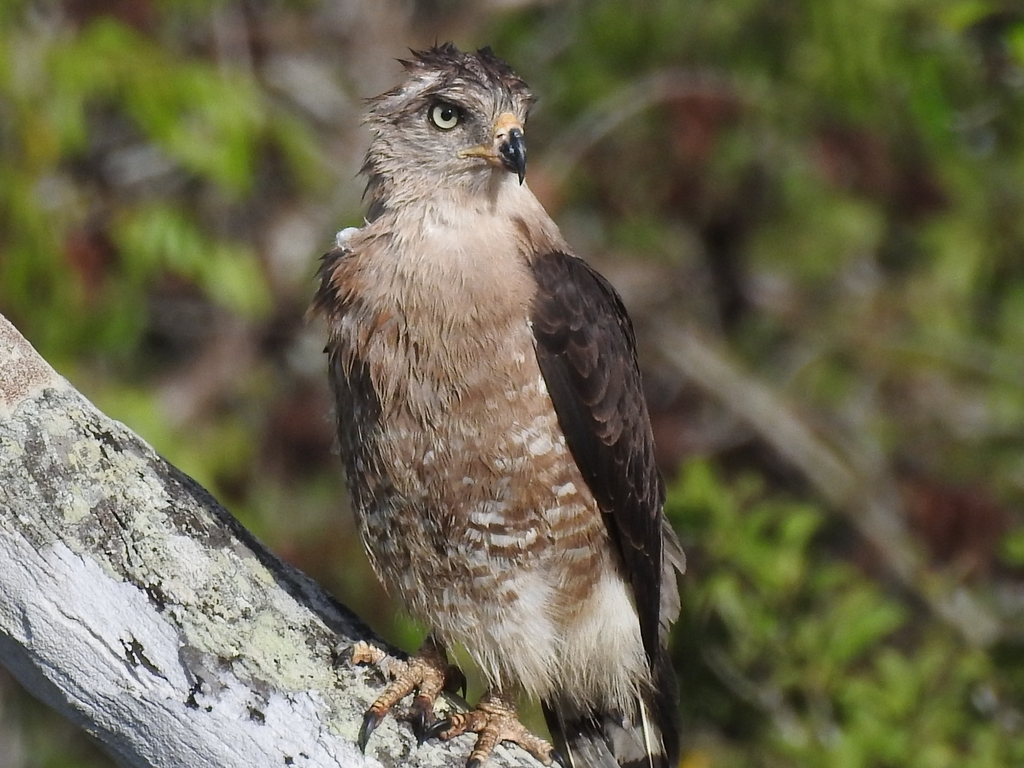
The southern banded snake eagle is a rather small, stocky snake eagle with a large, rounded head which has a hooded beak. It has a grey-brown head contrasting slightly with the mainly blackish-brown upperparts and whitish underparts. The tail has a white tip and shows three distinct dark bands on the underside. The large eyes are pale yellow eyes, the feet and cere are yellow and the bill us black. The juvenile lacks the grey head, has mainly dark upperparts and the whitish pale underparts are marked with dark streaks on the face, throat and upper breast. The total length varies from 55 to 60 cm with females larger than males.
Voice. The southern banded snake eagle is unobtrusive and is normally found due to its noisy, high-pitched call, "ko-ko-ko-kaw", repeatedly made either from a perch or while in flight.
Range & habitat
The southern banded snake eagle occurs in a narrow band along the east African coast from southern Somalia to the north eastern Kwazulu-Natal and inland along the Save River into south eastern Zimbabwe.
Wikipedia: “Distribution”
Listen
Looking for field recordings…
Where it lives
Recorded sightings
—
geo-referenced records in GBIF, from museums, herbaria and field observers.
Drag the globe to turn it. Dots are where records exist, not a range map; darker means more records.
In the stacks
Searching the stacks…
Every page naming Circaetus fasciolatus in the Biodiversity Heritage Library →
This page is assembled live from iNaturalist, GBIF, Wikipedia, the Source Library and the Internet Archive. It is not yet part of the hand-edited codex. iNaturalist taxon 5243.