- Animals
- ›Chordates
- ›Vertebrates
- ›Birds
- ›Hawks, Eagles, Kites, and Allies
- ›Hawks, Eagles, and Kites
- ›Snake-Eagles, Serpent-Eagles, and allies
- ›Circaetus
On eBird ↗
Western Banded Snake-Eagle
Live sightings near you, the range map, bar charts of when it is seen, and Macaulay Library photos and recordings.
Western Banded Snake-Eagle
Circaetus cinerascens
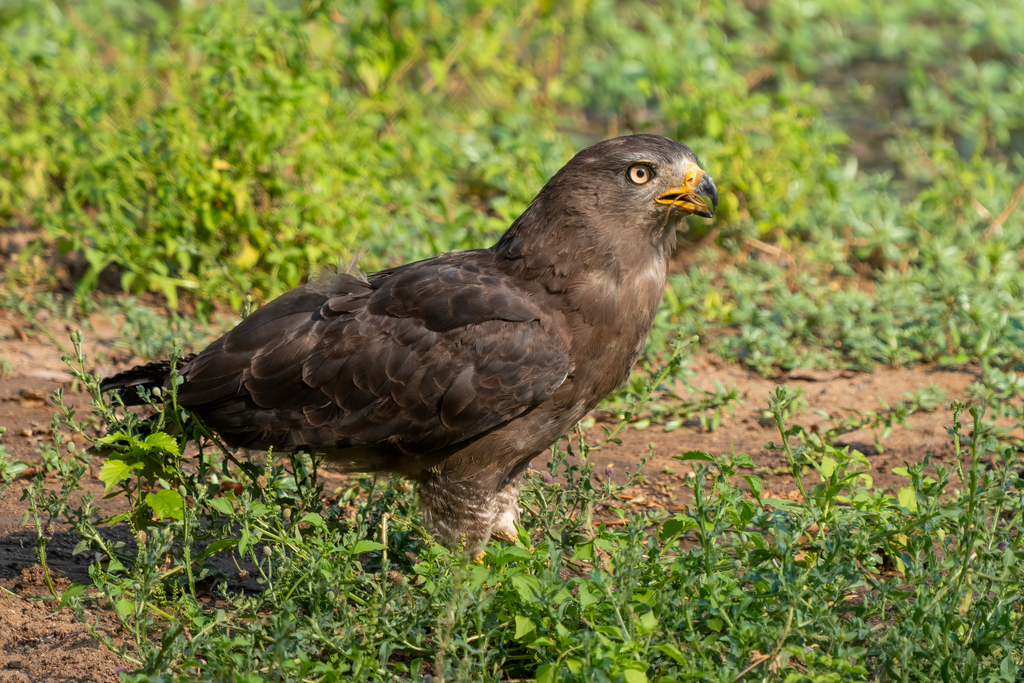
The western banded snake eagle (Circaetus cinerascens) is a grey-brown African raptor with a short tail and a large head. Juveniles have paler and browner upper parts than adults, with white-edged feathers. The eagle's head, neck and breast are dark-streaked. The underparts are white with pale brown streaks, mainly on belly and thighs. Subadults may be all dark grey-brown without any streak on underparts. The eyes, ears, and legs are yellow. They have crested chests.
From the article Western banded snake eagle on Wikipedia (CC BY-SA), quoted section by section
Description
It has a total length of 50-58 cm (19 to 22 in) and a wingspan of 120-134 cm (3 ft 11 in to 4 ft 4 in)
Range & habitat
Western banded snake eagles live in woodlands, mainly along rivers, but they avoid dense forests.
Wikipedia: “Habitat”
What it does
Western banded snake eagles mainly hunt snakes, but also other small vertebrates, ambushing from a perch. They drop from the perch to trunk, foliage or ground. They are solitary birds, and very secretive. Due to their sedentary lifestyle, they are often detected only by their calls. The western banded snake eagle sometimes rises to soar, while it calls above the canon. They utter a loud, high-pitched 'kok-kok-kok-kok-kok'.
Wikipedia: “Behaviour”
Listen
Looking for field recordings…
Where it lives
Recorded sightings
—
geo-referenced records in GBIF, from museums, herbaria and field observers.
Drag the globe to turn it. Dots are where records exist, not a range map; darker means more records.
In the stacks
Searching the stacks…
Every page naming Circaetus cinerascens in the Biodiversity Heritage Library →
This page is assembled live from iNaturalist, GBIF, Wikipedia, the Source Library and the Internet Archive. It is not yet part of the hand-edited codex. iNaturalist taxon 5244.