- Animals
- ›Chordates
- ›Vertebrates
- ›Birds
- ›Hawks, Eagles, Kites, and Allies
- ›Hawks, Eagles, and Kites
- ›Elanine Kites
- ›Elanus
On eBird ↗
Letter-winged Kite
Live sightings near you, the range map, bar charts of when it is seen, and Macaulay Library photos and recordings.
Letter-winged Kite
Elanus scriptus
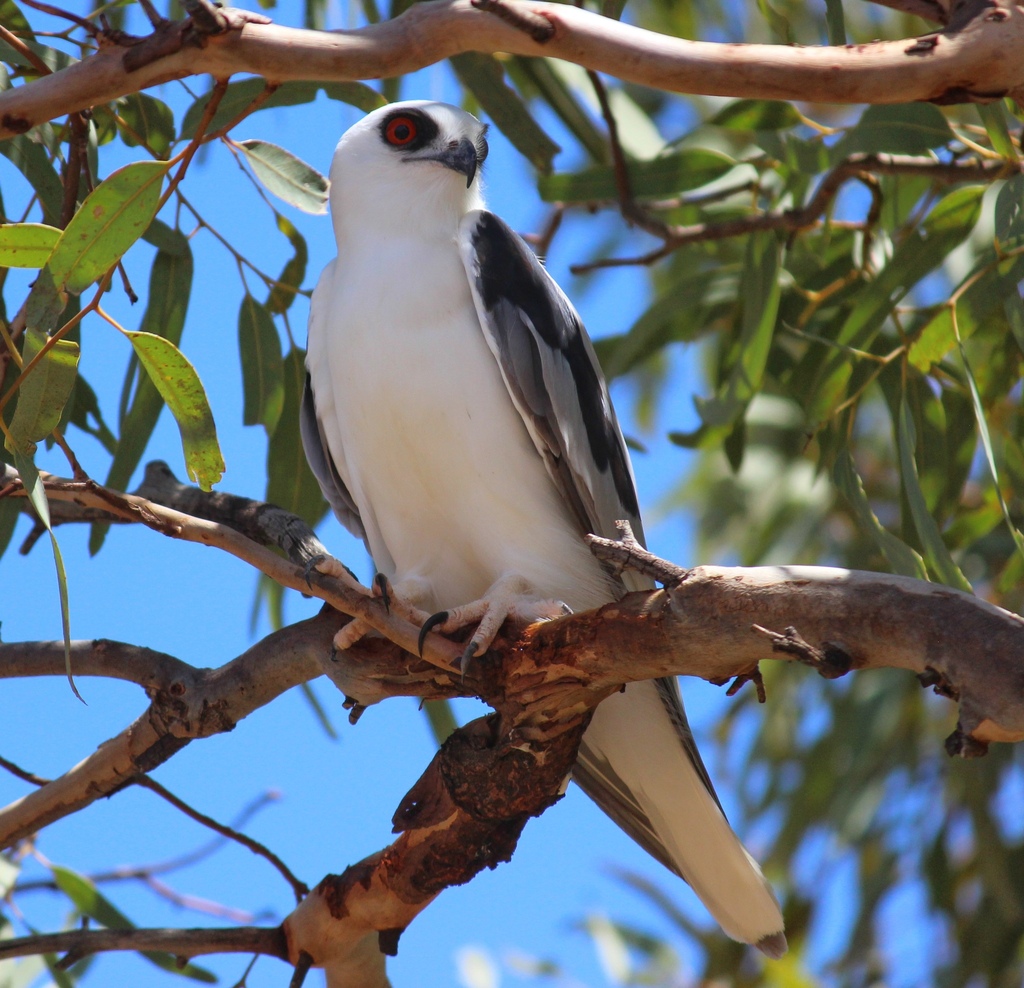
The letter-winged kite (Elanus scriptus) is a small, rare and irruptive bird of prey that is found only in Australia. Measuring around 35 cm (14 in) in length with a wingspan of 84–100 cm (33–39 in), the adult letter-winged kite has predominantly pale grey and white plumage and prominent black rings around its red eyes. Its name derives from its highly distinctive black underwing pattern of a shallow 'M' or 'W' shape, visible when in flight. This distinguishes it from the otherwise similar black-shouldered kite. This species is also the only nocturnal species within the order Accipitriformes despite few differences found in its visual anatomy to other closely related kites.
The species begins breeding in response to rodent outbreaks, with pairs nesting in loose colonies of up to 50 birds each. Three to four eggs are laid and incubated for around thirty days, though the eggs may be abandoned if the food source disappears. Chicks are fledged within five weeks of hatching. Roosting in well-foliaged trees during the day, the letter-winged kite hunts mostly at night. It is a specialist predator of rodents, which it hunts by hovering above grasslands and fields. It is rated as near threatened on the International Union for Conservation of Nature (IUCN)'s Red List of Threatened Species.
From the article Letter-winged kite on Wikipedia (CC BY-SA), quoted section by section
Description
The adult letter-winged kite is about 35 cm (14 in) in length, with a wingspan between 84 and 100 cm (33 and 39 in). The female is slightly heavier, averaging 310 g (11 oz) compared to the male's average weight of 260 g (9.2 oz). The sexes have similar plumage. The adult male has pale grey upperparts, wings and nape with a white head and white underparts. It has large deep-red eyes, which are surrounded by a black eye patch. Its bill is black, with a dark grey-brown cere at its base. Its wings are marked with a black shoulder patch above and a striking black line underneath, which runs from the primary coverts to the body, and which resembles a letter 'M' or 'W' when flying. The central rectrices of the tail are pale grey, while the rest of the tail feathers are white. The legs and feet are a fleshy pinkish white or white. The feet have three toes facing forwards and one toe facing backwards. The female is similar but can be distinguished by a greyer crown, and its grey plumage is slightly darker all over. Moulting has been recorded from all months except May and August, and is probably related to breeding. The juvenile has a white lower forehead, face, chin and throat, with a brownish orange band across the forehead, neck and breast. It has a similar dark eye patch to the adult, and the eyes themselves are dark brown. …
Range & habitat
The usual habitat of the letter-winged kite is arid and semi-arid open, shrubby or grassy country, across the arid interior of the continent, particularly the southern Northern Territory, particularly the Barkly Tableland, and northeastern South Australia, and Queensland, where it is relatively common in western areas south of 20° south, and has been recorded as far afield as Townsville and Stradbroke Island. In South Australia it may reach the Eyre Peninsula and southeastern corner on occasion. The species is generally rare in New South Wales: it has been recorded in the vicinity of Broken Hill in the far west, and twice in Inverell in the north of the state—once found dead in a street in 1965 and once spotted alive a year later. It is rare in Western Australia. Its abundance or even presence in any given area is heavily dependent on availability of food; spells of significant rainfall inland lead to surges in rodent numbers, which in turn lead to irruptions of letter-winged kites. Nesting and raising multiple broods in succession, the kite population may increase ten-fold. Major irruptions have taken place in 1951–53, 1969–70, 1976–77, and 1993–95. Eventually dry conditions lead to a fall in rodent numbers and dispersal of birds, which often starve if they fail to find prey elsewhere.
Wikipedia: “Distribution and habitat”
What it does
The letter-winged kite typically hunts at night, with daytime foraging taking place in areas of superabundant or scarce prey. By day, birds roost in leafy trees with plenty of cover, in colonies of up to 400 individuals, becoming active at dusk. Their social behaviour is poorly known on account of their nocturnal habits and shy nature, being difficult to approach when roosting.
Breeding. Within its range, the letter-winged kite generally breeds in an area covering the Diamantina and Lake Eyre drainage basins, Sturt Stony Desert, eastern Simpson Desert and Barkly Tableland, to Richmond, Queensland, and Banka Banka Station in the north and Boolkarie Creek, South Australia, in the south. Nesting has also been recorded in Exmouth Gulf and southwest Western Australia, the southwest of the Northern Territory, and the Clarence River district and northwest of New South Wales. The birds nest in colonies of up to 50 pairs, and have more than one nest and brood at once. At times their nests are close to those of spotted harriers (Circus assimilis), black kites (Milvus migrans), whistling kites (Haliastur sphenurus), brown falcons (Falco berigora) and black falcons (Falco subniger).
It is not known if breeding pairs remain bonded after breeding. …
Wikipedia: “Behaviour”
Listen
Looking for field recordings…
Where it lives
Recorded sightings
—
geo-referenced records in GBIF, from museums, herbaria and field observers.
Drag the globe to turn it. Dots are where records exist, not a range map; darker means more records.
In the stacks
Searching the stacks…
Every page naming Elanus scriptus in the Biodiversity Heritage Library →
This page is assembled live from iNaturalist, GBIF, Wikipedia, the Source Library and the Internet Archive. It is not yet part of the hand-edited codex. iNaturalist taxon 5274.