- Animals
- ›Chordates
- ›Vertebrates
- ›Birds
- ›Hawks, Eagles, Kites, and Allies
- ›Hawks, Eagles, and Kites
- ›Harpagine Kites and Hawks
- ›Harpagus
On eBird ↗
Double-toothed Kite
Live sightings near you, the range map, bar charts of when it is seen, and Macaulay Library photos and recordings.
Double-toothed Kite
Harpagus bidentatus
The double-toothed kite (Harpagus bidentatus) is a species of bird of prey in the family Accipitridae. It is found in Belize, Bolivia, Brazil, Colombia, Costa Rica, Ecuador, El Salvador, French Guiana, Guatemala, Guyana, Honduras, Mexico, Nicaragua, Panama, Peru, Suriname, Trinidad and Tobago, and Venezuela.
From the article Double-toothed kite on Wikipedia (CC BY-SA), quoted section by section
Description
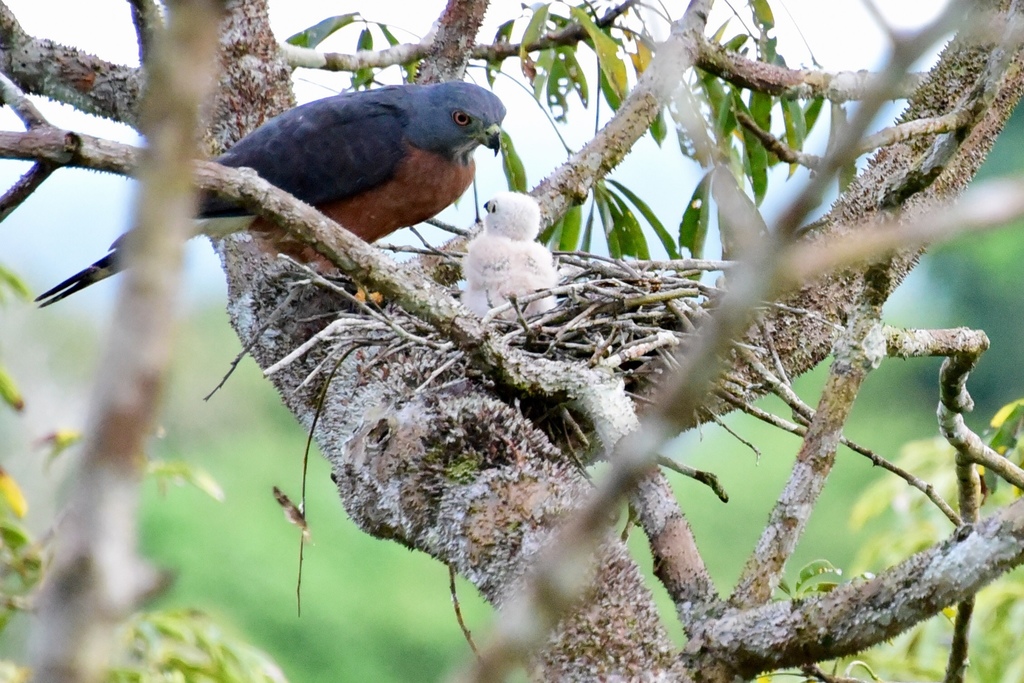
The double-toothed kite is 29 to 35 cm (11 to 14 in) long with a wingspan of 60 to 72 cm (24 to 28 in). Males weigh about 160 to 200 g (5.6 to 7.1 oz) and females about 190 to 230 g (6.7 to 8.1 oz). The species gets its English name from the tooth-like notches on the edge of its maxilla. Males and females have similar plumage though the females' colors are richer. Adults of both subspecies have a dark gray head with a white throat that has a dark stripe down its center. Their upperparts are a somewhat lighter gray and their tail blackish with three grayish bands and a gray tip. Their eyes are red, their cere greenish yellow, and their legs and feet yellow. The nominate subspecies has a rufous breast, a rufous belly with gray and whitish barring that sometimes extends into the lower breast, and white undertail coverts. Adults of subspecies H. b. fasciatus have similar underparts to the nominate but the rufous is paler and less extensive and the barring heavier and more extensive. Immatures of both subspecies have deep brown upperparts and whitish to buff underparts with bold vertical brown streaks.
Range & habitat
The nominate subspecies of double-toothed kite has the more southerly range of the two. It is found on Trinidad and from eastern Colombia east through Venezuela and the Guianas and south and east into Amazonian Ecuador, Peru, Bolivia, and Brazil. A separate population is found in southeastern Brazil. Subspecies H. b. fasciatus is found from Jalisco and southern Veracruz in Mexico through the Caribbean slopes of Guatemala, Belize, and Honduras and both slopes of Nicaragua, Costa Rica, and Panama into western Colombia and western Ecuador. One individual has been documented as a vagrant in Texas. The double-toothed kite primarily inhabits the interior of mature subtropical and tropical forest. It occurs less frequently at forest edges and clearings, young secondary forest, scrubby woodland, and disturbed forest. In elevation it ranges from sea level to at least 1,200 m (3,900 ft) in Costa Rica, about 1,200 m (3,900 ft) in Colombia, and 2,100 m (6,900 ft) in Ecuador.
Wikipedia: “Distribution and habitat”
What it does
The double-toothed kite primarily hunts from a perch in the forest interior. It dives to take prey; in one study about 2/3 of the captures were directly from vegetation, most of the rest in flight, and a small percentage from the ground. Its prey includes insects (such as butterflies, cicadas, grasshoppers, katydids, crickets, beetles, wasps, caterpillars, and cockroaches) and small vertebrates (mostly anoles and geckos but also iguanas, bats, birds, rodents, and snakes). Insects dominate in numbers but vertebrates in biomass. It regularly follows close behind troops of monkeys to catch prey flushed by them.
Wikipedia: “Feeding”
Listen
Looking for field recordings…
Where it lives
Recorded sightings
—
geo-referenced records in GBIF, from museums, herbaria and field observers.
Drag the globe to turn it. Dots are where records exist, not a range map; darker means more records.
In the stacks
Searching the stacks…
Every page naming Harpagus bidentatus in the Biodiversity Heritage Library →
This page is assembled live from iNaturalist, GBIF, Wikipedia, the Source Library and the Internet Archive. It is not yet part of the hand-edited codex. iNaturalist taxon 5280.