- Animals
- ›Chordates
- ›Vertebrates
- ›Birds
- ›Hawks, Eagles, Kites, and Allies
- ›Hawks, Eagles, and Kites
- ›Honey-buzzards, Pernine Kites, and Allies
- ›Lophoictinia
On eBird ↗
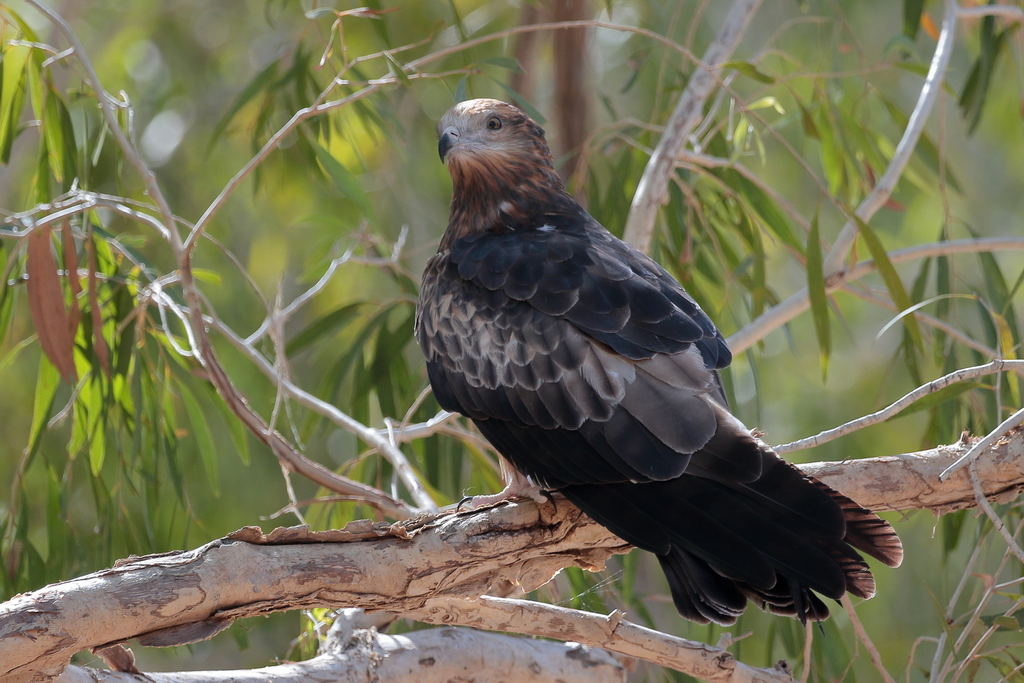
Square-tailed Kite
Live sightings near you, the range map, bar charts of when it is seen, and Macaulay Library photos and recordings.
Square-tailed Kite
Lophoictinia isura
The square-tailed kite (Lophoictinia isura) is a medium-sized bird of prey native to Australia. It is in the family Accipitridae, which also includes many other diurnal raptors such as kites, eagles and harriers.
From the article Square-tailed kite on Wikipedia (CC BY-SA), quoted section by section
Description
As an adult the square-tailed kite is a medium-sized raptor, with the following features:
Length: 50–56 cm (tail is about half the length of bird) Wingspan: 130–145 cm Weight: Male-501g, Female-650g
Plumage variation. As an adult, the squared-tailed kite has a white face, with pale eyes and black streaks across the crown. The breast is also heavily streaked. The ventral surface of the wings has a rufous-brown lining, a dark carpal crescent, and a boldly barred finger. There is also a pale white patch on the ventral surface of the wings, at the base of the primary feathers; the saddle, rump and central upper tail-coverts are blackish, while the upper tail-coverts are grey-brown and fade into a small pale patch above the tail. The tail itself is square with dark sub-terminal band. Square-tailed kites also have a black bill, with a pink base and cere, and short legs and feet which are whitish or cream. This species does not experience seasonal changes to the colouration of its plumage nor is the species sexual dimorphic. Juveniles are easily distinguished from adults by the lack of the white face and their richer rufous colouration (on both the head and the body). They are also significantly less streaked than adults. Square-tailed kites can be confused with a range of other similar sized kites and raptors. …
Range & habitat
The square-tailed kite is a specialised canopy-dwelling predator, and can be found in a number of different habitats including open and temperate forests, woodlands, scrub, heathland, riverine trees, and savannah. Square-tailed kites can also be found in well-vegetated urban areas such as golf courses and parks. They are seldom found on the ground. Square-tailed kites are widespread throughout Australia, but are not densely distributed. The birds are solitary, but can be observed in pairs or family units (parents and dependent young) during their breeding seasons. In Eastern New South Wales, nesting square-tailed kites were found to have home territories of 50 km2, with spaces of around 13 km between nesting pairs. Current population estimates from the IUCN Red List indicate a population of between 1000 and 10,000 individuals, of which 67% are thought to be sexually mature individuals. Many square-tailed kites migrate annually, but the timing and locations of these migrations are dependent on the home territory of each individual bird, with some birds not migrating at all.
Threats. Land clearing for agricultural use, illegal egg collection, and hunting are the major threats facing this species. …
Wikipedia: “Distribution and habitat”
What it does
Square-tailed kites hunt for food by soaring slowly above or through the tree canopy, skimming over grass, flying transect lines, or quartering. The diet of square-tailed kites includes avian prey-both smaller birds and eggs, small mammals such as mice, insects, molluscs (snails), and reptiles. Avian prey is typically young birds such as nestlings or juveniles, and square-tailed kites have been observed preying upon a range of other bird species including crested pigeons (Ocyphaps lophotes), New Holland honeyeater (Phylidonyris novaehollandiae); eastern yellow robin (Eopsaltria australis), rufous whistler (Pachycephala rufiventris) and juvenile Pacific koel (Eudynamis orientalis).
Wikipedia: “Diet and foraging”
Listen
Looking for field recordings…
Where it lives
Recorded sightings
—
geo-referenced records in GBIF, from museums, herbaria and field observers.
Drag the globe to turn it. Dots are where records exist, not a range map; darker means more records.
In the stacks
Searching the stacks…
Every page naming Lophoictinia isura in the Biodiversity Heritage Library →
This page is assembled live from iNaturalist, GBIF, Wikipedia, the Source Library and the Internet Archive. It is not yet part of the hand-edited codex. iNaturalist taxon 5286.