- Animals
- ›Chordates
- ›Vertebrates
- ›Birds
- ›Hawks, Eagles, Kites, and Allies
- ›Hawks, Eagles, and Kites
- ›Honey-buzzards, Pernine Kites, and Allies
- ›Hamirostra
On eBird ↗
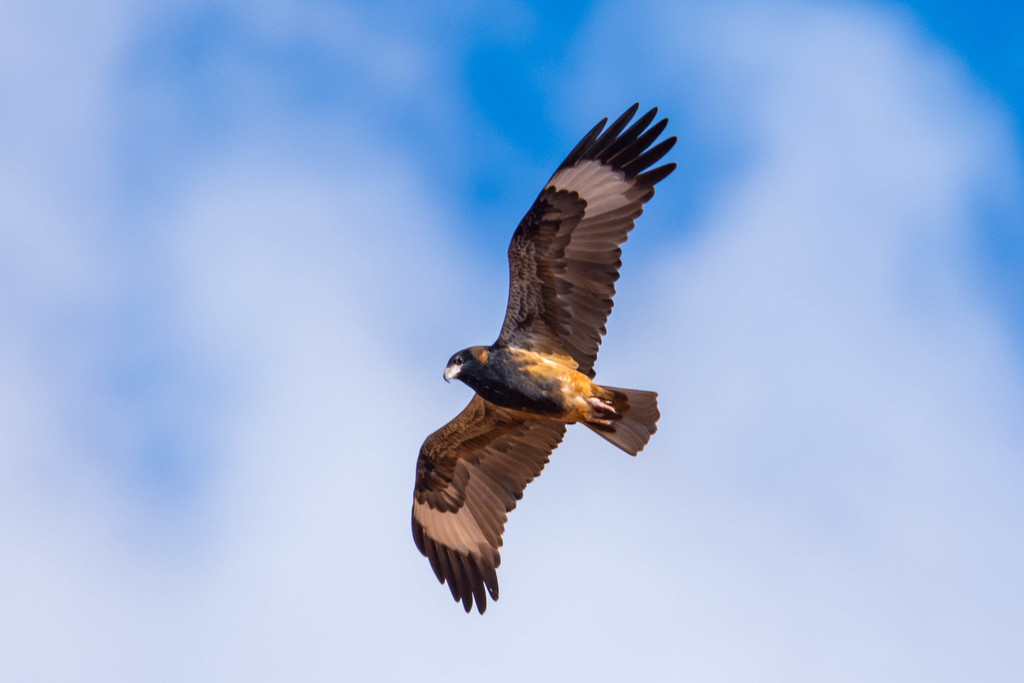
Black-breasted Kite
Live sightings near you, the range map, bar charts of when it is seen, and Macaulay Library photos and recordings.
Black-breasted Kite
Hamirostra melanosternon
The black-breasted buzzard (Hamirostra melanosternon) is a large raptor endemic to mainland Australia. First described by John Gould in 1841, the it forms part of the family Accipitridae (hawks and eagles) and is most closely related to the square-tailed kite (Lophoictinia isura). It is a versatile hunter known for its special skill in cracking eggs. The species is common throughout most of its range.
From the article Black-breasted buzzard on Wikipedia (CC BY-SA), quoted section by section
Description
Intermediate in body size between the well-known larger wedge-tailed eagle (Aquila audax) and the smaller little eagle (Hieraaetus morphnoides), the black-breasted buzzard is one of Australia's largest birds of prey and one of the world's largest kites alongside the red kite, which is slightly less heavy but has a longer total length. An adult black-breasted buzzard measures 51 to 61 cm (20 to 24 in) in height including its short square tail. The buzzard's outstretched wingspan measures 141 to 156 cm (4 ft 8 in to 5 ft 1 in), rendering the bird distinctive in flight as its wings are conspicuously long relative to its stout body and tail. Buzzards appear sexually monomorphic (identical in physical appearance), although the adult female is slightly larger, weighing approximately 1,330 g (2.93 lb) compared to the 1,196 g (2.637 lb) of the adult male. The weight range for the species is from 1,150 to 1,600 g (2.54 to 3.53 lb). It is most closely related to the Square-tailed kite (Lophoictinia isura). The black-breasted buzzard is striking in appearance due to the distinctive markings of the adult plumage. From the underside, the mainly black colouring of the body and wings is contrasted by thick white panels near the end of the wings. From above, the black plumage is broken by a rich mottled red across the back and shoulders. …
Range & habitat
The black-breasted buzzard is widely but sparsely distributed throughout northern and inland Australia in areas with less than 500 mm annual rainfall. The buzzard's range stretches from north-eastern South Australia, north-western New South Wales, northern Queensland, the Northern Territory and the north-western exterior of Western Australia. The buzzard does not occur in Victoria, the Australian Capital Territory or Tasmania, due to their wetter temperate climates. Found to occur in wooded and open habitats, the black-breasted buzzard is most commonly observed in riparian forests and tall-open woodlands surrounded by mid-dense shrublands. In a study of raptor habitat association in central Australia, it was most commonly observed in River Red Gum (Eucalyptus camaldulensis) open woodland, demonstrating a significant preference for this habitat type.
Wikipedia: “Distribution and habitat”
What it does
The black-breasted buzzard hunts a variety of reptiles (large lizards and small snakes), small mammals (such as young rabbits and small rodents, even juvenile kangaroos), large insects, and birds (up to the size of pigeons, parrots, and even ducks), and raids bird nests to steal eggs and nestlings, including those of other raptor species (such as the black kite and nankeen kestrel) and of colonial terns. Not regarded as a specialist or highly proficient hunter, the buzzard's diet often includes carrion of large mammals that may be sourced along roads, tracks, and creek lines. It uses a variety of methods to search for food, including soaring in transects over low vegetation, undertaking cooperative hunting with conspecifics and observing from high up on unconcealed perches. The buzzard may drop, pounce, dive or glide to attack its prey. Skilled in terrestrial hunting, the black-breasted buzzard is famous for its use of stones to crack the eggs of large ground-nesting birds such as the emu (Dromaius novaehollandiae), magpie goose (Anseranas semipalmata), brolga (Grus rubicundus) and Australian bustard (Ardeotis australis). Stones are either dropped onto or thrown at the eggs to break them open, allowing the buzzard to access the contents for food. The buzzard may also use its beak to crack eggs directly.
Wikipedia: “Diet”
Listen
Looking for field recordings…
Where it lives
Recorded sightings
—
geo-referenced records in GBIF, from museums, herbaria and field observers.
Drag the globe to turn it. Dots are where records exist, not a range map; darker means more records.
In the stacks
Searching the stacks…
Every page naming Hamirostra melanosternon in the Biodiversity Heritage Library →
This page is assembled live from iNaturalist, GBIF, Wikipedia, the Source Library and the Internet Archive. It is not yet part of the hand-edited codex. iNaturalist taxon 5288.