- Animals
- ›Chordates
- ›Vertebrates
- ›Ray-finned Fishes
- ›Spiny-rayed fishes
- ›Jacks, Flounders, Barracudas, and Allies
- ›Jacks, Remoras, and Allies
- ›Jacks
- ›Caranginae
- ›Pantolabus
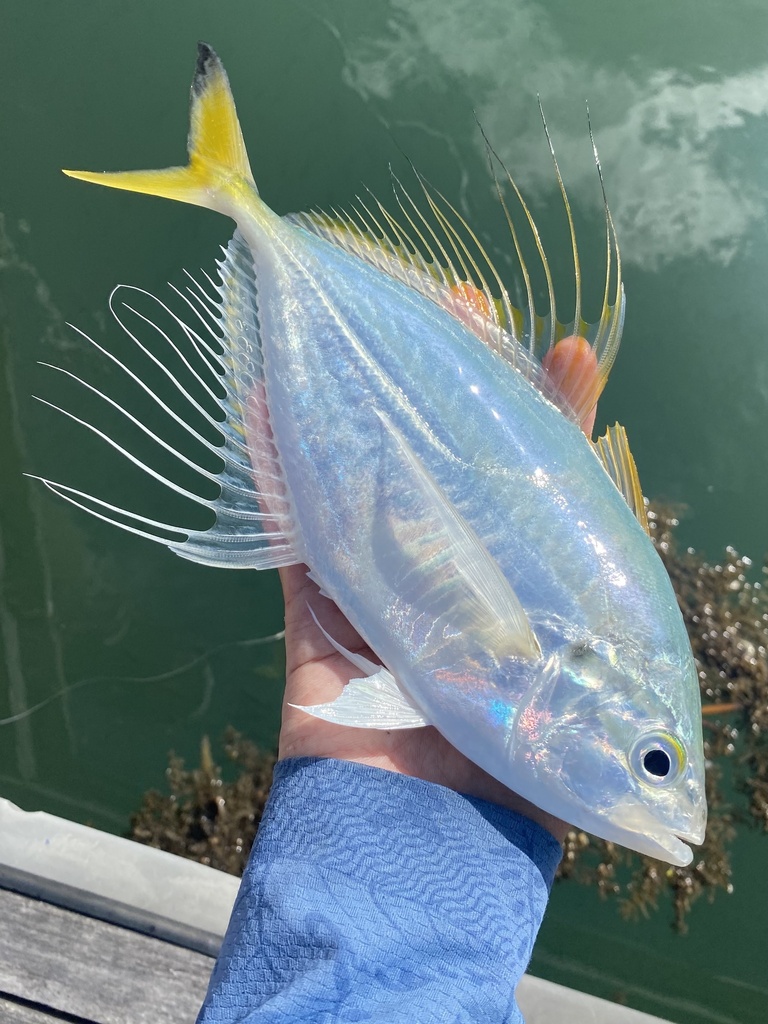
Fringefin Trevally
Pantolabus radiatus
The fringefin trevally (Pantolabus radiatus), also called fringe-finned trevally, round-finned trevally or reef herring, is a species of inshore marine fish classified in the jack and horse mackerel family Carangidae. A relatively small fish, the fringefin trevally is known to reach 40 cm (16 in), but is mostly encountered at lengths less than 25 cm (9.8 in). The fringefin trevally has an ovate body, with distinctive orange-yellow fins and a black opercular spot. The dental patterns of the species distinguish it from the closely related scads of the genus Alepes. Males have characteristic elongated dorsal and anal fins which produce a series of trailing filaments. The fringefin trevally is restricted to the waters of the Indo-Pacific, ranging from northern Australia to Papua New Guinea and eastern Indonesia. An inshore species, it is found in coastal and estuarine environments and exhibits daily and seasonal movements. The fringefin trevally is predatory, taking crustaceans as prey. The species is often taken as bycatch in prawn trawls and occasionally taken by anglers.
From the article Fringefin trevally on Wikipedia (CC BY-SA), quoted section by section
Description
The fringefin trevally is a relatively small species of carangid: reaching a maximum recorded length of 40 cm (16 in), it is more commonly encountered at lengths less than 25 cm. The species has an oval-shaped body with the dorsal and ventral profiles equally convex. The fringefin trevally's dentition is one of the features that allows it to be distinguished from the scads of the genus Alepes, having a single row of moderately enlarged, conical teeth on the lower jaw and an outer row of conical teeth on the upper jaw bordered by inner bands of small, but not villiform, sharply pointed teeth. A well developed adipose eyelid is present on the posterior half of the eye, similar to the members of Alepes. The dorsal fin is in two parts; the first having eight spines and the second one spine and 20 to 26 soft rays. The anal fin has two detached spines followed by 18 to 20 soft rays. The males of the species have all their soft dorsal and anal fins extended into distinctive filaments, with the longest filaments at the front of the second dorsal fin. The second dorsal and anal fins of both sexes have a scaly basal sheath. The lateral line has a moderate anterior arch, with 33 to 41 scales in the curved section and no to 9 scales and 38 to 49 scutes on the straight section. …
Range & habitat
The fringefin trevally is distributed through a small area of the Indo-Pacific, ranging from northern Australia to Papua New Guinea and West Papua in Indonesia. Around Australia, the species is known from Port Hedland in Western Australian around to Gladstone in Queensland. The fringefin trevally is predominantly an inshore species, rarely found in waters greater than 30 m deep. The species commonly enters estuaries, but is restricted to the lower reaches of these environments. Studies in northern Australia suggest the species prefer turbid waters, with trawl catches increasing in more turbid waters. Fringefin trevally have also been recorded over seagrass habitats.
Wikipedia: “Distribution and habitat”
Where it lives
Recorded sightings
—
geo-referenced records in GBIF, from museums, herbaria and field observers.
Drag the globe to turn it. Dots are where records exist, not a range map; darker means more records.
In the stacks
Searching the stacks…
Every page naming Pantolabus radiatus in the Biodiversity Heritage Library →
This page is assembled live from iNaturalist, GBIF, Wikipedia, the Source Library and the Internet Archive. It is not yet part of the hand-edited codex. iNaturalist taxon 529702.