- Animals
- ›Chordates
- ›Vertebrates
- ›Ray-finned Fishes
- ›Spiny-rayed fishes
- ›Gobies, cardinalfishes and allies
- ›Gobies and allies
- ›Mudskippers and Allies
- ›Mudskippers
- ›Periophthalmus
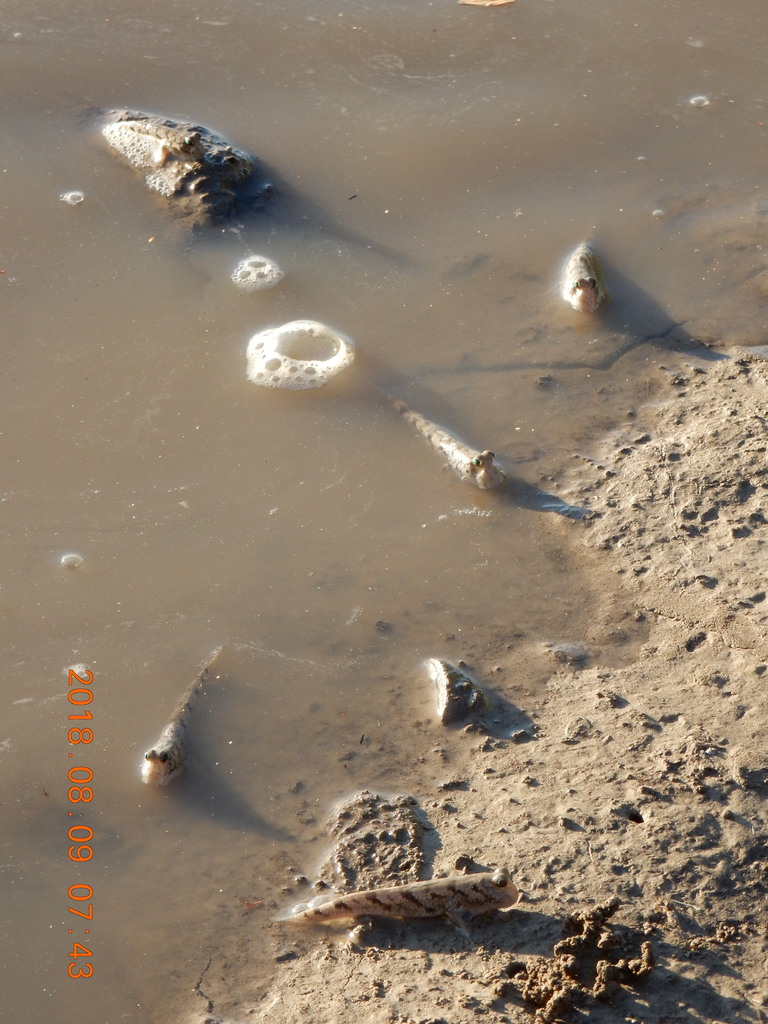
Darwin's Mudskipper
Periophthalmus darwini
Darwin's mudskipper (Periophthalmus darwini) is a relatively newly discovered mudskipper in 2004, so little is known about it. It is a brackish water ray-finned fish found in Australia along mud banks never far from mangrove trees. It is in the goby family Gobiidae. It is named after Charles Darwin because the holotype was collected in Darwin Harbour. Its greatest distinguishing characteristic from other mudskippers is its greatly reduced first dorsal fin in both sexes.
From the article Periophthalmus darwini on Wikipedia (CC BY-SA), quoted section by section
Description
The Darwin's mudskipper has a body shape and dorsally pultruding eyes similar to other mudskippers. They have a maximum length of 4.6 cm. It has 5–7 dorsal spines, 10–12 dorsal rays, 1 anal spine, and 11–13 anal rays. Its greatest distinguishing characteristic from other mudskippers is its greatly reduced first dorsal fin in both sexes. Its coloration is modally with a background color of light brown. They typically have dark brown streaks on their heads. They usually have dark brown saddles and diagonal and irregular bars.
Range & habitat
The Darwin's mudskipper is a brackish to freshwater fish. It is found in the intertidal zone, in tidal creeks, and in inlets along mud banks. They are always near mangrove trees. They often group together. They are considered less aggressive than other mudskippers.
Wikipedia: “Habitat”
What it does
The Darwin's mudskipper has been seen eating small invertebrates such as small crabs, but there has not been any published studies[2] on this topic.
Wikipedia: “Diet”
In human culture
The vernacular name and specific name honour Charles Darwin who the type locality, Darwin, Northern Territory was named after.
Wikipedia: “Etymology”
Where it lives
Recorded sightings
—
geo-referenced records in GBIF, from museums, herbaria and field observers.
Drag the globe to turn it. Dots are where records exist, not a range map; darker means more records.
In the stacks
Searching the stacks…
Every page naming Periophthalmus darwini in the Biodiversity Heritage Library →
This page is assembled live from iNaturalist, GBIF, Wikipedia, the Source Library and the Internet Archive. It is not yet part of the hand-edited codex. iNaturalist taxon 530080.