- Animals
- ›Chordates
- ›Vertebrates
- ›Ray-finned Fishes
- ›Grinners, Lizardfishes, and Allies
- ›Deepsea Tripod Fishes
- ›Bathypterois
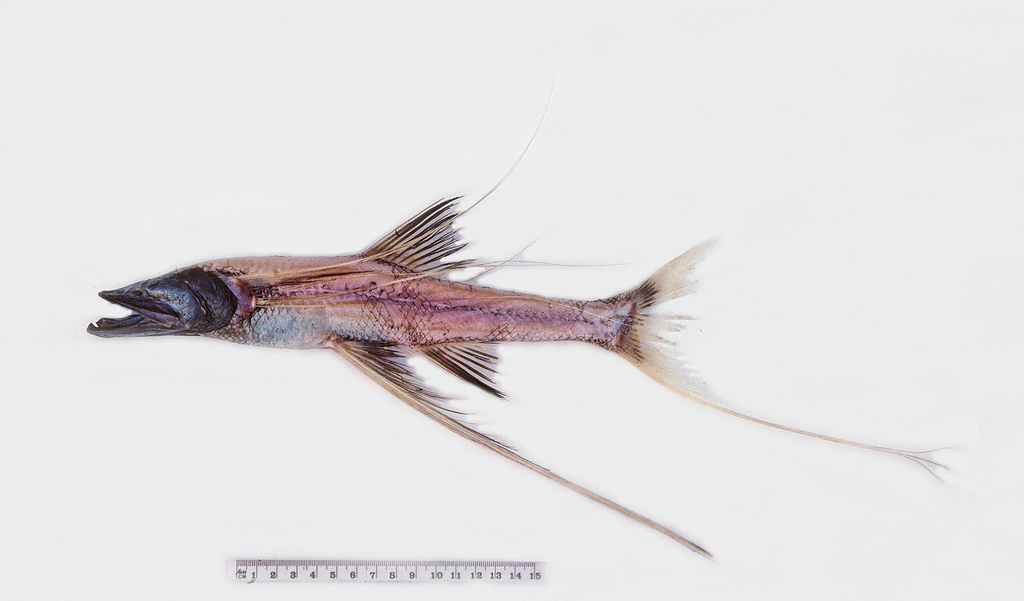
Tribute Spiderfish
Bathypterois guentheri
Bathypterois is a genus of deepsea tripod fishes. They are a diverse genus that belong to the greater family Ipnopidae and order Aulopiformes. They are distinguished by having two elongated pelvic fins and an elongated caudal fin, which allow them to move and stand on the ocean floor, much like a tripod, hence the common name. Bathypterois are distributed worldwide with some particular species of the genus having specialized environmental niches, such as lower dissolved oxygen concentrations. Bathypterois have a reduced eye size, highly specified extended fins, and a mouth adapted to filter feeding. They are filter feeders whose main food source is benthopelagic planktonic calanoid copepods, but some variation is seen with maturity in secondary food sources. Bathypterois use their three elongated fins for a wide range of motion from landing to standing on the ocean floor to catching prey, for which these fins serve as specialized perceptory organs. Bathypterois have both male and female gonads at once making them simultaneous hermaphrodites, whose gonads go through five stages of development following seasonal autumn spawning.
From the article Bathypterois on Wikipedia (CC BY-SA), quoted section by section
Description
Bathypterois are typically around 30 cm in size but have been observed as large as 43.4 cm in size. Their eyes tend to be small in size. The coloring of the genus varies from colorless to black as well as uniform to multicolored among the different species within the genus. Bathypterois tend to have non-sensory pads at the end of extended pelvic and caudal fin ray elements. These extended elements can extend to up to three times that of the body, or around 1 meter. The pads allow the rays to rest on the sea floor creating the sedentary three point (tripod) stance that is typically observed of Bathypterois. The pectoral fins are also extended, and are sensitive to sensory input as a result of the spinal nerves having three innervations and being enlarged in the pectoral fins of most Bathypterois species. They have two gonads, one male and one female. The male testicular gonad is more dorsal than the female ovarian gonad. Both gonads work, meaning they are able to produce sperm or eggs respectively, and are clearly unique from the other. Their mouth is large and upturned and contains little dentition. The laminar gill rakers are long, thin, and covered in small spines. They tend to have stomachs that are linear and poorly differentiated.
Wikipedia: “Morphology”
Range & habitat
The niches the different species within Bathypterois live in vary and can be as deep as 6,000 m and in both temperate or tropical oceans. Some species, such as Bathypterois ventralis, are known to prefer warmer waters and lower dissolved oxygen concentrations/oxygen deficient zones, which they are well adapted for. Certain species, such as Bathypterois filiferus are endemic to the southern Pacific and northern Indian oceans, while others such as Bathypterois longipes, are endemic to the mid/southern Atlantic. Some species prefer the continental slope while others prefer the depth of the abyssopelagic. However, in general, Bathypterois has a very broad distribution with much overlap between environments since they are so well adapted to survival in a variety of niches.
Wikipedia: “Distribution and habitat”
What it does
What they feed on changes based on maturity, however they are always filter feeders. In order to feed, they have laminar gill rakers that are long and thin that allow them to capture planktonic prey. They face into the current in the tripod stance allowing the food to come to them. The main food source for them is benthopelagic planktonic calanoid copepods, no matter the depth and maturity. However, between 1800 meters and 2250 meters the secondary prey is different for juvenile and mature Bathypterois. Both mature and juvenile organisms diet increases to include endobenthic and epibenthic prey as the secondary food source, which for juveniles is benthic tanaidaceans and for mature Bathypterois is mysids. The difference in diet between juvenile and mature organisms is not big but does vary across the different species. It has been indicated that the species Bathypterois grallator eats larger, gelatinous prey as well as the other common food sources for species within the genus.
Wikipedia: “Feeding and diet”
Where it lives
Recorded sightings
—
geo-referenced records in GBIF, from museums, herbaria and field observers.
Drag the globe to turn it. Dots are where records exist, not a range map; darker means more records.
In the stacks
Searching the stacks…
Every page naming Bathypterois guentheri in the Biodiversity Heritage Library →
This page is assembled live from iNaturalist, GBIF, Wikipedia, the Source Library and the Internet Archive. It is not yet part of the hand-edited codex. iNaturalist taxon 530178.