- Animals
- ›Chordates
- ›Vertebrates
- ›Ray-finned Fishes
- ›Spiny-rayed fishes
- ›Perches, Scorpionfishes, Sticklebacks, and Allies
- ›Scorpionfishes and Allies
- ›Searobins
- ›Armored Searobins
- ›Scalicus
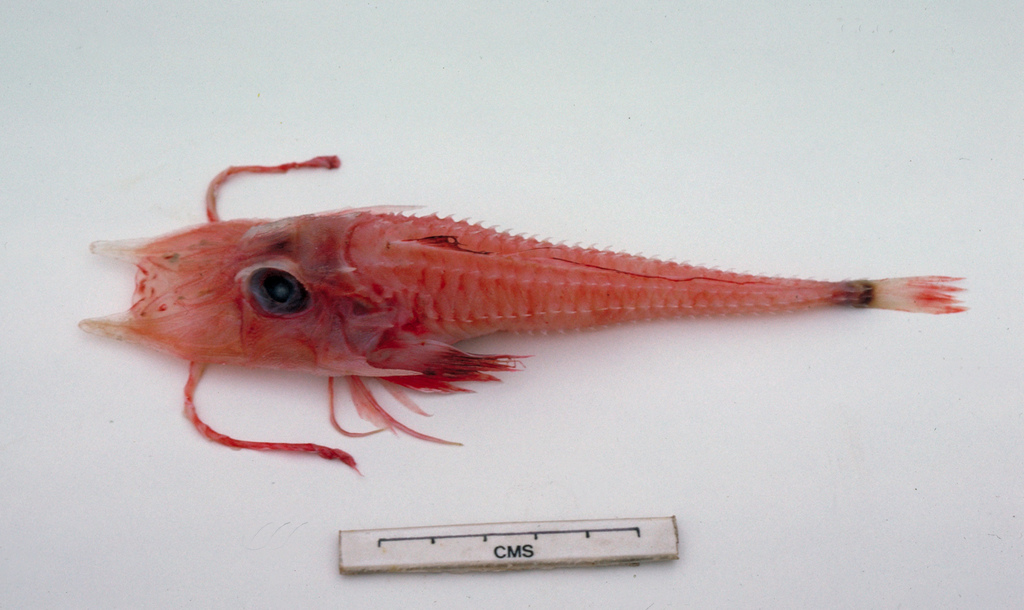
Scalicus orientalis
Scalicus orientalis is a species of marine ray-finned fish belonging to the family Peristediidae, the armoured gurnards or armored sea robins. This species is found in Indian Ocean and western Pacific Ocean.
From the article Scalicus orientalis on Wikipedia (CC BY-SA), quoted section by section
Description
Scalicus orientalis is pale pinkish-brown in colour becoming paler on the lower body with a scattering of variably sized but small brown spots on the head and body. The front portion of the first dorsal fin is blackish, as are the two large filamentous barbels on the lower jaw, and the long, triangular rostral projections. This species has a maximum standard length of 15.4 cm (6.1 in).
Range & habitat
Scalicus orientalis is found in theIndo-Pacific from Réunion and the Arabian Sea east to New Caledonia, north to Japan and south to northern Australia. In Australia it is found from the southwest of the Scott and Seringapatam Reefs and from Innisfall to Coolangatta in Queensland. This is a bathydemersal, benthic species found at depths between 357 and 497 m (1,171 and 1,631 ft) on the continental slope.
== References ==
Wikipedia: “Distribution and habitat”
Where it lives
Recorded sightings
—
geo-referenced records in GBIF, from museums, herbaria and field observers.
Drag the globe to turn it. Dots are where records exist, not a range map; darker means more records.
In the stacks
Searching the stacks…
Every page naming Scalicus orientalis in the Biodiversity Heritage Library →
This page is assembled live from iNaturalist, GBIF, Wikipedia, the Source Library and the Internet Archive. It is not yet part of the hand-edited codex. iNaturalist taxon 530623.