- Animals
- ›Chordates
- ›Vertebrates
- ›Birds
- ›Hawks, Eagles, Kites, and Allies
- ›Hawks, Eagles, and Kites
- ›Typical Eagles and Hawk-Eagles
- ›Stephanoaetus
On eBird ↗
Crowned Eagle
Live sightings near you, the range map, bar charts of when it is seen, and Macaulay Library photos and recordings.
Crowned Eagle
Stephanoaetus coronatus
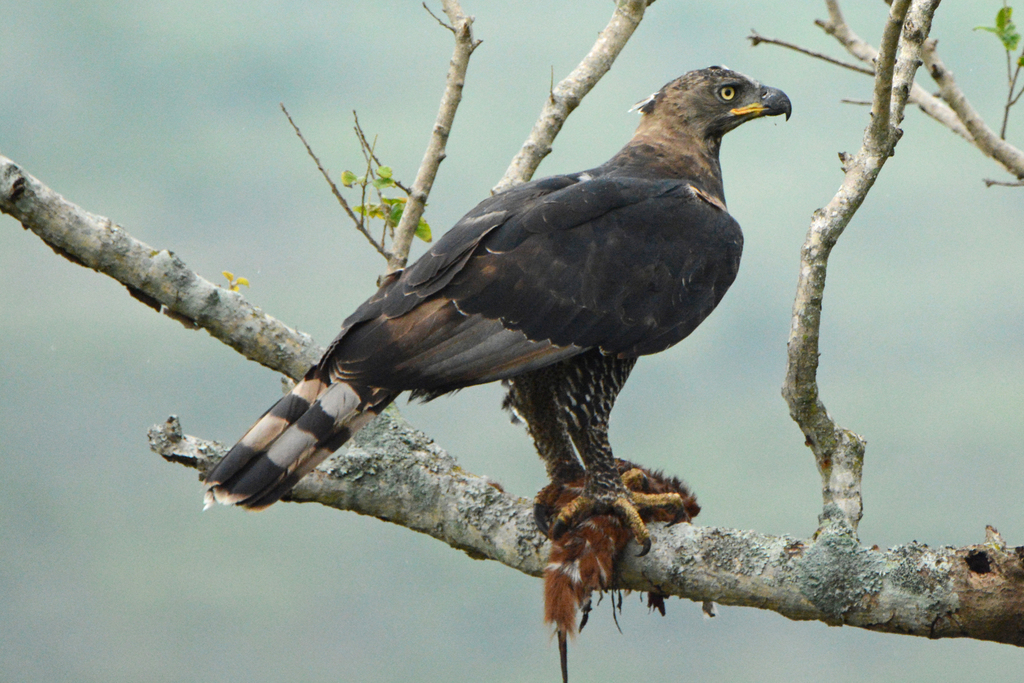
The crowned eagle, also known as the African crowned eagle or the crowned hawk-eagle (Stephanoaetus coronatus), is a large bird of prey found in sub-Saharan Africa; in Southern Africa, it is restricted to more easterly areas. Its preferred habitats are principally riparian woodlands and various forests. The crowned eagle is the only extant member of the genus Stephanoaetus. A second species, the Malagasy crowned eagle (Stephanoaetus mahery), went extinct after early humans settled on Madagascar.
Mammals comprise the majority of the eagle's diet. Principal prey species vary throughout its large range, with monkeys, antelopes, rodents, hyraxes, and viverrids all being notable prey groups. Other wild mammals recorded as prey include bushpigs, pangolins, and bats. Birds are also a considerable component of the diet in some populations. In an urban population in Durban, South Africa, camera traps at nest sites revealed that 25% of prey items were birds, of which 17% were hadada ibis juveniles. In Taï, Côte d'Ivoire, trumpeter hornbills comprised 8% of prey. Reptiles and carrion are occasionally consumed. Domesticated cats, dogs, sheep, goats, and chickens are sometimes taken. However, in Durban, South Africa, domesticated animals comprised only 6% of the diet across 11 nests and 836 prey items, of which 3% were chickens. There is at least one credible report of an attack, presumably a case of attempted predation, on a 19.6 kg human child.
From the article Crowned eagle on Wikipedia (CC BY-SA), quoted section by section
Description
The crowned eagle is a very large eagle. Measuring from 80 to 99 cm (31 to 39 in) in length, it is the fifth longest extant eagle in the world. The female, at a weight of 3.2–4.7 kg (7.1–10.4 lb), is around 10–15% larger than the male, at a weight of 2.55–4.12 kg (5.6–9.1 lb). An average body mass of 3.64 kg (8.0 lb) was given in one account. Elsewhere, an average of 3.8 kg (8.4 lb) has been claimed. Slightly smaller weights were found in a South African survey where 5 males averaged 2.65 kg (5.8 lb) and 8 females averaged 3.71 kg (8.2 lb). Overall, they are the 9th heaviest living eagle species. The wingspan typically ranges from 1.51 to 1.81 m (4 ft 11 in to 5 ft 11 in). The largest authenticated wingspan for a female was 1.9 m (6 ft 3 in), with a claim of wingspans of up to 2 m (6 ft 7 in) needing confirmation. This eagle's wingspan is quite short for the bird's size, being around the same mean width as that of a tawny eagle (Aquila rapax) or a short-toed snake eagle (Circaetus gallicus), species that weigh about half as much as a crowned eagle. However, the somewhat boxy and rounded wings are quite broad, being broader than, for example, the much longer-winged golden eagle (Aquila chrysaetos). The wing morphology of the species gives it maneuverability in its densely wooded environment. …
Range & habitat
The crowned eagle is found only on the continent of Africa. In East Africa, the crowned eagle's range extends from central Ethiopia, to Uganda, forested parts of Kenya and Tanzania to as far south as eastern South Africa, with a southern distribution limit around Knysna. In western and central Africa, the crowned eagle's range extends through much of the (once) vast African rainforest. They may be found from Senegal, The Gambia, Sierra Leone and Cameroon, where they inhabit the Guinean forests, to the Democratic Republic of the Congo, where they live in the Congolian forests, and down south to as far Angola. Despite its large distribution there, the crowned eagle is now rare in many parts of West Africa.
Wikipedia: “Distribution”
What it does
Typical of most raptors that breed in Africa, the crowned eagle is non-migratory and is largely sedentary. This species usually inhabits a fixed territory throughout the year during its adult life. There is evidence that the birds move about to some degree when circumstances require it, for example when they need to change mates in isolated breeding areas. The greatest movement of any notable distance is usually associated with juvenile birds, which wander relatively widely before maturation. Forty-four birds of various ages that were ringed in southern Africa and recovered were all found near the ringing localities. Small movements by crowned eagles has resulted in them being sighted in improbable habitats, such as on an open savanna hill in Kenya, an open river bed in Lewa Wildlife Conservancy and even a golf course in Nairobi. The crowned eagle is highly vocal and has a noisy, undulating display flight. In Equatorial Africa, they often call year-around, while elsewhere they may vocalize mainly in the context of breeding and nesting activities. The call is a series of loud whistles that rise and fall in pitch. The male performs an elaborate rise-and-fall display over the forest canopy both during the breeding season and outside it as a territorial proposition. …
Wikipedia: “Behavior”
Listen
Looking for field recordings…
Where it lives
Recorded sightings
—
geo-referenced records in GBIF, from museums, herbaria and field observers.
Drag the globe to turn it. Dots are where records exist, not a range map; darker means more records.
In the old herbals & bestiaries

In the stacks
Searching the stacks…
Every page naming Stephanoaetus coronatus in the Biodiversity Heritage Library →
This page is assembled live from iNaturalist, GBIF, Wikipedia, the Source Library and the Internet Archive. It is not yet part of the hand-edited codex. iNaturalist taxon 5323.