- Animals
- ›Chordates
- ›Vertebrates
- ›Birds
- ›Hawks, Eagles, Kites, and Allies
- ›Hawks, Eagles, and Kites
- ›Honey-buzzards, Pernine Kites, and Allies
- ›Pernis
On eBird ↗
European Honey-buzzard
Live sightings near you, the range map, bar charts of when it is seen, and Macaulay Library photos and recordings.
European Honey-buzzard
Pernis apivorus
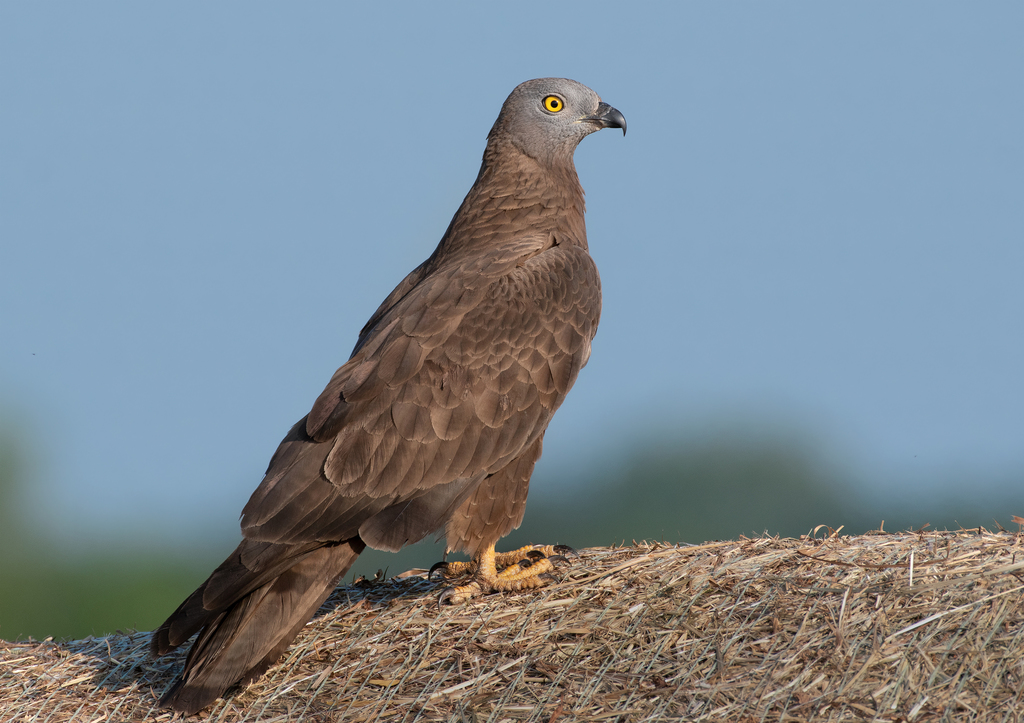
The European honey buzzard (Pernis apivorus) is an insectivorous bird of prey in the family Accipitridae breeding in Europe and western Asia, and wintering in Africa.
From the article European honey buzzard on Wikipedia (CC BY-SA), quoted section by section
Description
The European honey buzzard is 52–60 cm (20–24 in) long, longer and longer winged, with a 130–150 cm (51–59 in) wingspan, when compared to the common buzzard (Buteo buteo), but at 440–1050 g, not as heavy-bodied as that is. It appears long-necked with a small head, and soars on flat wings. It has a longer tail, which has fewer bars than the Buteo buzzards, usually with two narrow dark bars and a broad dark subterminal bar. The sexes can be distinguished on plumage, which is unusual for a large bird of prey; the male has a blue-grey head, while the female's head is brown. The female is slightly larger and darker than the male. The soaring jizz is quite diagnostic; the wings are held straight with the wing tips horizontal or sometimes slightly pointed down. The head protrudes forwards with a slight kink downwards and sometimes a very angular chest can be seen, similar to a sparrowhawk, although this may not be diagnostic. The angular chest is most pronounced when seen in direct flight with tail narrowed. The call is a clear peee-lu.
Range & habitat
The European honey buzzard has a vast range estimated at 18,200,000 km2 (7,000,000 sq mi) including most of Europe, sub-Saharan Africa to western Russia, southwestern Siberia, and Kazakhstan. It is a summer migrant to most of the western Palearctic, absent only from the north and northwest fringes of the region. The eastern area boundary is not yet known exactly, it is thought to be in the Tomsk – Novosibirsk – Barnaul area. It is seen in a wide range of habitats, but generally prefers woodland, including plantations of exotic trees.
Movements. Being a long-distance migrant, the honey buzzard relies on magnetic orientation to find its way south, as well as (for adult birds) a visual memory of recognisable geographical features such as mountain ranges and rivers, along the way. It avoids large expanses of water over which it cannot soar. Accordingly, great numbers of honey buzzards can be seen crossing the Mediterranean Sea over its narrowest stretches, such as the Gibraltar Strait, the Messina Strait, the Bosphorus, Lebanon, or in Israel.
Status in Britain. The bird is scarce in the United Kingdom, though its population is increasing. Due to its secretive behaviour while breeding, its numbers are hard to determine; a dedicated survey in 2020-2021 found 109 breeding pairs, with the expected total being thought to be in the region of 130–150 pairs. …
Wikipedia: “Distribution and habitat”
What it does
The European honey buzzard is a specialist feeder, living mainly on the larvae and nests of wasps and hornets, although it takes small mammals, reptiles, and birds. It is the only known predator in Europe of the invasive Asian hornet. It spends large amounts of time on the forest floor excavating wasp nests. It is equipped with long toes and claws adapted to raking and digging, and scale-like feathering on its head, thought to be a defence against the stings of its prey. Honey buzzards are thought to have a chemical deterrent in their feathers that protects them from wasp attacks.
Wikipedia: “Feeding”
In human culture
The binomen is derived from Ancient Greek pernes πέρνης, a term used by Aristotle for a bird of prey, and Latin apivorus "bee-eating", from apis, "bee" and -vorus, "-eating". In the 19th century, it was also sometimes known as the 'pern' or 'common pern', from the scientific name.
Wikipedia: “Etymology”
Listen
Looking for field recordings…
Where it lives
Recorded sightings
—
geo-referenced records in GBIF, from museums, herbaria and field observers.
Drag the globe to turn it. Dots are where records exist, not a range map; darker means more records.
In the stacks
Searching the stacks…
Every page naming Pernis apivorus in the Biodiversity Heritage Library →
This page is assembled live from iNaturalist, GBIF, Wikipedia, the Source Library and the Internet Archive. It is not yet part of the hand-edited codex. iNaturalist taxon 5325.