- Animals
- ›Chordates
- ›Vertebrates
- ›Birds
- ›Hawks, Eagles, Kites, and Allies
- ›Hawks, Eagles, and Kites
- ›Harpy Eagles and allies
- ›Harpyopsis
On eBird ↗
New Guinea Eagle
Live sightings near you, the range map, bar charts of when it is seen, and Macaulay Library photos and recordings.
New Guinea Eagle
Harpyopsis novaeguineae
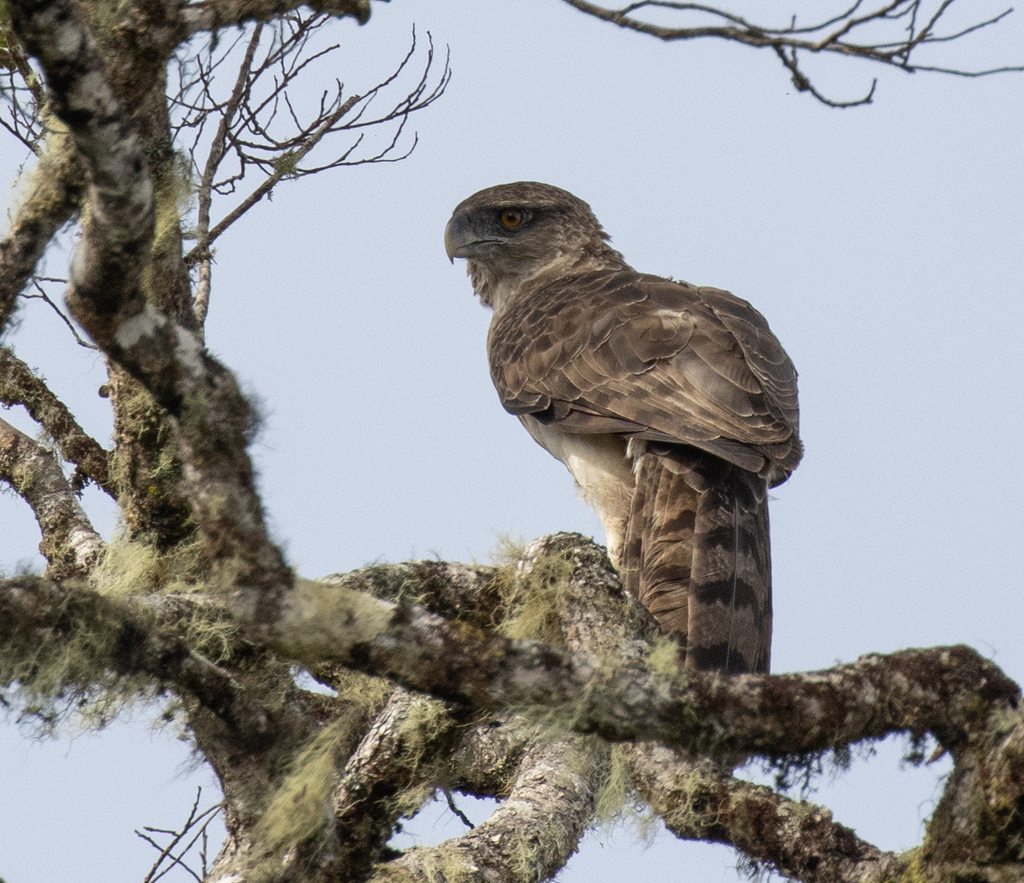
The Papuan eagle (Harpyopsis novaeguineae) is a large bird of prey. It is also known by several other names, including Papuan harpy eagle, New Guinea eagle, New Guinea harpy eagle, or kapul eagle, the latter name from the local name for a usually arboreal marsupial that the eagle is known to regularly hunt. This is an endemic species to New Guinea, and it can occasionally be found throughout the island. This is a forest-dwelling species, usually occurring in mature rainforest. The Papuan eagle is a fairly little-known species for a large eagle; however, it is known to prey on a wide range of prey, probably by and large mammals and birds from small to quite large sizes. Unique amongst eagles, the Papuan eagle is a surprisingly fast and agile terrestrial avian predator and is capable of chasing down prey on the forest floor. What little study has been conducted about its breeding habits suggests it nests in a large forest tree, perhaps every other year. The Papuan eagle is probably naturally scarce, but it is under the threat of habitat destruction by deforestation, as well as hunting. Due to its small and declining population, the species has been classified as vulnerable by the IUCN.
From the article Papuan eagle on Wikipedia (CC BY-SA), quoted section by section
Description
The New Guinea eagle is a fairly large eagle and very large raptor. Though the sexes are similar, the female is slightly larger than the male, with a range up to a 34% size difference. In total length, adults range from 75 to 90 cm (30 to 35 in). The relatively short but broad wingspan, as expected in forest-dwelling raptors, is 121 to 157 cm (4 ft 0 in to 5 ft 2 in). The body mass widely reported is relatively light for so large a raptor at 1.6 to 2.4 kg (3.5 to 5.3 lb). This may be due in no small part to its extremely long tail, which measures 384 to 394 mm (15.1 to 15.5 in) in males and 410 to 435 mm (16.1 to 17.1 in) in females. The weights reported according to some authors probably underrepresent their size, especially those of full-grown females, and their body size range based on linear dimensions (the weighed birds could have been all smaller males). This species also possesses an exceptional long tarsus, which may rival the Philippine eagle, which weighs about three times more than the Papuan eagle, as the longest of all living eagles at 123 to 145 mm (4.8 to 5.7 in). Meanwhile, the wing chord measures 368 to 442 mm (14.5 to 17.4 in) in males and 450 to 494 mm (17.7 to 19.4 in). A single male had a culmen length of 48 mm (1.9 in). At all ages, Papuan eagles are a greyish brown raptor with a creamy-coloured underside. …
Range & habitat
The Papuan eagle is endemic to New Guinea. It has been seen in almost every part of the island, from peninsular Indonesian Papua in the west to throughout the nation of Papua New Guinea in the east. The main native habitat inhabited by Papuan eagles are undisturbed tropical rainforests. However, they will also utilize gallery forests, monsoon scrub forest and dry woodland. The species has even been reported to sometimes turn up in forest edge and relatively open areas such as gardens, but more extensive research that this is extraordinarily rare if it does even occur. They can live at several elevations from sea level up to regularly 2,000 m (6,600 ft), but occasionally have reported at elevations ranging from 3,200 to 3,700 m (10,500 to 12,100 ft). At times, it has been considered a bird that prefers steeper sloped or ridged parts of the forest.
Wikipedia: “Distribution and habitat”
What it does
The Papuan eagle is an elusive forest dweller. Despite old claims that it soars, even claims that it does so frequently, evidence indicates it never engages in soaring flight. Typically, this species is known to perch inconspicuously in thick canopy and can be fairly difficult to see as it often slips away quietly, seemingly to avoid human detection. Due to its occasional tendency to vocalize at night, large eyes, and almost owl-like facial area, this species has at times been hypothesized to be an occasional nocturnal hunter, but the Papuan eagle has never been proven to hunt by night and is now thought to be a diurnal hunter like other eagles. The Papuan eagle is a powerful hunter that uses the still or perch hunting style typical of many forest raptors, gliding from often routine perch sites inconspicuously as possible within the forest. Flights between hunting perches are up to 1,500 m (4,900 ft) but usually as little as 50 to 60 m (160 to 200 ft). This raptor is said to detect terrestrial prey partially through sound by listening for movement in the undergrowth, and while hunting, often bobs its head side to side, and turns it at peculiar angles, seeming to be getting a fix on the prey's location before dropping down. …
Wikipedia: “Behaviour and ecology”
Listen
Looking for field recordings…
Where it lives
Recorded sightings
—
geo-referenced records in GBIF, from museums, herbaria and field observers.
Drag the globe to turn it. Dots are where records exist, not a range map; darker means more records.
In the stacks
Searching the stacks…
Every page naming Harpyopsis novaeguineae in the Biodiversity Heritage Library →
This page is assembled live from iNaturalist, GBIF, Wikipedia, the Source Library and the Internet Archive. It is not yet part of the hand-edited codex. iNaturalist taxon 5388.