Bale Mountains Adder
Bitis harenna
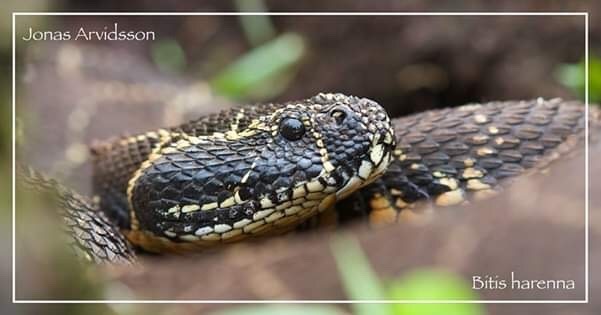
Bitis harenna, or the Bale Mountains adder, is a relatively unknown species of viper from and named after the Harenna Forest in the Oromia Region of Ethiopia. It is often mixed up with the Bitis parviocula in multiple scientific papers, as both it and B. parviocula lack horns between nostrils, as well as sharing specific numbers of specific scales and a pale 'cross bar' marking on the head behind the eyes. However, it can be told apart from all other Macrocerastes (or 'Bitis') species by their unique colouring, markings and braincase. The species has only been officially sighted at a length of 66 cm to 1 m.
From the article Bitis harenna on Wikipedia (CC BY-SA), quoted section by section
Description
Bitis harenna is similar (and has often been confused for) B. parviocula as they both lack horns between their nostrils, have less than four scales between their rostral and first supralabial, and share a pale 'cross bar' marking on the dorsal surface behind their eyes. However, B. harenna is unique to all other species of the subgenus Macrocerastes due to their limited concavity on the lateral wall of the braincase, their majority black colouring on their dorsal side (extending mid-dorsally between the nostrils) with slim and pale cream markings and their lack of a regular parallel-sided mid-dorsal stripe. The species also has distinct divided upper flank dorsal scale rows, and fused lower flank rows. Its darker colouring differs B. harenna from B. rhinoceros and B. gabonica which share a more pale head colouring, its lack of posteriorly notched scales differs B. harenna from B. nasicornis, and its frontals with facets and its lack of subhorizontal ridge on the prootic differ B. harenna from the very similar B. parviocula.
== References ==
Where it lives
Recorded sightings
—
geo-referenced records in GBIF, from museums, herbaria and field observers.
Drag the globe to turn it. Dots are where records exist, not a range map; darker means more records.
In the stacks
Searching the stacks…
Every page naming Bitis harenna in the Biodiversity Heritage Library →
This page is assembled live from iNaturalist, GBIF, Wikipedia, the Source Library and the Internet Archive. It is not yet part of the hand-edited codex. iNaturalist taxon 539392.