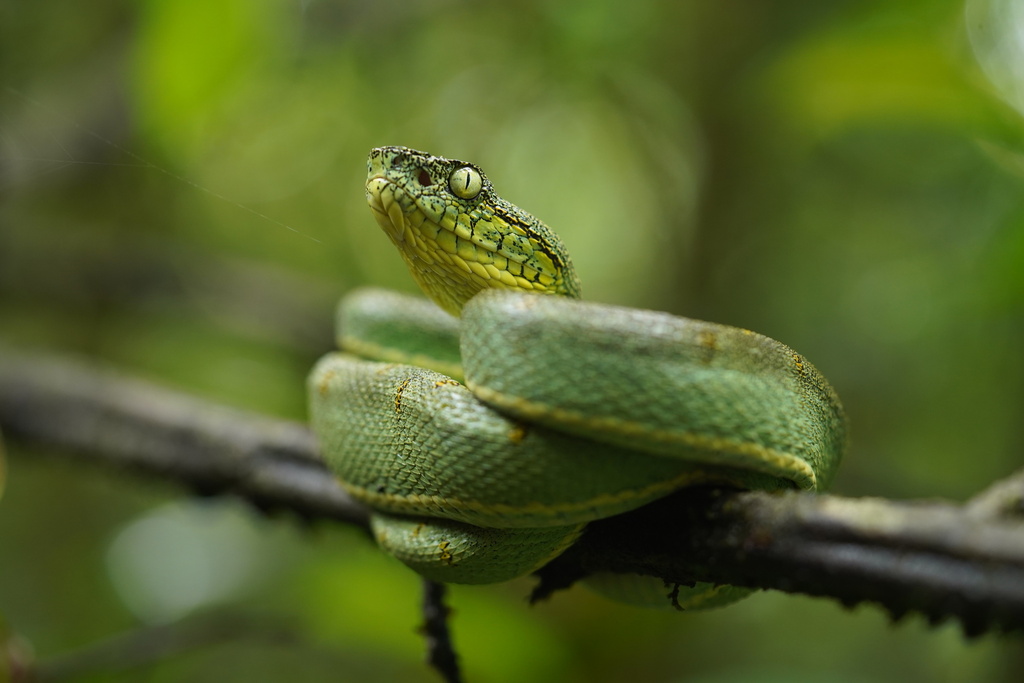
Green Jararaca
Bothrops bilineatus
Bothrops bilineatus, also known as the two-striped forest-pitviper, parrotsnake, Amazonian palm viper, or green jararaca, is a highly venomous pit viper species found in the Amazon region of South America. Two subspecies are currently recognized, including the nominate subspecies described here. A pale green arboreal species that may reach 1 m (3.3 ft) in length, it is an important cause of snakebite throughout the entire Amazon region.
From the article Bothrops bilineatus on Wikipedia (CC BY-SA), quoted section by section
Description
Adults usually do not grow to more than 70 cm (28 in) in length, although some may reach 100 cm (39 in). The maximum reported size is 123 cm (48 in). The body is relatively slender, with a prehensile tail. The scalation includes 23–35 dorsal scales at midbody, 190–218/192–220 ventral scales in males/females and 65–76/55–73 mostly divided subcaudal scales in males/females. On the head are 5–9 keeled intersupraoculars, 8–12 sublabial scales and 7–9 supralabial scales. Of the latter, the second is usually fused with the prelacunal to form a lacunolabial, although partial or complete sutures may exist to separate these scales. The colour pattern consists of a pale green ground colour overlaid dorsally with either a peppering of black spots, or a series of tan or reddish brown spots that are usually paired. The ventrals are bordered by a creamy yellow line running down the length of the body, while the belly itself is yellow and bordered with a tinge of green. The latter part of the tail is pink and bordered with yellow. The head is either green with a scattering of small black spots, or green with isolated tan or reddish brown spots that are bordered in black. The iris is pale green, while the labials are yellow green, often with black spots. The nominate subspecies, B. b. …
Range & habitat
This species is found in the Amazon region of South America: Colombia, Venezuela, Guyana, Suriname, French Guiana, Brazil, Ecuador, Peru, and Bolivia. An isolated population is known from the Atlantic versant of southeastern Brazil. The type locality given is "Brasilien".
Wikipedia: “Geographic range”
What it does
Nocturnal, this species spends the day hidden in thick foliage, tree hollows, or at the base of palm fronds, always remaining in places where it can anchor itself with its prehensile tail. It tends to rely on ambush instead of actively hunting for prey. Some species of viper are only active during the day as they bask in the sunlight and strike at prey that draw too close. Others tend to be nocturnal choosing to hunt at night and rest in the day.
Wikipedia: “Behaviour”
Toxicity
This species is an important cause of snakebite throughout the entire Amazon region. Due to its arboreal nature, most bites are to the upper body, including hands, arms, and faces. Clinical features of bite wounds include bruising, profound coagulopathy, and spontaneous bleeding. Symptoms reported from various case histories include local pain, swelling, bruising, bleeding of the gums, loss of consciousness, hematemesis, hematuria, fever, erythema, bleeding from the fang punctures, shock, bleeding from the mouth, nose and eyes, nausea, and incoagulable blood. At least one death has been reported. The DL50 is 6.28 mg/kg.
Wikipedia: “Venom”
Where it lives
Recorded sightings
—
geo-referenced records in GBIF, from museums, herbaria and field observers.
Drag the globe to turn it. Dots are where records exist, not a range map; darker means more records.
In the stacks
Searching the stacks…
Every page naming Bothrops bilineatus in the Biodiversity Heritage Library →
This page is assembled live from iNaturalist, GBIF, Wikipedia, the Source Library and the Internet Archive. It is not yet part of the hand-edited codex. iNaturalist taxon 539411.