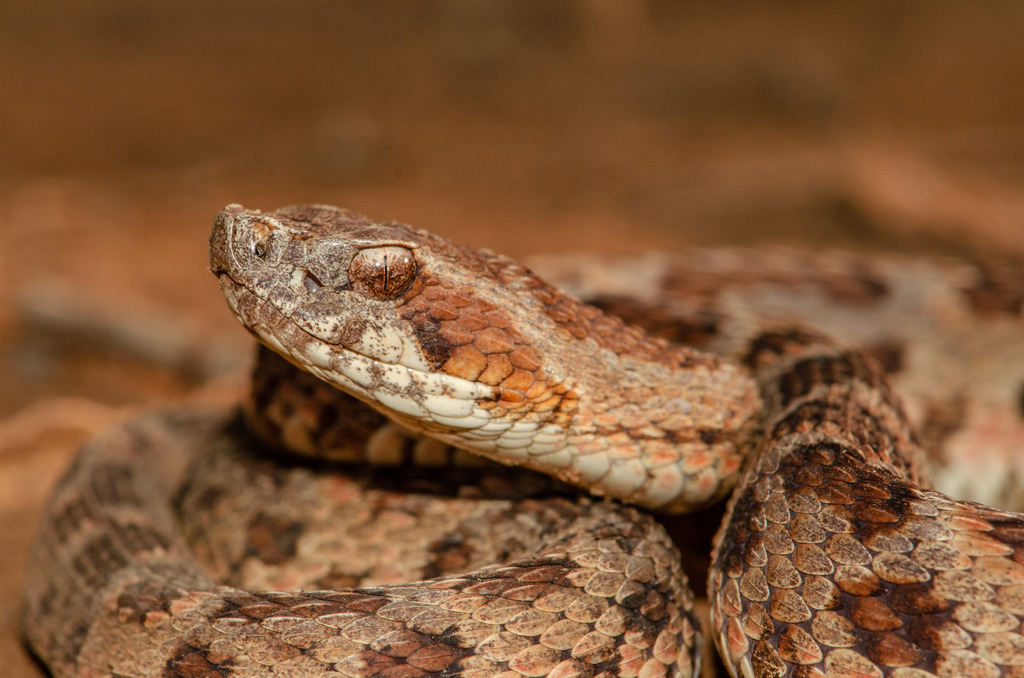
Caatinga Lancehead
Bothrops erythromelas
Bothrops erythromelas, commonly known as the Caatinga lancehead or the jararaca-da-seca, is a species of venomous snake in the family Viperidae. It is endemic to Brazil. It belongs to reptile class.
From the article Bothrops erythromelas on Wikipedia (CC BY-SA), quoted section by section
Description
Adults may attain a total length of 54 cm (21 in), which includes a tail 6.5 cm (2.6 in) long. Can grow to a maximum of about 0.85 m. Dorsally, B. erythromelas is reddish brown, with a double series of black or dark brown triangular markings, which may be alternating or opposite. The head is dark brown on the top and sides, with some darker markings. Ventrally, it is yellowish, speckled with brown, and with dark spots extending from the sides of the ventrals onto the first two dorsal rows. Eyes are moderately large in size, with vertically elliptical pupils. The strongly keeled dorsal scales are arranged in 21 rows at midbody. Ventrals 144–155; anal plate entire; subcaudals divided 33–35. It's mainly a terrestrial and nocturnal snake, but climb into low vegetation. Tend to hide its head when approached. Highly irascible, can strike violently with minimal provocation. Feeds mainly on rodents and lizards.
Range & habitat
It is found in the Brazilian states of Alagoas, Bahia, Ceará, Maranhão, Minas Gerais, Paraíba, Pernambuco, Piauí, Rio Grande do Norte, and Sergipe. The type locality is "near Juazeiro, State of Bahia, Brazil".
Wikipedia: “Geographic range”
In human culture
The specific name, erythromelas, is from the Ancient Greek words έρυθρός (érythrós), meaning "red", and μέλας (mélas), meaning "black", referring to this snake's coloration.
Wikipedia: “Etymology”
Where it lives
Recorded sightings
—
geo-referenced records in GBIF, from museums, herbaria and field observers.
Drag the globe to turn it. Dots are where records exist, not a range map; darker means more records.
In the stacks
Searching the stacks…
Every page naming Bothrops erythromelas in the Biodiversity Heritage Library →
This page is assembled live from iNaturalist, GBIF, Wikipedia, the Source Library and the Internet Archive. It is not yet part of the hand-edited codex. iNaturalist taxon 539413.