- Animals
- ›Chordates
- ›Vertebrates
- ›Reptiles
- ›Snakes and Lizards
- ›Lizards
- ›Iguanas and Allies
- ›Dragons and Chameleons
- ›Dragons
- ›Flying Dragons and Allies
- ›Calotes
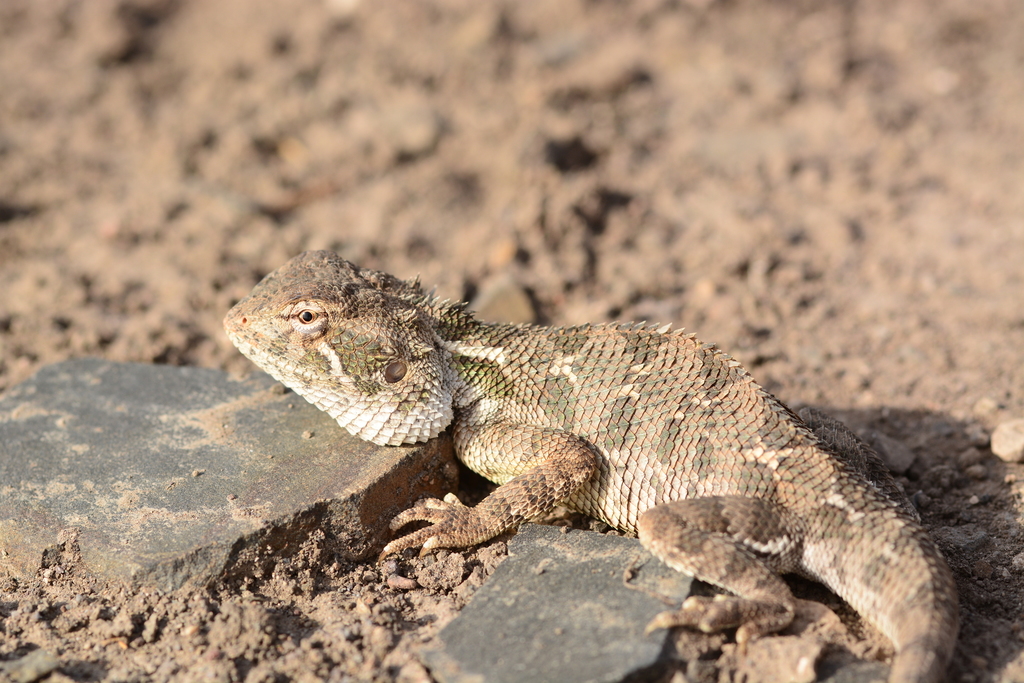
Hardwicke's Bloodsucker
Calotes minor
Hardwicke's bloodsucker (Calotes minor), also known commonly as the dwarf rock agama and the lesser agama, is a species of lizard in the subfamily Draconinae of the family Agamidae. The species is native to South Asia.
From the article Hardwicke's bloodsucker on Wikipedia (CC BY-SA), quoted section by section
Description
Physical structure: Calotes minor is a small stocky and pot-belly lizard with a short tail. Its head is large and elongated, flat above, and sloping towards the snout. The dorsal scales are large, strongly imbricate, and keeled, pointing backward and upward. The ventral scales are smaller than the dorsal scales. The upper head scales are large, unequal, and strongly keeled or tubercular. Females are larger than males. Color pattern: The dorsal color is olive brown with three rows of dark brown, light-edged spots on the body and the base of the tail. The spots of the middle row are most prominent and rhomboidal. On each side of the neck there is a white streak which is bifurcated posteriorly. Also, there is an oblique white streak from the eye to the corner of mouth. The limbs have dark brown crossbars. The throat is profusely spotted with dark brown and orange. The belly is yellowish white, with numerous orange dots. The olor inside the mouth is ink blue. Females are more brilliantly colored during the breeding season. Length: The maximum recorded total length (tail included) is 18 cm (7.1 in), but most specimens have a total length of about 10 cm (3.9 in) and a snout-to-vent length (SVL) of about 6 cm (2.4 in).
Wikipedia: “Morphology”
Range & habitat
Calotes minor is found in Bangladesh (southeast part of the country), India (Madhya Pradesh, Uttar Pradesh, Rajasthan, Gujarat, Odissa) and Pakistan (Sindh).
Wikipedia: “Geographic distribution”
What it does
Calotes minor is terrestrial, diurnal, and crepuscular. It shelters in burrows close to the roots of thorny bushes. Generally it is found sitting on stones, but it can climb up shrubby vegetation. It is sluggish in movements, often not attempting to escape when approached. It is a docile species.
Wikipedia: “Behavior”
In human culture
The specific name, minor, is a Latin word, meaning "less" or "smaller", referring to the smaller size of this agamid.
Wikipedia: “Etymology”
Where it lives
Recorded sightings
—
geo-referenced records in GBIF, from museums, herbaria and field observers.
Drag the globe to turn it. Dots are where records exist, not a range map; darker means more records.
In the stacks
Searching the stacks…
Every page naming Calotes minor in the Biodiversity Heritage Library →
This page is assembled live from iNaturalist, GBIF, Wikipedia, the Source Library and the Internet Archive. It is not yet part of the hand-edited codex. iNaturalist taxon 539437.