- Animals
- ›Chordates
- ›Vertebrates
- ›Birds
- ›Hawks, Eagles, Kites, and Allies
- ›Hawks, Eagles, and Kites
- ›Typical Hawks and Harriers
- ›Erythrotriorchis
On eBird ↗
Red Goshawk
Live sightings near you, the range map, bar charts of when it is seen, and Macaulay Library photos and recordings.
Red Goshawk
Erythrotriorchis radiatus
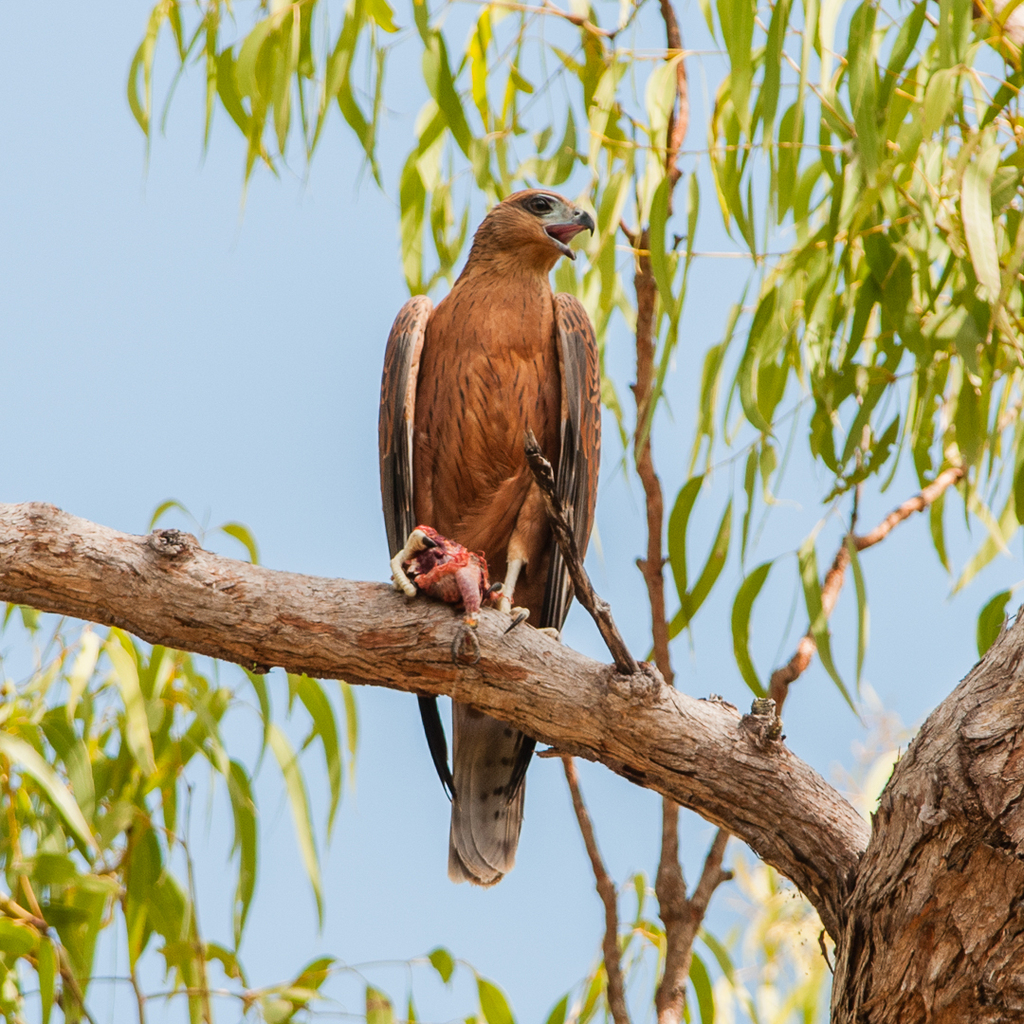
The red goshawk (Erythrotriorchis radiatus) is probably the rarest Australian bird of prey. It is found mainly in the savanna woodlands of northern Australia, particularly near watercourses. It takes a broad range of live prey, mostly birds.
From the article Red goshawk on Wikipedia (CC BY-SA), quoted section by section
Description
Plumage is generally rufous; on the head streaked with black and white, having more white on the face and throat; on the upper surfaces (body and upperwings) marked with black. Flight feathers and tail are barred grey, dark above and light below. Underside (belly and underwing coverts) are rufous with slight black ticking. The female has a paler belly than the male. Juveniles (first year) have less streaking on the head. Adults have yellow irides (brown to yellow in the male); juveniles brown. The cere and skin around the eye vary from pale-blue in the juvenile through pale blue-grey to pale-grey in the adult. Adults' legs and feet are yellow; juveniles are pale grey, cream, or pale yellow. Wings are long, broad and fingered at the tips. Its long wings are unlike the short wings of the Accipiter goshawks. Its tail is long and broad; square-tipped and about half its total length. It has a robust bill, slight brow ridge, and very heavy feet with bare tarsi having scutellate scale pattern. Pattern of direct flight is described as "sometimes leisurely, rather heavy and crow-like, with sustained flapping". Pursuit is "powerful and energetic with deep, fluid wing beats, like a fast-flying Brown Falcon". It soars with wings raised in a slight dihedral, almost flat; glides with wings flat or slightly bowed; and sometimes stoops with closed wings. …
Range & habitat
Sites identified by BirdLife International as being important for red goshawk conservation are Lilyvale in Far North Queensland, Kakadu Savanna and the Tiwi Islands in the Northern Territory, and Mornington Sanctuary in the Kimberley region of Western Australia.
Wikipedia: “Distribution and habitat”
What it does
Red goshawks eat mostly birds, especially parrots and pigeons; rarely they also prey on mammals, reptiles, and large insects. Early and late in the day, they hunt from concealed perches in the trees. In the middle of the day, they use long transects, quartering through or above the canopy, or search from a high soaring position. They attack by a stealthy glide, direct chase, or may stoop from a height.
Wikipedia: “Diet”
Listen
Looking for field recordings…
Where it lives
Recorded sightings
—
geo-referenced records in GBIF, from museums, herbaria and field observers.
Drag the globe to turn it. Dots are where records exist, not a range map; darker means more records.
In the stacks
Searching the stacks…
Every page naming Erythrotriorchis radiatus in the Biodiversity Heritage Library →
This page is assembled live from iNaturalist, GBIF, Wikipedia, the Source Library and the Internet Archive. It is not yet part of the hand-edited codex. iNaturalist taxon 5396.