- Animals
- ›Chordates
- ›Vertebrates
- ›Reptiles
- ›Snakes and Lizards
- ›Snakes
- ›Blind snakes
- ›Threadsnakes
- ›Epictinae
- ›Epictia
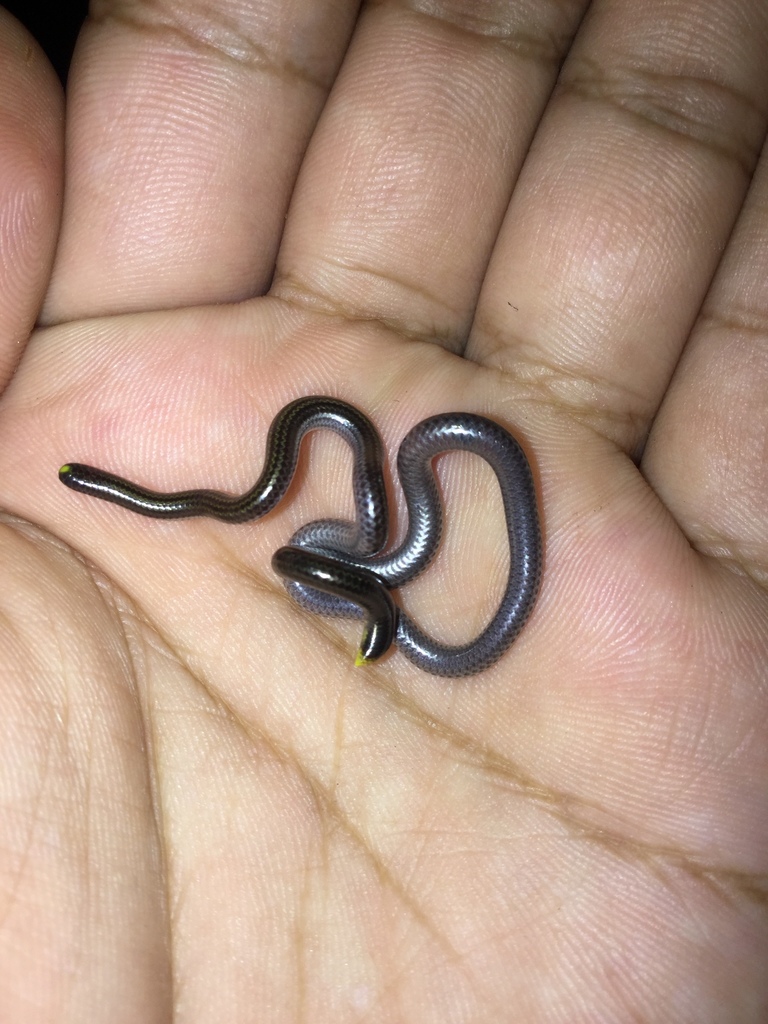
Vindum's Worm Snake
Epictia vindumi
Epictia vindumi, or Vindum's worm snake, is a member of the family Leptotyphlopidae, whose species, as well as worm snakes, often are called slender blind snakes or thread snakes.
From the article Epictia vindumi on Wikipedia (CC BY-SA), quoted section by section
Description
As with most Epictia species, Epictia vindumi looks like a worm. The species is brown with yellowish stripes running its length, with a small yellow spot at the body's front end. The head is slightly wider than the neck. The snake's scale arrangement formula, often used by herpetologists to identify species, is 14–14–14, meaning that there are 14 rows of scales at the neck, 14 rows at the body's middle, and 14 rows at the tail area before the cloaca. To distinguish the species from similar ones, much more technical details must be noticed.
Range & habitat
Epictia vindumi is endemic just to the northern portion of Mexico's Yucatan Peninsula, in the states of Yucatán and Quintana Roo, at elevations of up to about 30 meters (~100 feet).
Wikipedia: “Distribution”
In human culture
The genus name Epictia was first published by John Edward Gray in 1845. However, in that publication he doesn't explain the name's origin. The species name vendumi honors Jens Vindum, Senior Collection Manager, Department of Herpetology, California Academy of Sciences, and commemorates his 35 years of service to the museum.
== References ==
Wikipedia: “Etymology”
Where it lives
Recorded sightings
—
geo-referenced records in GBIF, from museums, herbaria and field observers.
Drag the globe to turn it. Dots are where records exist, not a range map; darker means more records.
In the stacks
Searching the stacks…
Every page naming Epictia vindumi in the Biodiversity Heritage Library →
This page is assembled live from iNaturalist, GBIF, Wikipedia, the Source Library and the Internet Archive. It is not yet part of the hand-edited codex. iNaturalist taxon 539662.