- Animals
- ›Chordates
- ›Vertebrates
- ›Reptiles
- ›Snakes and Lizards
- ›Snakes
- ›Colubrid Snakes
- ›Dipsadine Snakes
- ›Erythrolamprus
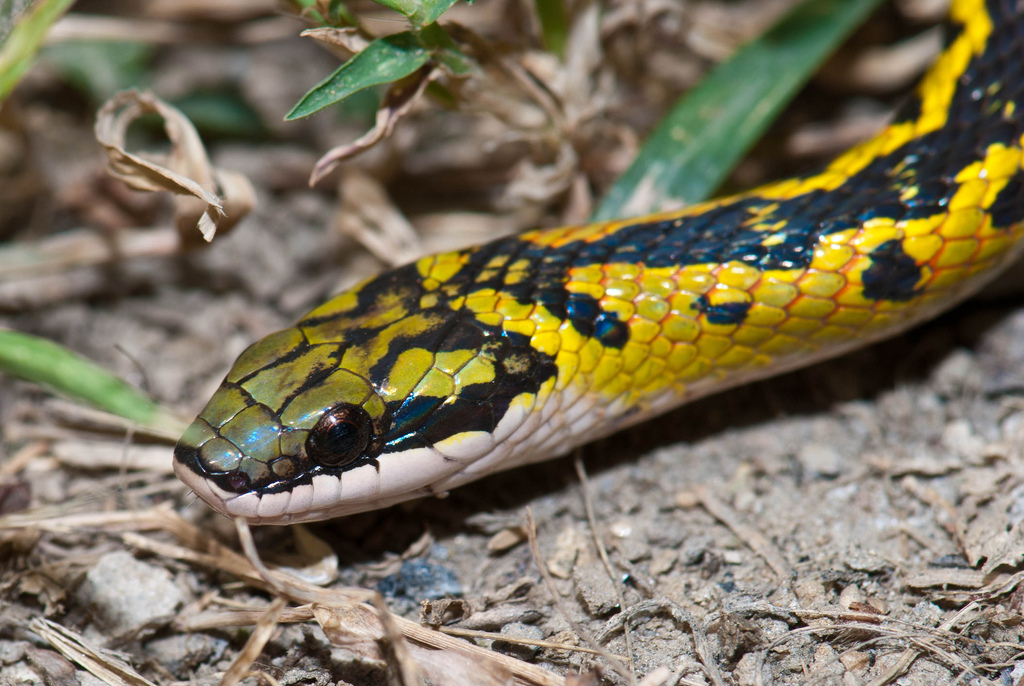
Black-backed Snake
Erythrolamprus melanotus
Shaw's dark ground snake (Erythrolamprus melanotus), also known commonly as Shaw's black-backed snake, and in Spanish as candelilla, guarda caminos, and reinita cazadora, is a species of snake in the subfamily Dipsadinae of the family Colubridae. The species is native to northern South America.
From the article Shaw's dark ground snake on Wikipedia (CC BY-SA), quoted section by section
Description
Erythrolamprus melanotus grows to a total length (tail included) of 43 cm (17 in). Dorsally, it has a light yellow or pinkish color, with a wide, dark vertebral stripe, which is bordered on each side by a thin whitish stripe, followed by a thin dark stripe. The top of the head is olive, and there is a dark stripe passing through the eye. The upper labials and the venter (underside) of the snake are whitish. The dorsal scales are smooth, with apical pits, and are arranged in 17 rows at midbody.
Range & habitat
The geographic distribution of Erythrolamprus melanotus includes Colombia, Venezuela, and Trinidad and Tobago. It is probably extirpated from Grenada.
Wikipedia: “Geographic range”
What it does
Erythrolamprus melanotus is diurnal, hunting during the day along the forest floor, where it feeds on spectacled lizards in the genus Bachia, the rain frog Pristimantis urichi, the puddle frog Engystomops pustulosus, the gecko Gonatodes vittatus, and various unidentified fish.
Wikipedia: “Behavior and diet”
In human culture
The English common names for Erythrolamprus melanotus refer to English biologist George Kearsley Shaw, who described and named this snake as a species new to science in 1802.
Wikipedia: “Etymology”
Where it lives
Recorded sightings
—
geo-referenced records in GBIF, from museums, herbaria and field observers.
Drag the globe to turn it. Dots are where records exist, not a range map; darker means more records.
In the stacks
Searching the stacks…
Every page naming Erythrolamprus melanotus in the Biodiversity Heritage Library →
This page is assembled live from iNaturalist, GBIF, Wikipedia, the Source Library and the Internet Archive. It is not yet part of the hand-edited codex. iNaturalist taxon 539688.