- Animals
- ›Chordates
- ›Vertebrates
- ›Birds
- ›Hawks, Eagles, Kites, and Allies
- ›Hawks, Eagles, and Kites
- ›Typical Old World Vultures
- ›Torgos
On eBird ↗
Lappet-faced Vulture
Live sightings near you, the range map, bar charts of when it is seen, and Macaulay Library photos and recordings.
Lappet-faced Vulture
Torgos tracheliotos
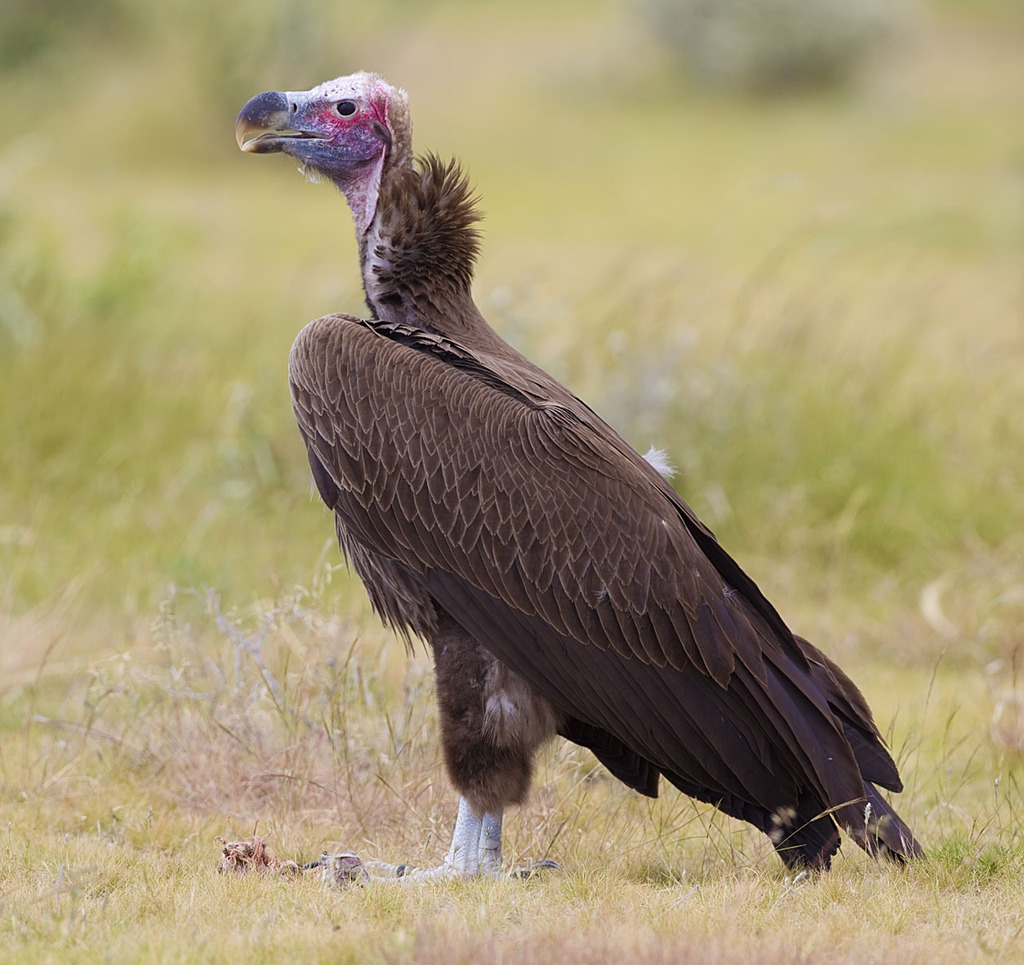
The lappet-faced vulture or Nubian vulture (Torgos tracheliotos) is an Old World vulture belonging to the bird order Accipitriformes, which also includes eagles, kites, buzzards and hawks. It is the only extant member of the genus Torgos. It is not closely related to the superficially similar New World vultures, and does not share the good sense of smell of some members of that family of birds.
The lappet-faced vulture was formerly considered monotypical, but now is separated into two subspecies. The nominate race lives throughout Africa. The subspecies T. t. negevensis, differing considerably in appearance from African vultures (as described below), is endemic to the Arabian Peninsula.
From the article Lappet-faced vulture on Wikipedia (CC BY-SA), quoted section by section
Description
The lappet-faced vulture is a very large species, ranking as the longest and largest winged vulture in its range, behind the closely related cinereous vulture, although some co-occurring Gyps vultures tend to be heavier on average, especially the Cape vulture and Eurasian griffon. This species measures around 95–115 cm (37–45 in) in body length, with a wingspan of 2.5–2.9 m (8.2–9.5 ft). Among the standard measurements, the wing chord is 71.5–82.5 cm (28.1–32.5 in), the tail is 33–36 cm (13–14 in) and the tarsus is 12.2–15 cm (4.8–5.9 in). The bill, at up to 10 cm (3.9 in) long and 5 cm (2.0 in) deep, ranks as one of the largest of any accipitrid, although a reported culmen length of 7.2 cm (2.8 in) is slightly less than the culmen length of the cinereous vulture. Wild vultures of the subspecies T. t. tracheliotus range from 4.4 to 9.4 kg (9.7 to 20.7 lb) and in East Africa, average only 6.2 kg (14 lb). On the other hand, captive vultures of the larger T. t. negevensis subspecies weighed 6.5–9.2 kg (14–20 lb) in males and 10.5–13.6 kg (23–30 lb) in females.
Overall, the lappet-faced vulture is blackish above with a strongly contrasting white thigh feathers. The black feathers on the back of African vultures are lined with brown, while Arabian birds are dark brown rather than black above. The underside can range from pure white to buff-brown. …
Range & habitat
This species is patchily distributed through much of Africa and the Arabian Peninsula, though it is absent from much of the central and western parts of the continent and declining elsewhere in its range. The lappet-faced vulture breeds in Senegal, Mali, Mauritania, Burkina Faso, Niger, Chad, Sudan, Egypt, Ethiopia, Somalia, Kenya, Tanzania, Uganda, Rwanda, the Democratic Republic of the Congo, Zambia, Malawi, Mozambique, Eswatini, South Africa, Zimbabwe, Botswana and Namibia. On the Arabian Peninsula, it breeds in Yemen, Oman, the United Arab Emirates and Saudi Arabia. It is also present in Gambia, Guinea, Ivory Coast, Benin, the Central African Republic and Angola, as well as a single vagrant record in Kuwait.
Wikipedia: “Distribution”
What it does
The lappet-faced vulture is a scavenging bird, feeding mostly from animal carcasses, which it finds by sight or by watching other vultures. More so than many African vultures, they often find carrion on their own and start tearing through the skin. They are the most powerful and aggressive of the African vultures, and other vultures will usually cede a carcass to the lappet-faced vulture if it decides to assert itself. This is often beneficial to the less powerful vultures because the Lappet-face can tear through the tough hides and knotty muscles of large mammals that the others cannot penetrate. However hyenas are even more efficient in this regard (if more voracious eaters). However, lappet-faced vultures frequently hang around the edges of the throngs at large carcasses, waiting until the other vultures are done, to feed on remnant skin, tendons, and other coarse tissues that the others will not eat. Big game animals, up to the size of elephants, are preferred as carrion since they provide the most subsistence at a sitting. A full crop can contain up to 1.5 kg (3.3 lb) of meat. Perhaps more than any other true vulture, lappet-faced vultures have been recorded as regularly feeding on freshly killed smaller mammals, birds, and reptiles. …
Wikipedia: “Feeding”
In human culture
Lappet-faced vultures are generally solitary birds. They do not nest in cohesive colonies as do many smaller vultures, with one tree or area usually only having one to two nests in it, though rarely up to 10 nests have been recorded in one area. The home range of a lappet-faced vulture is usually at least 8 to 15 km (5.0 to 9.3 mi). Groups of up to 25 to 50 Lappet-faces may congregate at large carcasses or watering holes, though typically only from one to as many as seven turn up per carcass. This species nests in November through July in the north of its range, throughout the year in eastern Africa and May to January in southern Africa. The huge nest, a pile of neatly formed sticks, measures 120–220 cm (47–87 in) across and 30–70 cm (12–28 in) deep. The nest is often lined with green leaves, as well as animal hair and skins. Nests are almost always placed in the main fork or top of an Acacia tree, though Balanites and Terminalia trees are sometimes also used, at 5 to 15 m (16 to 49 ft) off the ground. The clutch contains one or two eggs, which are incubated by both parents over the course of 54 to 56 days. The young fledge at 124 to 135 days old, although can be dependent on their parents for up to an age of 1 year or more, sometimes forcing parents to only nest in alternate years. …
Wikipedia: “Life history”
Listen
Looking for field recordings…
Where it lives
Recorded sightings
—
geo-referenced records in GBIF, from museums, herbaria and field observers.
Drag the globe to turn it. Dots are where records exist, not a range map; darker means more records.
In the stacks
Searching the stacks…
Every page naming Torgos tracheliotos in the Biodiversity Heritage Library →
This page is assembled live from iNaturalist, GBIF, Wikipedia, the Source Library and the Internet Archive. It is not yet part of the hand-edited codex. iNaturalist taxon 5401.