- Animals
- ›Chordates
- ›Vertebrates
- ›Birds
- ›Hawks, Eagles, Kites, and Allies
- ›Hawks, Eagles, and Kites
- ›Buteonine Hawks, Kites, and allies
- ›Ictinia
On eBird ↗
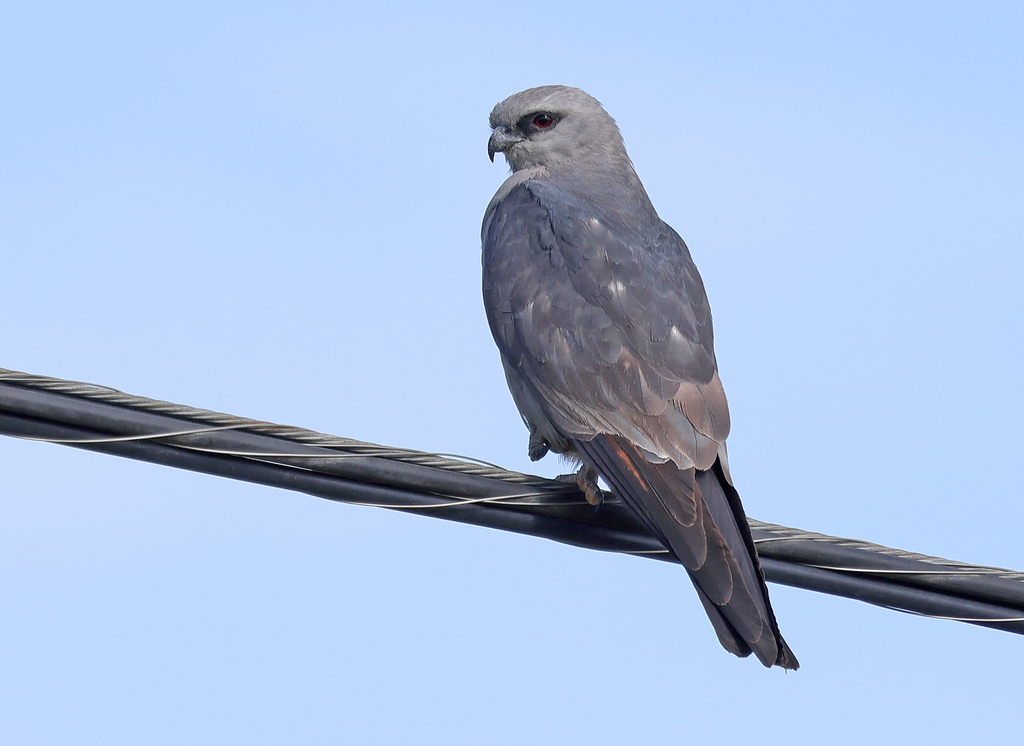
Mississippi Kite
Live sightings near you, the range map, bar charts of when it is seen, and Macaulay Library photos and recordings.
Mississippi Kite
Ictinia mississippiensis
The Mississippi kite (Ictinia mississippiensis) is a small bird of prey in the family Accipitridae. Mississippi kites have narrow, pointed wings and are graceful in flight, often appearing to float in the air. It is not uncommon to see several circling in the same area.
From the article Mississippi kite on Wikipedia (CC BY-SA), quoted section by section
Range & habitat
The summer breeding territory of the Mississippi kite is in the Central and Southern United States; the southern Great Plains is considered a stronghold for the species. Sightings are frequently documented across many states, including Florida, Kansas, Louisiana, Missouri, Oklahoma, Tennessee, Texas and Virginia. Breeding territories have seemingly expanded during the early 21st century, with the kites having been regularly recorded from Southern California to the southern reaches of New England; in 2008, a pair successfully bred and raised chicks near Newmarket, New Hampshire. The year prior, another pair was observed breeding in Ohio, in 2007. The species has also been documented as far north as Canso, Nova Scotia. Indeed, the species' territory has expanded west due to the creation of shelterbelts (similar to hedgerows), usually planted in grassland habitats, providing shelter and food for numerous birds. This Mississippi kite migrates to subtropical and temperate regions of South America for the winter, mostly to northern Argentina and southern Brazil. They are also known from Belize, Costa Rica, El Salvador, México, and Panamá. Migration normally occurs in groups of 20 to 30 birds. However, there are exceptions, as mixed flocks may occur; groups of up to 10,000 birds at one time may be observed, such as at Fuerte Esperanza, Argentina.
Wikipedia: “Range and migration”
What it does
The diet of the Mississippi kite consists mostly of larger-bodied invertebrates and insects (which they capture in-flight), seasonally feeding on a variety of cicadas, crickets, grasshoppers and locusts and other crop-damaging insects, making them agriculturally and economically beneficial for humans. As with most raptors, the Mississippi kite is an opportunistic hunter, and has also been known to capture small vertebrates, including passerine birds, amphibians, reptiles, and small mammals. They will usually hunt from a low perch before pursuing prey, consuming it in-flight upon capture. They will often patrol around herds of livestock to catch insects stirred-up from the ground.
Wikipedia: “Food and feeding”
Listen
Looking for field recordings…
Where it lives
Recorded sightings
—
geo-referenced records in GBIF, from museums, herbaria and field observers.
Drag the globe to turn it. Dots are where records exist, not a range map; darker means more records.
In the stacks
Searching the stacks…
Every page naming Ictinia mississippiensis in the Biodiversity Heritage Library →
This page is assembled live from iNaturalist, GBIF, Wikipedia, the Source Library and the Internet Archive. It is not yet part of the hand-edited codex. iNaturalist taxon 5416.