- Animals
- ›Chordates
- ›Vertebrates
- ›Birds
- ›Hawks, Eagles, Kites, and Allies
- ›Hawks, Eagles, and Kites
- ›Typical Old World Vultures
- ›Sarcogyps
On eBird ↗
Red-headed Vulture
Live sightings near you, the range map, bar charts of when it is seen, and Macaulay Library photos and recordings.
Red-headed Vulture
Sarcogyps calvus
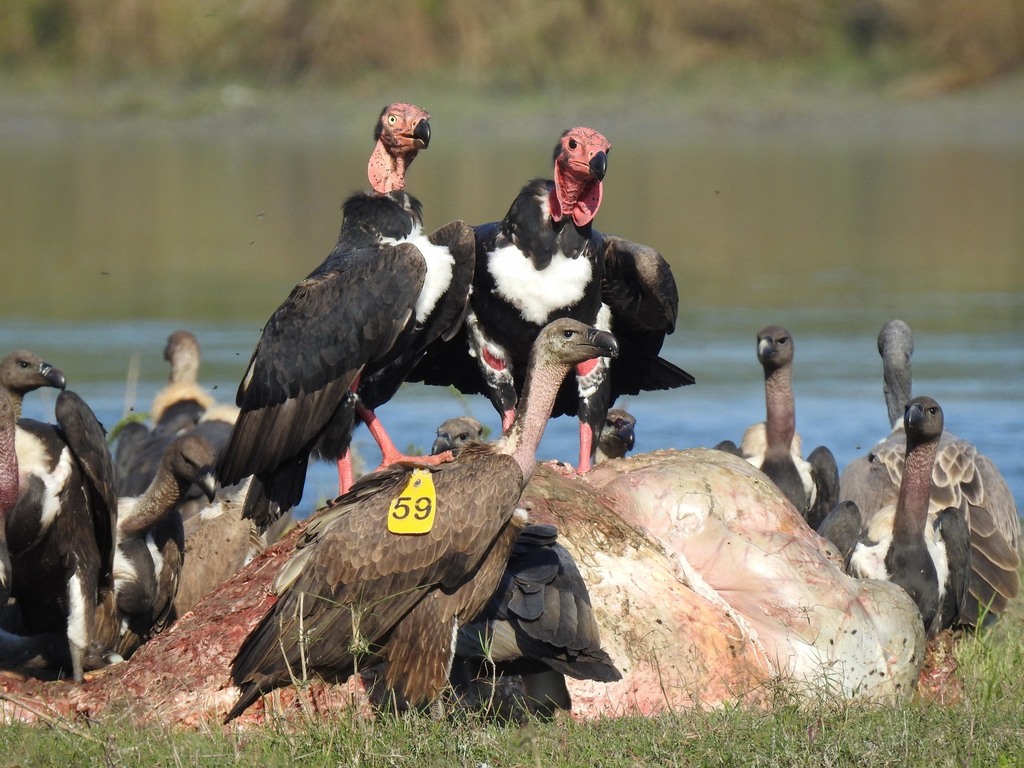
The red-headed vulture (Sarcogyps calvus), also known as the Asian king vulture, Indian black vulture or Pondicherry vulture, is an Old World vulture mainly found in the Indian subcontinent, with small disjunct populations in some parts of Southeast Asia.
From the article Red-headed vulture on Wikipedia (CC BY-SA), quoted section by section
Description
It is a medium-sized vulture of 76 to 86 cm (30 to 34 in) in length, weighing 3.5–6.3 kg (7.7–13.9 lb) and having a wingspan of about 1.99–2.6 m (6.5–8.5 ft). It has a prominent naked head: deep-red to orange in the adult, paler red in the juvenile. It has a black body with pale grey band at the base of the flight feathers. The sexes differ in colour of the iris: males have a paler, whitish iris, whilst in females it is dark brown.
The red-headed vulture is very similar in appearance to its larger relative the lappet-faced vulture in Africa and Arabia, even being historically placed in the genus Torgos
Range & habitat
This gaudy-faced vulture was historically abundant, range widely across the Indian subcontinent, and also eastwards to south-central and south-eastern Asia, extending from India to Singapore. Today the range of the red-headed vulture is localized primarily to northern India. It is usually in open country and in cultivated and semi-desert areas. It is also found in deciduous forests and foothills and river valleys. It is usually found up to an altitude of 3000m from sea level.
Wikipedia: “Distribution and habitat”
In medicine
A significant factor in the rapid decline of red-headed vulture populations since the 21st century is the pharmaceutical NSAID diclofenac, used to treat livestock. This substance has proven highly toxic to vultures, leading to mortality from renal failure and visceral gout. Recent findings indicate that red-headed vulture populations in India have shown signs of recovery following a ban on diclofenac, suggesting the drug's adverse effects on the species.
Wikipedia: “Pharmaceutical toxins and diclofenac”
Listen
Looking for field recordings…
Where it lives
Recorded sightings
—
geo-referenced records in GBIF, from museums, herbaria and field observers.
Drag the globe to turn it. Dots are where records exist, not a range map; darker means more records.
In the stacks
Searching the stacks…
Every page naming Sarcogyps calvus in the Biodiversity Heritage Library →
This page is assembled live from iNaturalist, GBIF, Wikipedia, the Source Library and the Internet Archive. It is not yet part of the hand-edited codex. iNaturalist taxon 5420.