On eBird ↗
Southern Yellow-billed Hornbill
Live sightings near you, the range map, bar charts of when it is seen, and Macaulay Library photos and recordings.
Southern Yellow-billed Hornbill
Tockus leucomelas
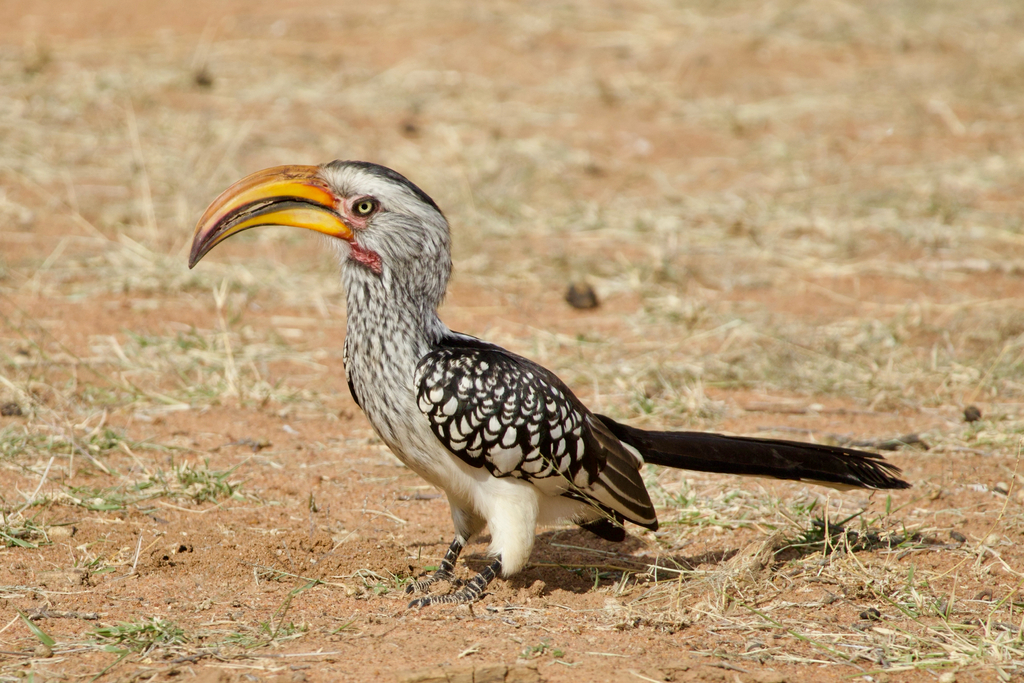
The southern yellow-billed hornbill (Tockus leucomelas) is a hornbill found in southern Africa. Yellow-billed hornbills feed mainly on the ground, where they forage for seeds, small insects, spiders and scorpions. This hornbill species is a common and widespread resident of dry thornveldt and broad-leafed woodlands. They can often be seen along roads and water courses.
From the article Southern yellow-billed hornbill on Wikipedia (CC BY-SA), quoted section by section
Description
It is a medium-sized bird, 48–60 cm (19–24 in) in length, 132–242 g (0.29–0.53 lb) in weight and is characterized by a long yellow and down-curved beak. This beak is huge in comparison to its body and can account for up 1/6th of the entire body length. Male beaks are on average 90 mm long while female beaks are an average of 74 mm. Males are generally bigger than females but there is overlap between the sexes. The size difference of the beak is a fairly reliable way of differentiating sex in wild hornbills. The casque that characterizes all hornbills is of a very modest size in the southern yellow-billed hornbill. It is small, but it covers almost the entire length of the beak in males (less so in females), and may give the impression that they do not actually have a casque. As in all hornbills, the size of the beak actually intrudes on the frontal vision of the bird and the first two neck vertebrae are fused together. Also, like most other hornbills, they possess a long tail, long eyelashes, stubby legs and stubby toes. The front three toes are fused together near the base. They have white belly, grey neck, and black back plumage with abundant white spots and stripes. The neck has gray spots and the chest is lightly striated with black. Southern yellow-billed hornbills have no plumage pigmentation save for melanin, which can only produce shades of black and white. …
Range & habitat
These birds are near endemic to the dry savannas of southern Africa, where they can be found across all longitudes, from Angola and Namibia in the west to Mozambique and KwaZulu-Natal in the east, including Botswana, Zimbabwe and northern South Africa. The southern yellow-billed hornbill lives mostly in the dry, open savannas, but they are also very partial to woodlands when they can find them. When in woodlands, they seem to prefer acacia and broadleaved woodlands. The highest reported concentration of southern yellow-billed hornbill is in open mopane scrub.
Wikipedia: “Distribution and habitat”
What it does
The southern yellow-billed hornbill is active during morning, day and evening. At night, it will sleep high in a tree so it won't be preyed on. They can be found alone, in couples or in small groups. They generally tend to be loners unless it is breeding season, nesting season or if there is local migration during dry season. The southern yellow-billed hornbill is often seen searching for food on the ground or in shrubs. It will not dig the ground, but it will overturn debris to find insects. It can also be seen pursuing insects by hopping heavily after it. They are generally sedentary and they will defend their territories with elaborate displays. However, during the dry season, they will sometimes range widely in order to find food. Couples are usually monogamous and have a clear division of labour between males and females. They have been known to live for up to 20 years in captivity, though their longevity in the wild remains unknown.
Wikipedia: “Behaviour”
Listen
Looking for field recordings…
Where it lives
Recorded sightings
—
geo-referenced records in GBIF, from museums, herbaria and field observers.
Drag the globe to turn it. Dots are where records exist, not a range map; darker means more records.
In the stacks
Searching the stacks…
Every page naming Tockus leucomelas in the Biodiversity Heritage Library →
This page is assembled live from iNaturalist, GBIF, Wikipedia, the Source Library and the Internet Archive. It is not yet part of the hand-edited codex. iNaturalist taxon 5479.