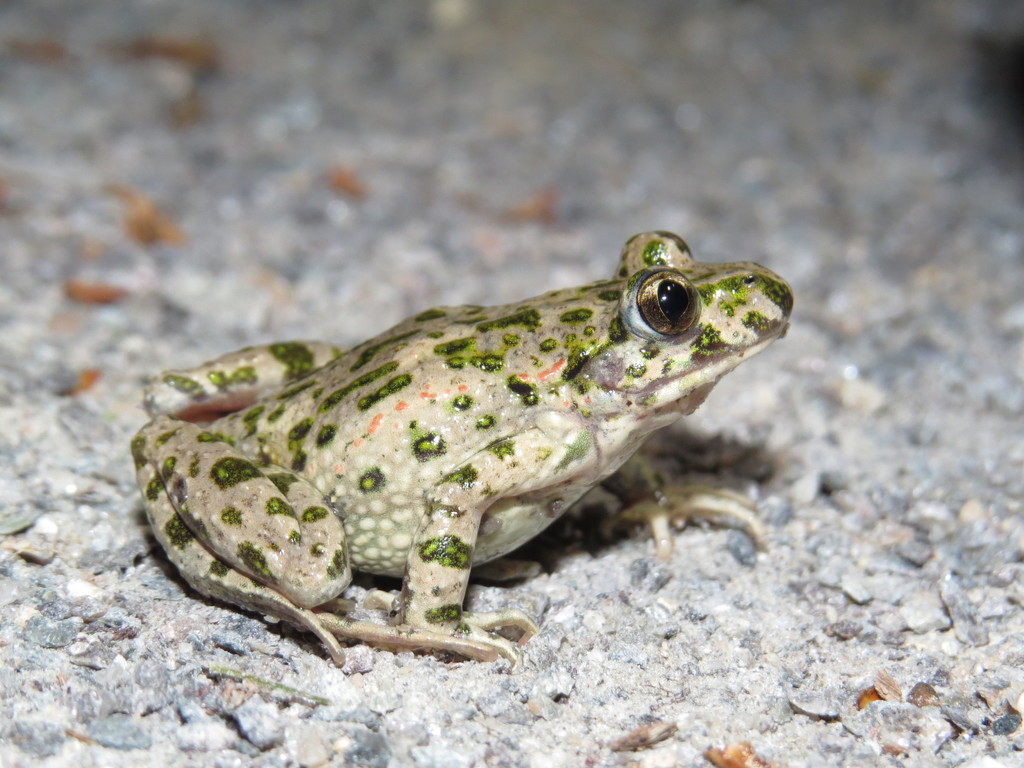
Common Parsley Frog
Pelodytes punctatus
The common parsley frog (Pelodytes punctatus) is a very small and slender frog with long hindlegs, flat head and vertical pupils. Males reach only 3.5, females 4.5 centimetres. The upper side of the body is variable in colour, usually with irregular green patches on a light brown, grey or light olive background. The frog's back is dotted with elongated warts, often in undulating longitudinal rows that can be orange along the flanks. Behind the protruding eyes...
From the article Common parsley frog on Wikipedia (CC BY-SA), quoted section by section
Description
The common parsley frog (Pelodytes punctatus) is a very small and slender frog with long hind legs, a flat head, and vertical pupils. Males tend to only reach 3.5 cm (1.4 in), whereas females are typically larger at 3.9 cm (1.5 in). The upper part of the body is variable in colour, usually with irregular green patches on a light brown, grey, or light olive background. The frog's back is dotted with elongated warts, often in undulating longitudinal rows that may be orange along the flanks. Behind the protruding eyes and above the tympanum there is a short small gland. It does not have parotid glands. The underside of the frog is white and yellow-orange around the pelvis. They are fossorial, meaning they can live underground with limbs suited for burying and digging. In the mating season, males develop dark swellings on the insides of their digits and forelimbs, as well as on the chest. The males' forelimbs are usually stronger than the females. They are not completely cryptic like many other species of frog, but are still camouflaged in their environments. They can jump 50–70 cm (19.5–27.5 in) in a single leap, and they are referred to as the "Mud-Jumper", or "Modderkruiper" in Germany, for this ability.
Range & habitat
These frogs can be found in France, Northeastern Spain and a small part of Northwestern Italy (southern Piedmont and Liguria, specifically). Their numbers are decreasing all over the distribution range due to habitat changes that eliminate their breeding sites. They are also threatened and more at-risk in southern Spain and northern Portugal. The current situation of the genus is under discussion and there is disagreement regarding the taxonomy due to the separation of the lineages, especially in the different contact zones within the Iberian Peninsula. The habitats of the frogs reach from sea level to middle mountainous regions as high as 1,630–2,000 meters (5,350–6,560 feet) above sea level. Though they can live comfortably in that range, they prefer to breed at lower elevations of around 60–460 meters (200–1,510 feet) above sea level. The parsley frog's habits differ from one ecological niche to another since they are heavily weather-dependent. Because of their diverse range and flexibility in egg-laying and mating habits, different local parsley frogs may not have the same date range as another frog of the same species that lives somewhere with a different weather pattern.
Wikipedia: “Habitat and distribution”
What it does
Pelodytes punctatus breed on a temporal schedule. They can breed twice a year, once in the autumn and once in the spring, and having two separate mating seasons is of evolutionary benefit as this increases their numbers of offspring. The flexibility in breeding patterns allows them to better adapt to differences in their environment. However, the ponds in which they breed are not necessarily the ponds that they go on to live in as adults. There are three models of breeding, the opportunity, contingent, and bet-hedging model. In the opportunity model, the frogs may reproduce in the spring and autumn months of a given year. In the contingent model, frogs will select a season to reproduce and stick with it year after year, even if it was not the season they were born in. In the bet-hedging model, they switch back and forth between autumn and spring breeding throughout their lives and several breeding seasons, depending on the environment and their own fitness at the time. In France, the breeding season spans from the end of February to early April; in Portugal, it is from November to March. In Andalusia, this parsley frog may spawn several times a year, and the bimodal mating can be seen in various other habitats as well. Parsley frogs generally tend to lay eggs following intense rainfall. …
Wikipedia: “Mating and behavior”
Listen
Looking for field recordings…
Where it lives
Recorded sightings
—
geo-referenced records in GBIF, from museums, herbaria and field observers.
Drag the globe to turn it. Dots are where records exist, not a range map; darker means more records.
In the stacks
Searching the stacks…
Every page naming Pelodytes punctatus in the Biodiversity Heritage Library →
This page is assembled live from iNaturalist, GBIF, Wikipedia, the Source Library and the Internet Archive. It is not yet part of the hand-edited codex. iNaturalist taxon 548418.