On eBird ↗
Rufous Hornbill
Live sightings near you, the range map, bar charts of when it is seen, and Macaulay Library photos and recordings.
Rufous Hornbill
Buceros hydrocorax
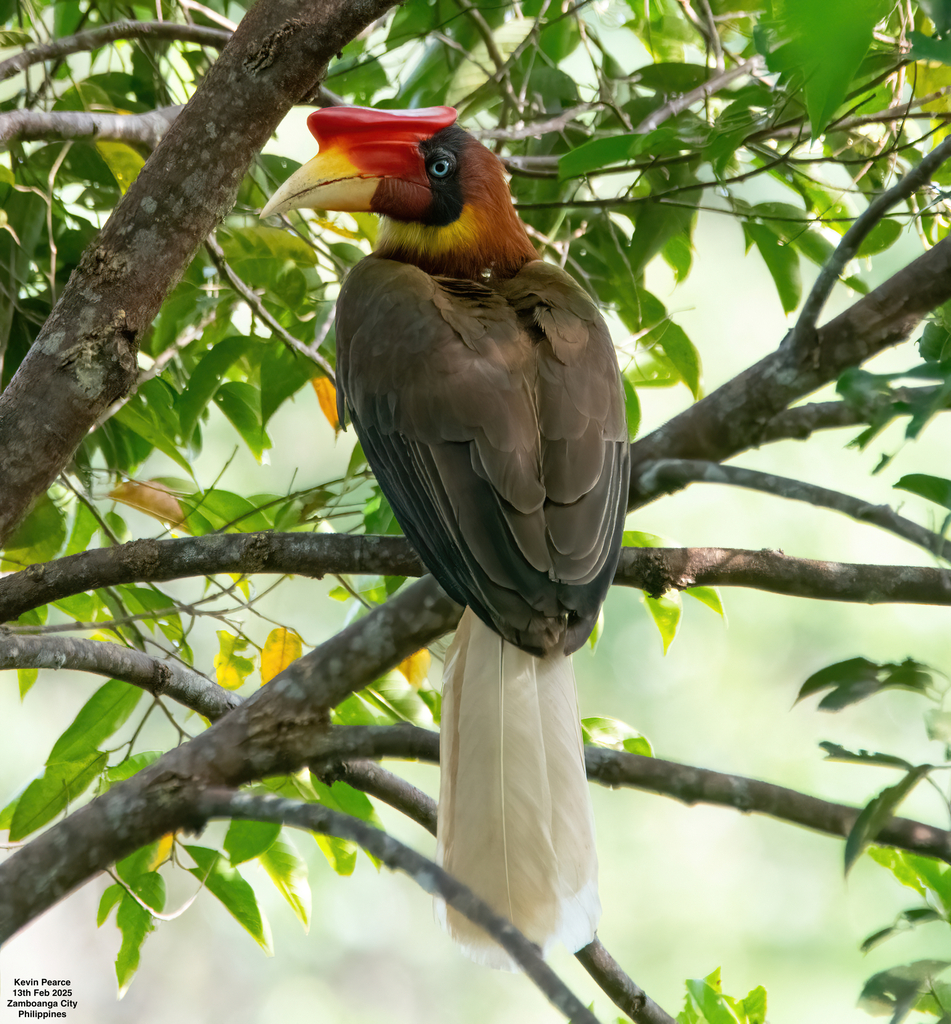
The rufous hornbill (Buceros hydrocorax), also known as the Philippine hornbill and locally as kalaw (pronounced KAH-lau), is a large species of hornbill endemic to the Philippines (the largest hornbill in the country). It is called the "clock-of-the-mountains" by locals, because of its loud booming call which typically occurs every hour. Rufous hornbills inhabit moist tropical lowland forest areas, and are now regarded as a threatened species. Reasons for decline include habitat destruction, hunting and poaching for the illegal pet trade.
It is illegal to hunt, capture or possess rufous hornbills under Philippine Law RA 9147.
From the article Rufous hornbill on Wikipedia (CC BY-SA), quoted section by section
Description
The bird is endemic to the Philippines, where it occurs in primary, mature secondary, and disturbed forests, and is found across majority of the country except the regions of Mimaropa, Sulu and Western Visayas. Its described as a large bird with a dark body, rufous legs, chest and neck, an off-white tail and a black fack faced and a yellow thorat. The bill of the nominate subspecies is entirely red, while the bill of the subspecies semigaleatus and mindanensis are pale yellow on the distal half. Birds are sexually dimorphic in which females have striking electric blue eyes, a smaller casque and no eye ring while males have yellow eyes and a larger casque. Its striking red bill is caused by the oxidation of oils produced by the uropygial gland.
Subspecies. Three subspecies are recognized:
B. h. hydrocorax – Linnaeus, 1766: Luzon and Marinduque, Larger with an all red bill, large casque Now extinct on Marinduque; B. h. semigaelatus – Tweeddale, 1878: Samar, Leyte, Bohol, Panaon, Biliran, Calicoan and Buad; Yellow front half of beak; flatter top of head with the casque (horn) smaller and merges into the maxilla; B. h. …
Wikipedia: “Description and taxonomy”
Range & habitat
This species occurs largely in primary evergreen dipterocarp forests, but also uses secondary forest. The Northern rufous hornbill has recorded up to 760 meters in Luzon while its southern counterpart has been recorded up to 2,100 meters above sea level on Mt. Apo. This species has been classified as vulnerable. It is believed that the North Rufous Hornbill is more threatened as the National List of Threatened Terrestrial Fauna of the Philippines has classified it and Endangered while classifying the southern species or sub-species as Vulnerable. This species suffers from substantial hunting pressure and widespread loss of habitat as a result of logging and conversion to agriculture. Continued subsistence hunting and felling of remnant dipterocarp forests for agriculture are thought to be further depressing population numbers, and the range is now highly fragmented and likely suffering from an acute lack of suitable nesting trees, at least in parts of the range. Hunters climb up nesting trees to capture the mother and its chicks for the illegal wildlife trade. Hunting for sport and food has been recorded throughout its range. The Northern rufous hornbill occurs in a few protected areas such as Quezon Protected Landscape, Bataan National Park, Northern Sierra Madre Natural Park, Aurora Memorial National Park and Kalbario–Patapat Natural Park. …
Wikipedia: “Habitat and conservation status”
What it does
It is sometimes called "the clock of the mountains" because of its periodic noontime call which can be heard up to 1.5 kilometers away. Due to its large size, its wings make a distinct whirring sound in flight. It has been recorded to have been preyed upon by the Philippine eagle. Seen in flocks of up to 12 birds, the Southern rufous hornbill is occasionally seen with Writhed hornbills forming flocks of up to 20.
Feeding. Rufous Hornbills play a crucial role in maintaining the balance of their ecosystem. They are considered a keystone species due to their omnivorous feeding habits, which allow them to disperse seeds along the forest floor from the fruits they consume and control pest populations of insects they predate on.
Breeding. Recorded to lay eggs from March to May but juveniles have been seen as late as November in Luzon. It nests in cavities of large dipterocarp trees 15 to 30 meters above the ground.
As with other hornbills, females seal themselves within the nest cavity, where they lay the clutch, and remain with the growing young for most or all of the nesting period. In some species, the male helps with the sealing process from outside the nest cavity. The females lays 2 large white eggs, which has weighed 465 to 480 grams. …
Wikipedia: “Behaviour and ecology”
Listen
Looking for field recordings…
Where it lives
Recorded sightings
—
geo-referenced records in GBIF, from museums, herbaria and field observers.
Drag the globe to turn it. Dots are where records exist, not a range map; darker means more records.
In the stacks
Searching the stacks…
Every page naming Buceros hydrocorax in the Biodiversity Heritage Library →
This page is assembled live from iNaturalist, GBIF, Wikipedia, the Source Library and the Internet Archive. It is not yet part of the hand-edited codex. iNaturalist taxon 5528.