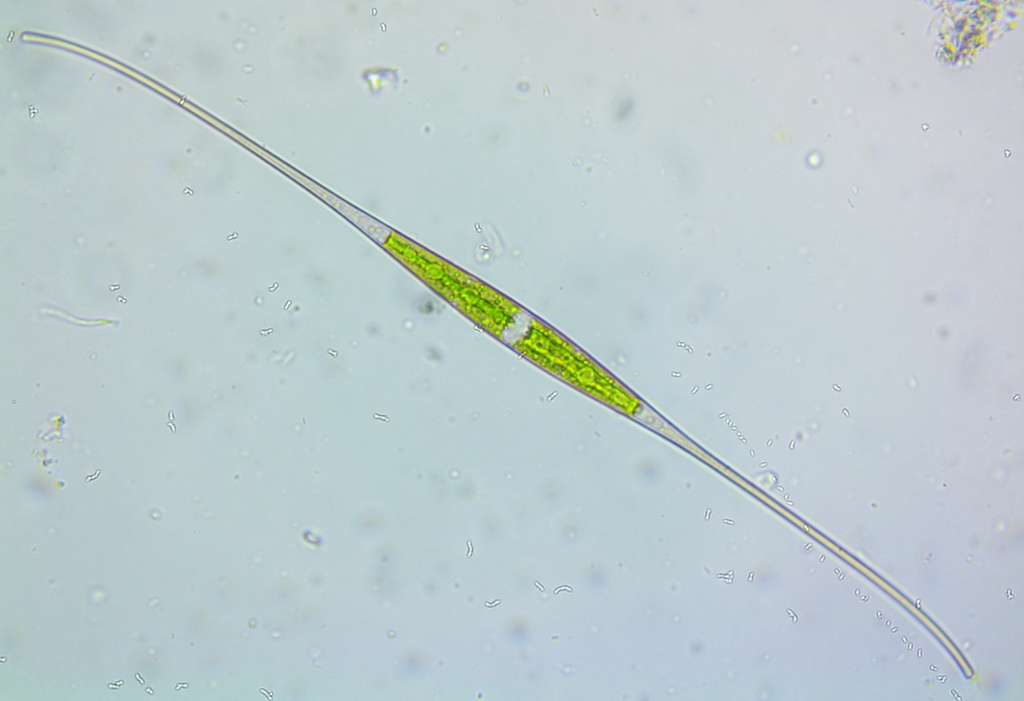
Closterium setaceum
Closterium setaceum is a species of unicellular charophyte green algae in the family Closteriaceae. It has a cosmopolitan distribution, and is typically found in oligotrophic to mesotrophic waters, with a pH of 4.5 to 6.
Closterium setaceum consists of very narrow cells about (150–)220–450(–610) μm long and (6–)8–13(–16) μm wide. The central portion of the cell is fusiform, with the dorsal and ventral sides of the central region of the cell being equally curved. The apices are drawn out into long, slender tips which are curved at the end with rounded or rounded-truncate tips. Each chloroplast contains two or three pyrenoids. The cell wall is colorless or brownish and is faintly striate with a density of 7 to 13 striae per 10 μm, or appears smooth. Zygospores are rectangular with concave sides.
Where it lives
Recorded sightings
—
geo-referenced records in GBIF, from museums, herbaria and field observers.
Drag the globe to turn it. Dots are where records exist, not a range map; darker means more records.
In the stacks
Searching the stacks…
Every page naming Closterium setaceum in the Biodiversity Heritage Library →
This page is assembled live from iNaturalist, GBIF, Wikipedia, the Source Library and the Internet Archive. It is not yet part of the hand-edited codex. iNaturalist taxon 553327.