- Animals
- ›Chordates
- ›Vertebrates
- ›Reptiles
- ›Snakes and Lizards
- ›Lizards
- ›Iguanas and Allies
- ›Dragons and Chameleons
- ›Dragons
- ›Bearded Dragons, Water Dragons, and Allies
- ›Ctenophorus
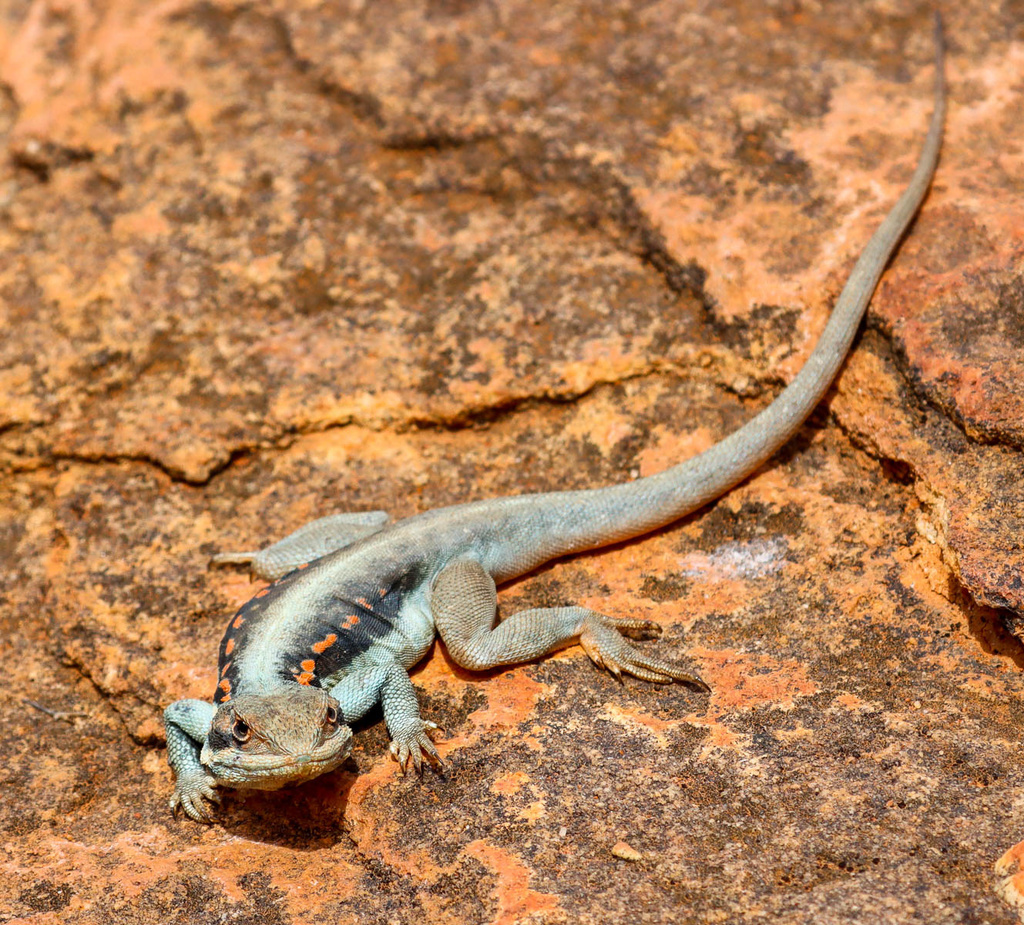
Barrier Range Rock Dragon
Ctenophorus mirrityana
Ctenophorus mirrityana (Barrier Range dragon) is an Australian species in the family Agamidae. It was first described in 2013 based on holotype collected from the Mutawintji National Park. The name mirrityana means 'out in the sunlight' in the local Aboriginal language. This species may have been first depicted in Aboriginal rock art.
From the article Ctenophorus mirrityana on Wikipedia (CC BY-SA), quoted section by section
Description
The Barrier Range dragon is a medium sized terrestrial lizard, which can reach a total length of 26 cm. Both males and females have small head and snout length measurements compared to other Ctenophorus species. Their compressed head and dorsoventrally flattened body, likely an adaptation for navigating the narrow rock crevices these lizards inhabit. As a sexually dimorphic species, male Barrier Range dragons are brightly coloured in contrast to the cryptically coloured females. The body of the male ranges from grey-blue to pale blue, however as the lizard’s temperature increases, this blue becomes more prominent. In contrast to the body’s pale colouration, the head is orange with a black stripe beginning at the eye and continuing laterally along the flank. The cream base colour of the male’s throat features grey parallel stripes, overlain with orange colouration, and a central black stripe running the length of the throat. The unique colouration of the male’s throat is one feature that distinguishes this species from C. decresii. Female Barrier Range dragons are brown in colour with black and terracotta stripes running along the flank. The dorsal scales also feature grey and terracotta specks. Similar to males, female lizards also have cream coloured throats with grey stripes but lack any black or orange colouration on the head. …
Range & habitat
The Barrier Range Dragon is found in the rocky hills of Western NSW at just three locations, including Mutawintji National Park, Purnamoota and Silverton Wind Farm. Typically, this species occurs in rocky habitat such as outcrops, gorges, ridges and scattered rock aggregates. However, it has also been recorded in mulga shrubland, black oak woodland and hummock grass woodland habitat.
Wikipedia: “Distribution and habitat”
What it does
C. mirrityana is a rock dwelling, diurnal species that predominately occupies rock aggregates and the flat tops of ridges. As an ectotherm, these lizards utilise rocky habitat for basking but are inactive during the hottest part of the day (1300 and 1500 hrs). As temperatures peak during the day, these dragons will seek out rock crevices, which are an important habitat requirement for this species. This species will also shelter in these structures when threatened. The dorsoventrally flattened head and body of the Barrier Range dragon further reflects how this species has evolved to rely on rock crevices. These lizards also have long hindlimbs which assists them in navigating their rocky environment. As male Barrier Range dragons are territorial and participate in conspicuous courtship behaviour, they utilise elevated rocky outcrops to demonstrate these displays.
Wikipedia: “Ecology”
In human culture
The Barrier Range dragon is an oviparous, that is, egg laying species that breeds between late July and early November. During the breeding season, males will perform courtship and territorial behaviour, characterised by head bobbing and push-ups. Typically, this species will lay 3-7 eggs in a clutch and multiple clutches can be produced within a breeding season. Females will lay their eggs in constructed burrows that create a stable humid environment for the eggs. Under stable environmental conditions in the burrow eggs can hatch after 55 days; however, it can take up to 89 days for eggs to hatch. During the breeding season both males and females develop orange colouration on the belly.
Wikipedia: “Life-history traits”
Where it lives
Recorded sightings
—
geo-referenced records in GBIF, from museums, herbaria and field observers.
Drag the globe to turn it. Dots are where records exist, not a range map; darker means more records.
In the stacks
Searching the stacks…
Every page naming Ctenophorus mirrityana in the Biodiversity Heritage Library →
This page is assembled live from iNaturalist, GBIF, Wikipedia, the Source Library and the Internet Archive. It is not yet part of the hand-edited codex. iNaturalist taxon 554062.