On eBird ↗
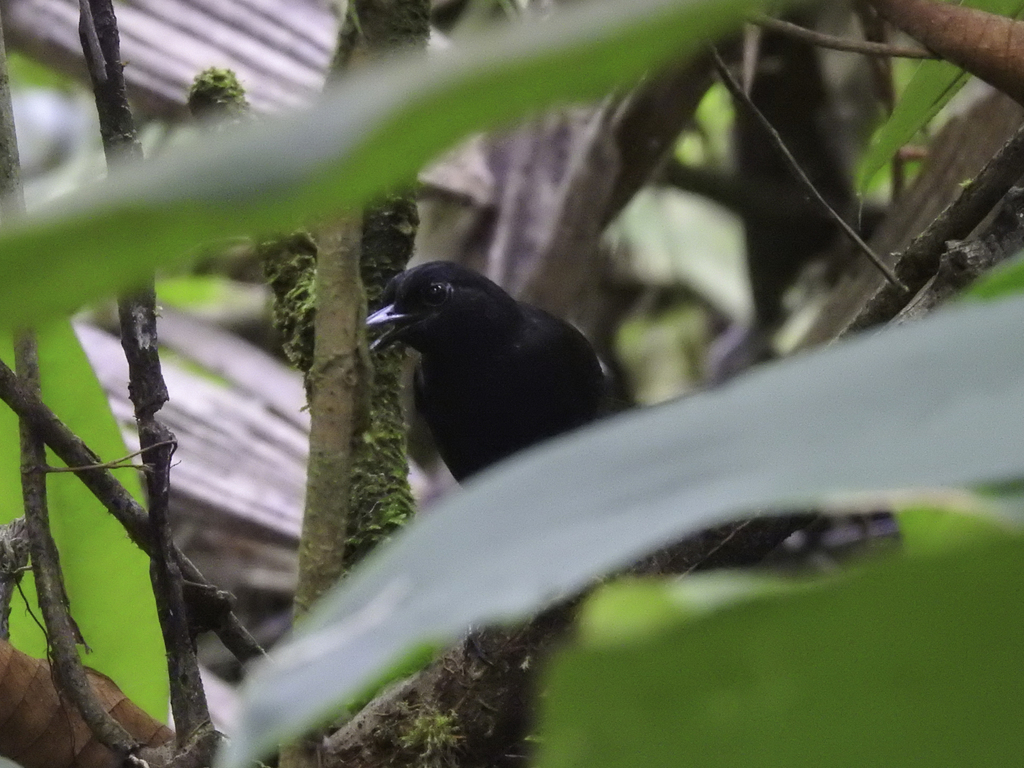
Stub-tailed Antbird
Live sightings near you, the range map, bar charts of when it is seen, and Macaulay Library photos and recordings.
Stub-tailed Antbird
Sipia berlepschi
The stub-tailed antbird (Myrmeciza berlepschi) is a species of bird in the family Thamnophilidae. It is found in Colombia and Ecuador. Its natural habitat is subtropical or tropical moist lowland forests.
From the article Stub-tailed antbird on Wikipedia (CC BY-SA), quoted section by section
Description
The stub-tailed antbird is 13.5 to 14.5 cm (5.3 to 5.7 in) long. Adult males are almost entirely black, with a white patch between their scapulars. Adult females are also mostly black, with white dots on the tips of their wing coverts and white spots on their throat, breast, and upper belly. Those on the belly sometimes have a scaly pattern. Both sexes have a deep red iris.
Range & habitat
The stub-tailed antbird is found from central Chocó Department in western Colombia, south into northwestern Ecuador's Esmeraldas Province. It is a bird of the Chocó Endemic Bird Area. There it inhabits the understorey of evergreen forest in the wet lowlands and foothills. It favors the forest edge, overgrown openings within the forest, and adjacent mature secondary forest. In elevation it mostly ranges from near sea level to 400 m (1,300 ft), though locally it reaches 650 m (2,100 ft). Research by Morton Isler, along with Gustavo Bravo and Robb Brumfield (2013), showed that stub-tailed antbirds have formed their own lineage. This disagreed with the placement with the Mymeciza family.
Wikipedia: “Distribution and habitat”
What it does
The stub-tailed antbird feeds primarily on insects and probably includes other arthropods in its diet. Individuals, pairs, and family groups forage in dense vegetation on the ground and up to about 2 m (7 ft) above it. It seldom joins mixed-species feeding flocks but sometimes attends army ant swarms to capture prey that flees from the ants. In the 2013 taxonomic revision of the antbird family, Sipia berlepschi was distinguished from related genera in part on the basis of its shorter tail and distinctive foraging behaviour in tangled understory near fallen logs, which supported its placement in the resurrected genus Sipia.
Wikipedia: “Feeding”
Listen
Looking for field recordings…
Where it lives
Recorded sightings
—
geo-referenced records in GBIF, from museums, herbaria and field observers.
Drag the globe to turn it. Dots are where records exist, not a range map; darker means more records.
In the stacks
Searching the stacks…
Every page naming Sipia berlepschi in the Biodiversity Heritage Library →
This page is assembled live from iNaturalist, GBIF, Wikipedia, the Source Library and the Internet Archive. It is not yet part of the hand-edited codex. iNaturalist taxon 554086.