On eBird ↗
Chestnut-backed Antbird
Live sightings near you, the range map, bar charts of when it is seen, and Macaulay Library photos and recordings.
Chestnut-backed Antbird
Poliocrania exsul
The chestnut-backed antbird (Poliocrania exsul) is a passerine bird in the antbird family. It is found in humid forests in Central and South America (Chocó-Magdalena), ranging from eastern Nicaragua to western Ecuador. It mainly occurs in lowlands up to an altitude of 900 metres (3,000 ft) m, but locally it occurs higher.
From the article Chestnut-backed antbird on Wikipedia (CC BY-SA), quoted section by section
Description
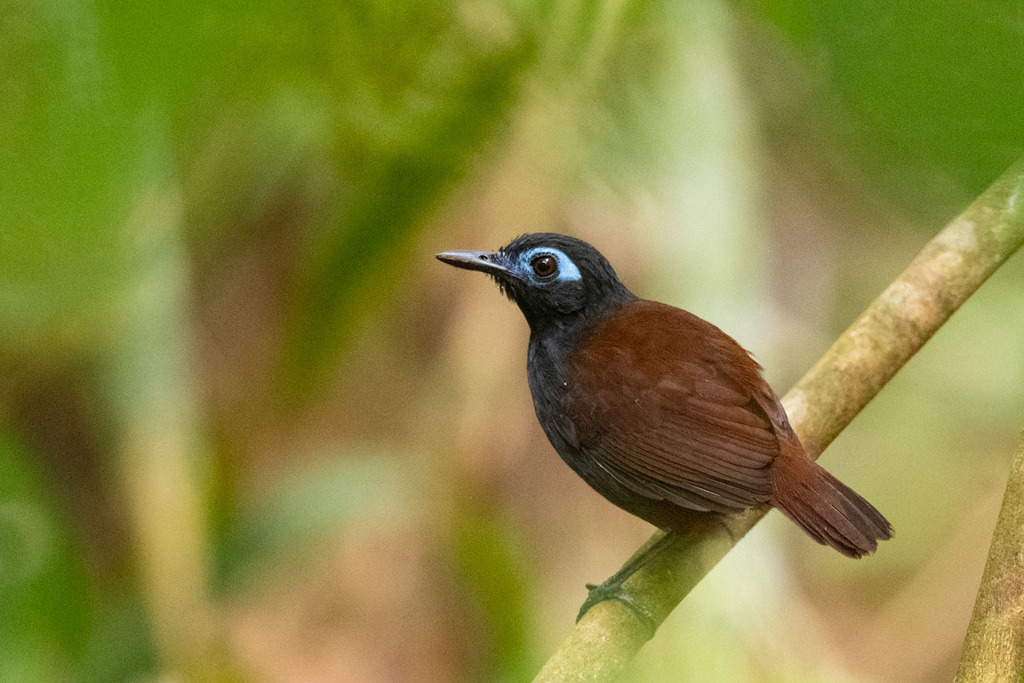
The chestnut-backed antbird is 14 to 15 centimetres (5.5 to 5.9 in) long and weighs about 29 grams (1.0 oz). Both sexes of all subspecies have a pale blue patch of bare skin around each eye. Adult males of the nominate subspecies P. e. exsul have a slate-black head and neck. Their upperparts are deep chestnut. Their wings and tail are deep chestnut with some black and white on the wing coverts. Their throat, breast, and belly are blackish slate and their flanks, vent area, and undertail coverts are brown. Adult females have a duller black head and neck than males; their upperparts are otherwise the same as the male's. Their chin and throat are duller slate-blackish than the male's and the rest of their underparts are brown. Both sexes have a reddish brown iris, a black bill, and dark horn to blackish legs and feet. Males of subspecies P. e. occidentalis are paler overall than the nominate but otherwise similar. Females have similar upperparts to the nominate but bright tawny-chestnut or rufous-chestnut throat and upper breast, tawny-russet lower breast and belly, and tawny-brown flanks, vent, and undertail coverts. Males of subspecies P. e. maculifer are like nominate males with the addition of white tips on their wing coverts. Females also resemble the nominate except for rufous-chestnut underparts. Males of P. e. …
Range & habitat
The subspecies of the chestnut-backed antbird are found thus:
P. e. exsul: from eastern Honduras along the Caribbean slope through Nicaragua and Costa Rica into Panama to near the Panama Canal P. e. occidentalis: Pacific slope of western Costa Rica and western Panama to Veraguas Province P. e. cassini: from extreme southeastern Panama south of the Bay of San Miguel into northern Colombia east to Cesar Department and south in the Magdalena Valley P. e. niglarus: Panama east of the Canal in Colón Province and on the Pacific slope from Panama Province south into northern Chocó Department in far northwestern Colombia P. e. maculifer: Pacific slope from central Chocó in Colombia south into western Ecuador as far as El Oro Province Most of the chestnut-backed antbird subspecies inhabit the understorey in the interior of humid to wet evergreen forest. The occur in both primary and secondary forest though they prefer the former. They favor dense vegetation, vine tangles, and the undergrowth of older gaps caused by fallen trees. Subspecies P. e. occidentalis inhabits drier and more open semi-humid transitional forest than the other subspecies and occurs more often in younger secondary forest. In elevation the species occurs to 1,200 m (3,900 ft) in Honduras, Costa Rica, and Colombia and to about 1,000 m (3,300 ft) in much of the rest of Central America. …
Wikipedia: “Distribution and habitat”
What it does
The chesnut-backed antbird feeds primarily on insects and other arthropods and also takes small lizards and frogs. Pairs and family groups usually forage in dense vegetation on and near the ground but also in more open situations. It walks and makes short flutter-flights while picking prey from the substrate. It sometimes joins mixed-species feeding flocks and attends army ant swarms that pass through its territory.
Wikipedia: “Feeding”
Listen
Looking for field recordings…
Where it lives
Recorded sightings
—
geo-referenced records in GBIF, from museums, herbaria and field observers.
Drag the globe to turn it. Dots are where records exist, not a range map; darker means more records.
In the stacks
Searching the stacks…
Every page naming Poliocrania exsul in the Biodiversity Heritage Library →
This page is assembled live from iNaturalist, GBIF, Wikipedia, the Source Library and the Internet Archive. It is not yet part of the hand-edited codex. iNaturalist taxon 554103.