On eBird ↗
Blue-billed Teal
Live sightings near you, the range map, bar charts of when it is seen, and Macaulay Library photos and recordings.
Blue-billed Teal
Spatula hottentota
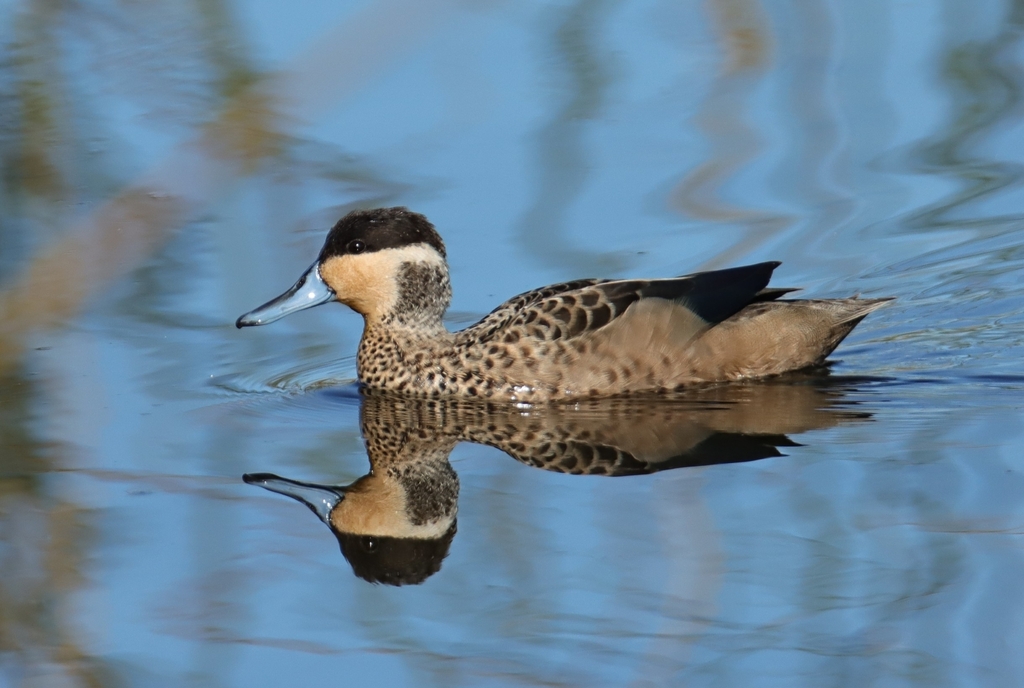
The blue-billed teal (Spatula hottentota), also sometimes called spotted teal and formerly Hottentot teal, is a species of dabbling duck of the genus Spatula. It is resident in eastern, southern, and western Africa, from Sudan and Ethiopia west to Niger and Nigeria, and south to South Africa and Namibia, and also in Madagascar. It is generally sedentary, but shows nomadic behaviour in response to water requirements, moving away if drought causes wetlands to dry out.
The blue-billed teal breeds year round, depending on rainfall, and stays in small groups or pairs. They build nests above water in tree stumps and use vegetation. Ducklings leave the nest soon after hatching, and the mother's parenting is limited to providing protection from predators and leading young to feeding areas. This species is omnivorous and prefers smaller shallow bodies of water.
From the article Blue-billed teal on Wikipedia (CC BY-SA), quoted section by section
Range & habitat
The range of the blue-billed teal extends in Africa from Angola, Zambia, eastern Congo, Malawi, northern Mozambique, Tanzania, Kenya, Uganda, southern Ethiopia, Sudan and Madagascar. They are mainly found in tropical eastern Africa: Ethiopia to Cape Province, westward to northern Botswana and Namibia, and Madagascar. The blue-billed teal prefers habitats with abundant plants with floating leaves and fringe vegetation, including shallow fresh-water swamps, marshes, streams, shallow small lakes and ponds with fringed edges of reeds or papyrus. They are observed to spend the twilight and night hours dabbling in very shallow waters and move to deeper and safer parts of the marsh during daytime.
Wikipedia: “Distribution and habitat”
What it does
The blue-billed teal is sedentary in West Africa and Madagascar but partly migratory elsewhere, following regular but unpredictable short-distance migration routes, up to 700 km (430 mi), in southern and eastern Africa in response to changing water levels.
Feeding and diet. The blue-billed teal prefers feeding at muddy edges, it will also feed on lands and flooded fields like rice paddies, and in waterside that is disturbed heavily by livestock. It feeds in well-vegetated areas by dabbling, swimming or on foot. No diving during foraging is recorded. It is omnivorous, although its diet consists mainly of grass seeds, especially of the grass Sacciolepis, however it may also consume aquatic invertebrates almost exclusively such as crustaceans like ostracods, molluscs, water insects such as beetles and their larvae, if these are super abundant.
Moult. Moult is poorly understood in the blue-billed teal; there is no identified eclipse plumage in males, but breeding males are much brighter than females and the breast spots are more distinct.
Vocal behaviour. Both sexes produce series of clicking notes, given as harsh ke-ke-ke when they are disturbed, during flying or within flock. …
Wikipedia: “Behaviour”
Listen
Looking for field recordings…
Where it lives
Recorded sightings
—
geo-referenced records in GBIF, from museums, herbaria and field observers.
Drag the globe to turn it. Dots are where records exist, not a range map; darker means more records.
In the stacks
Searching the stacks…
Every page naming Spatula hottentota in the Biodiversity Heritage Library →
This page is assembled live from iNaturalist, GBIF, Wikipedia, the Source Library and the Internet Archive. It is not yet part of the hand-edited codex. iNaturalist taxon 558430.