- Animals
- ›Chordates
- ›Vertebrates
- ›Birds
- ›Hawks, Eagles, Kites, and Allies
- ›Hawks, Eagles, and Kites
- ›Typical Hawks and Harriers
- ›Circus
On eBird ↗
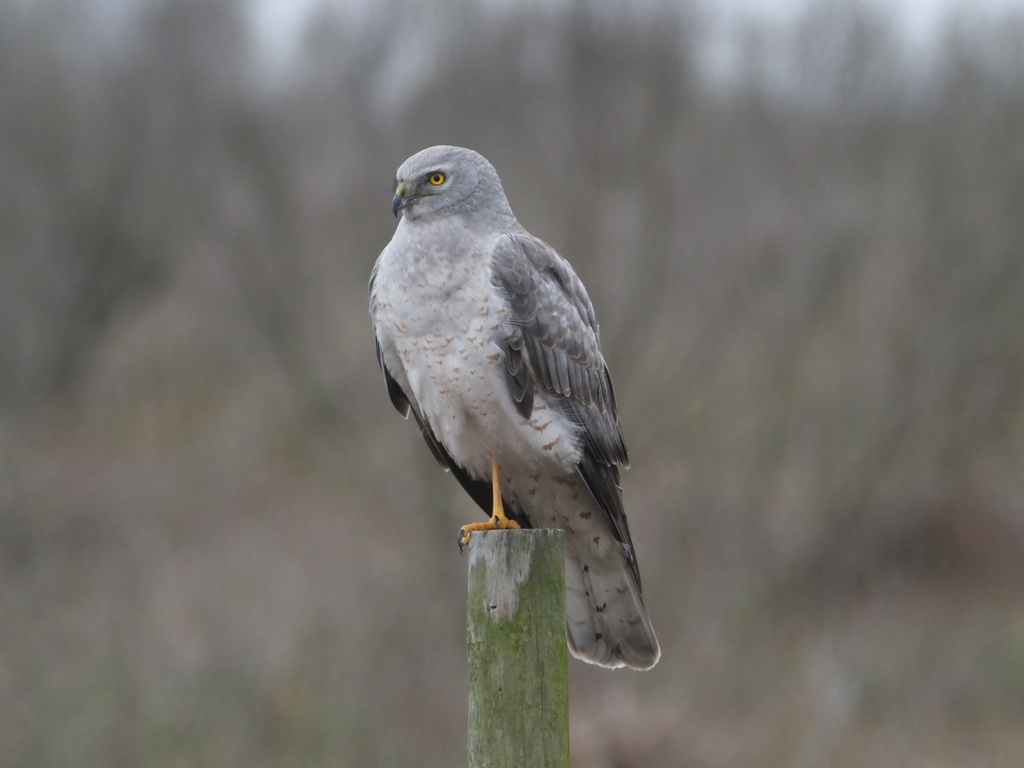
Northern Harrier
Live sightings near you, the range map, bar charts of when it is seen, and Macaulay Library photos and recordings.
Northern Harrier
Circus hudsonius
The northern harrier (Circus hudsonius), also known as the marsh hawk or ring-tailed hawk, is a bird of prey. It breeds throughout the northern parts of the Northern Hemisphere in Canada and the northernmost United States.
The northern harrier migrates south in winter, with breeding birds in Canada and northern Great Plains of the U.S. moving to the American south, Mexico, and Central America. In the midwestern, mountain west, and north Atlantic states of the U.S., they may be present all year. This bird inhabits prairies, open areas, and marshes.
From the article Northern harrier on Wikipedia (CC BY-SA), quoted section by section
Description
The northern harrier is 41–52 cm (16–20 in) long with a 97–122 cm (38–48 in) wingspan. It resembles other harriers in having distinct male and female plumages. The sexes also differ in weight, with males weighing 290 to 400 g (10 to 14 oz), with an average of 350 g (12 oz), and females weighing 390 to 750 g (14 to 26 oz), with an average of 530 g (19 oz). Among standard measurements, the wing chord is 32.8 to 40.6 cm (12.9 to 16.0 in), the tail is 19.3 to 25.8 cm (7.6 to 10.2 in) and the tarsus is 7.1 to 8.9 cm (2.8 to 3.5 in). It is relatively long-winged and long-tailed, having the longest wing and tail relative to its body size of any raptor occurring in North America. The northern harrier breeds in North America, and its closest relative is the cinereous harrier (C. cinereus) of South America. The male's plumage is darker grey than that of the hen harrier, and the female is also darker and more rufous. The adult male is sometimes nicknamed the "Grey Ghost", because of his striking plumage and spectral aura. The northern harrier is mostly silent, although males and females will both give fast kek notes that will last 1-2 seconds. When faced with predators or surrounded by smaller birds, they still emit kek notes but at a higher pitch. During the mating season, the female emits a loud scream, which causes the male to either mate or provide food.
What it does
This medium-sized raptor breeds on moorland, bogs, prairies, farmland coastal prairies, marshes, grasslands, swamps and other assorted open areas. A male will maintain a territory averaging 2.6 km2 (1.0 sq mi), though male territories have ranged from 1.7 to 150 km2 (0.66 to 57.92 sq mi).
These are one of the few raptorial birds known to practice polygyny – one male mates with several females. Up to five females have been known to mate with one male in a season. The nest is built on the ground or on a mound of dirt or vegetation. Nests are made of sticks and are lined inside with grass and leaves. Four to eight (exceptionally 2 to 10) whitish eggs are laid. The eggs measure approximately 47 mm × 36 mm (1.9 in × 1.4 in). The eggs are incubated mostly by the female for 31 to 32 days. When incubating eggs, the female sits on the nest while the male hunts and brings food to her and the chicks. The male will help feed chicks after they hatch, but does not usually watch them for a greater period of time than around 5 minutes. The male usually passes off food to the female, which she then feeds to the young, although later the female will capture food and simply drop into the nest for her nestlings to eat. The chicks fledge at around 36 days old, though breeding maturity is not reached until 2 years in females and 3 years in males.
Hunting behavior. …
Wikipedia: “Behaviour”
Listen
Looking for field recordings…
Where it lives
Recorded sightings
—
geo-referenced records in GBIF, from museums, herbaria and field observers.
Drag the globe to turn it. Dots are where records exist, not a range map; darker means more records.
In the stacks
Searching the stacks…
Every page naming Circus hudsonius in the Biodiversity Heritage Library →
This page is assembled live from iNaturalist, GBIF, Wikipedia, the Source Library and the Internet Archive. It is not yet part of the hand-edited codex. iNaturalist taxon 558446.