On eBird ↗
Striped Owl
Live sightings near you, the range map, bar charts of when it is seen, and Macaulay Library photos and recordings.
Striped Owl
Asio clamator
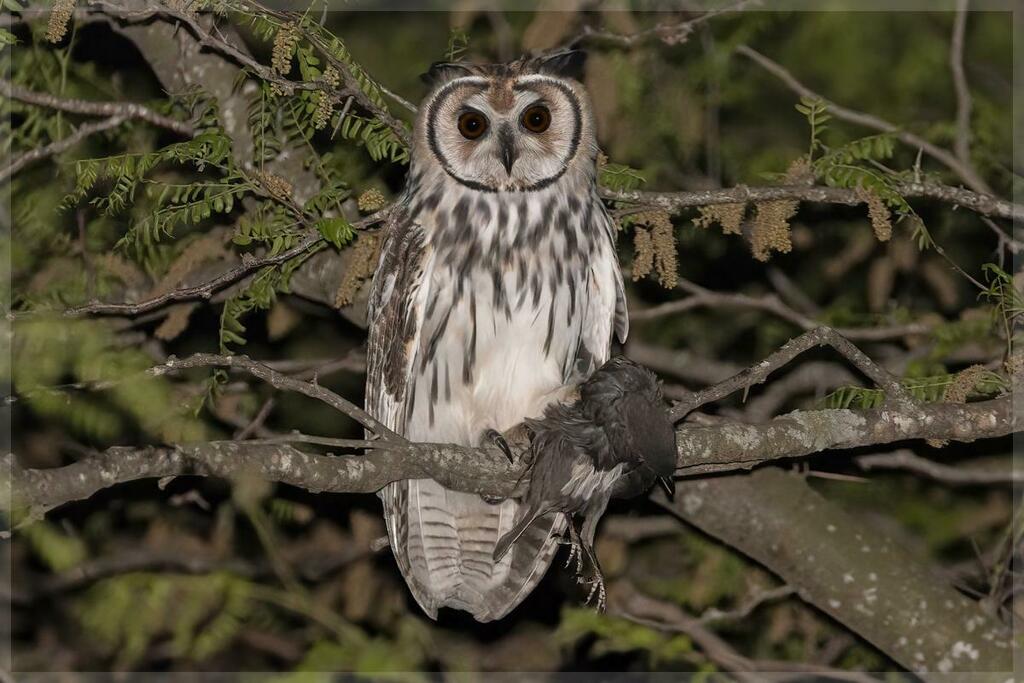
The striped owl (Pseudoscops clamator) is a medium-sized owl with large ear tufts and a brownish-white facial disk rimmed with black. Its beak is black, and it has cinnamon-colored eyes. It has shorter, rounder wings than most of its close relatives. The upperparts are cinnamon with fine black vermiculation and heavy stripes. The underparts are pale tawny with dusky streaks. It is native to South America, and parts of Central America.
From the article Striped owl on Wikipedia (CC BY-SA), quoted section by section
Description
The striped owl is a relatively large species with prominent tufts of elongated feathers on the crown resembling ears. It is 30–38 cm (12–15 in) long and weighs from 320 to 546 g (11.3 to 19.3 oz). Its head, back, wings and tail are brown with black stripes and small markings while its underparts are buff-coloured with heavy black streaking on the breast. The facial disk is pure white with a thin black border.
Range & habitat
The striped owl is native to much of South and Central America. Its range is not well known, perhaps because it is nocturnal and not easily seen, but it is known from Argentina, Belize, Bolivia, Brazil, Colombia, Costa Rica, Ecuador, El Salvador, French Guiana, Guatemala, Guyana, Honduras, Mexico, Nicaragua, Panama, Paraguay, Peru, Suriname, Tobago, Uruguay and Venezuela. It uses a variety of habitats, including riparian woodlands, marshes, savannahs, grassy open areas, and tropical rainforests. It can be found from sea level to an altitude of 1,400 m (4,600 ft) and above.
Wikipedia: “Distribution and habitat”
Listen
Looking for field recordings…
Where it lives
Recorded sightings
—
geo-referenced records in GBIF, from museums, herbaria and field observers.
Drag the globe to turn it. Dots are where records exist, not a range map; darker means more records.
In the stacks
Searching the stacks…
Every page naming Asio clamator in the Biodiversity Heritage Library →
This page is assembled live from iNaturalist, GBIF, Wikipedia, the Source Library and the Internet Archive. It is not yet part of the hand-edited codex. iNaturalist taxon 558468.