On eBird ↗
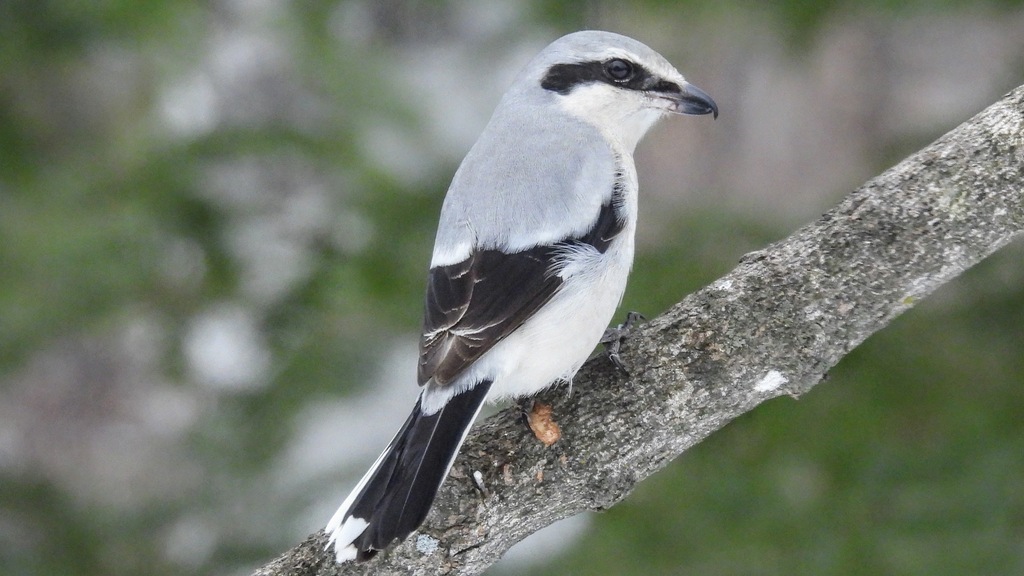
Northern Shrike
Live sightings near you, the range map, bar charts of when it is seen, and Macaulay Library photos and recordings.
Northern Shrike
Lanius borealis
The northern shrike (Lanius borealis) is a large songbird species in the shrike family (Laniidae) native to North America and Siberia. Long considered a subspecies of the great grey shrike, it was classified as a distinct species in 2017. Six subspecies are recognised.
From the article Northern shrike on Wikipedia (CC BY-SA), quoted section by section
Description
The loggerhead shrike can be distinguished from the northern shrike by its smaller size, darker grey plumage and larger black face mask that covers the eye completely. It also has a shorter bill with less prominent hook. Their calls are similar. Measurements:
Length: 9.1–9.4 in (23–24 cm) Weight: 2.0–2.8 oz (57–79 g) Wingspan: 11.8–13.8 in (30–35 cm)
Range & habitat
The northern shrike breeds in taiga and tundra from Labrador west through Alaska (including some Aleutian Islands) to western Siberia, and south to extreme northwestern China, northern Mongolia, and James Bay. It breeds in forest edge habitats wherever suitable trees or shrubs are present and has nested in white spruce, black spruce, felt-leaf willow, mountain alders, and poplars. The northern limit of its breeding range is defined by the presence of 1-2 meter high shrubby willows. Northern shrikes are irruptive in the non-breeding season. Some stay year-round in this breeding range, but most move south depending on the severity of the winter, food supply, and competition from other shrikes. They will go as far south as northeastern China and Japan in Asia and irregularly as far south as New Mexico, Kansas, Illinois, Ohio, Pennsylvania, and New Jersey. On their wintering grounds, they prefer open country, including forest edges, prairies, agricultural land, savannas, and coastal marshes. Observations of wintering habitats in Idaho suggest suitable wintering territories are in demand, as northern shrikes that died in a particular area were quickly replaced.
Wikipedia: “Distribution and habitat”
What it does
Northern shrikes often sit on tall poles and branches surveying for food. They prey on arthropods such as spiders, beetles, bugs, and grasshoppers, and small vertebrates. Prey identified include passerine birds such as horned lark, black-capped chickadee, common starling, brewer's sparrow, white-crowned sparrow, dark-eyed junco, pine siskin, house sparrow, small mammals such as the vagrant shrew, western harvest mouse, deer mouse, long-tailed vole, meadow vole and house mouse, and reptiles such as spiny lizards. They have been observed hunting finches and house sparrows at bird feeders. They are known to lure small birds by imitating their calls.
Wikipedia: “Feeding”
Listen
Looking for field recordings…
Where it lives
Recorded sightings
—
geo-referenced records in GBIF, from museums, herbaria and field observers.
Drag the globe to turn it. Dots are where records exist, not a range map; darker means more records.
In the stacks
Searching the stacks…
Every page naming Lanius borealis in the Biodiversity Heritage Library →
This page is assembled live from iNaturalist, GBIF, Wikipedia, the Source Library and the Internet Archive. It is not yet part of the hand-edited codex. iNaturalist taxon 558512.