On eBird ↗
White-rumped Shrike
Live sightings near you, the range map, bar charts of when it is seen, and Macaulay Library photos and recordings.
White-rumped Shrike
Eurocephalus ruppelli
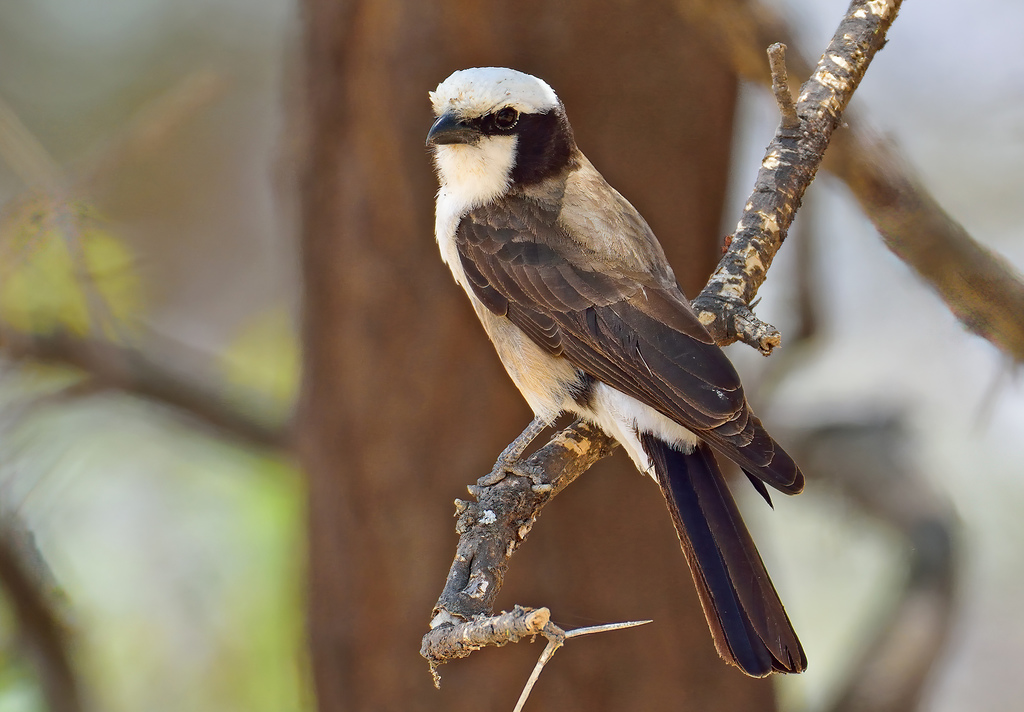
The northern white-crowned shrike or white-rumped shrike (Eurocephalus ruppelli), is a shrike found in dry thornbush, semi-desert, and open acacia woodland in east Africa from south eastern South Sudan and southern Ethiopia to Tanzania. Its binomial name commemorates the German naturalist and explorer Eduard Rüppell.
From the article Northern white-crowned shrike on Wikipedia (CC BY-SA), quoted section by section
Description
The northern white-crowned shrike is a large and fluffy passerine, measuring 19–23-cm long and weigh 42–58 gram. The adult has a white crown and rump, black eyestripe, brown back and wings and black tail. The throat, breast and belly are white, and the flanks are brown. The sexes are similar, but juveniles have a brown crown, white head sides, and grey breast. The flight is parrot-like. Several subspecies have been described, but there is extensive individual variation in plumage. Although birds in the north of the range are larger than in the south, the difference is clinal and the northern white-crowned shrike may be monotypic. The calls are high-pitched squawks, squeaks and chatters, including kek-kek and chee-chee.
What it does
The northern white-crowned shrike is gregarious, occurring in groups of up 12 birds. It hunts from an exposed perch, feeding mainly on large insects, usually taken from the ground. It also will feed from the backs of large mammals, like an oxpecker, and occasionally will eat fruit which has fallen to the ground. The neat thick-walled cup nest is constructed from grass and spider webs in a horizontal tree fork 4–6 metres above the ground. The two to four white or lilac eggs are blotched with grey, purple or brown. It is likely that cooperative breeding occurs, given the gregarious habits of this species and the known cooperative breeding of the closely related southern white-crowned shrike.
Wikipedia: “Behaviour”
Listen
Looking for field recordings…
Where it lives
Recorded sightings
—
geo-referenced records in GBIF, from museums, herbaria and field observers.
Drag the globe to turn it. Dots are where records exist, not a range map; darker means more records.
In the stacks
Searching the stacks…
Every page naming Eurocephalus ruppelli in the Biodiversity Heritage Library →
This page is assembled live from iNaturalist, GBIF, Wikipedia, the Source Library and the Internet Archive. It is not yet part of the hand-edited codex. iNaturalist taxon 558513.