- Animals
- ›Chordates
- ›Vertebrates
- ›Birds
- ›Perching Birds
- ›Old World Flycatchers, Robins, and Chats
- ›Sholicola
On eBird ↗
White-bellied Sholakili
Live sightings near you, the range map, bar charts of when it is seen, and Macaulay Library photos and recordings.
White-bellied Sholakili
Sholicola albiventris
The white-bellied blue robin (Sholicola albiventris) or white-bellied sholakili, is a bird of the family Muscicapidae. It is endemic to the Shola forests of the higher hills of southern India. The Nilgiri blue robin and this species were once considered separate species, later lumped as sub-species of a single species (major) and elevated again to full species in 2005 by Pamela C. Rasmussen. The species was earlier thought to be related to the shortwings and placed in the genus Brachypteryx and later moved to Myiomela since species in the genus Brachypteryx show marked sexual dimorphism. In 2017, a study found that this is a sister group of the flycatchers in the genera Niltava, Cyornis and Eumyias among others. It was then placed in newly erected genus Sholicola. This small bird is found on the forest floor and undergrowth of dense forest patches sheltered in the valleys of montane grassland, a restricted and threatened habitat.
From the article White-bellied blue robin on Wikipedia (CC BY-SA), quoted section by section
Description
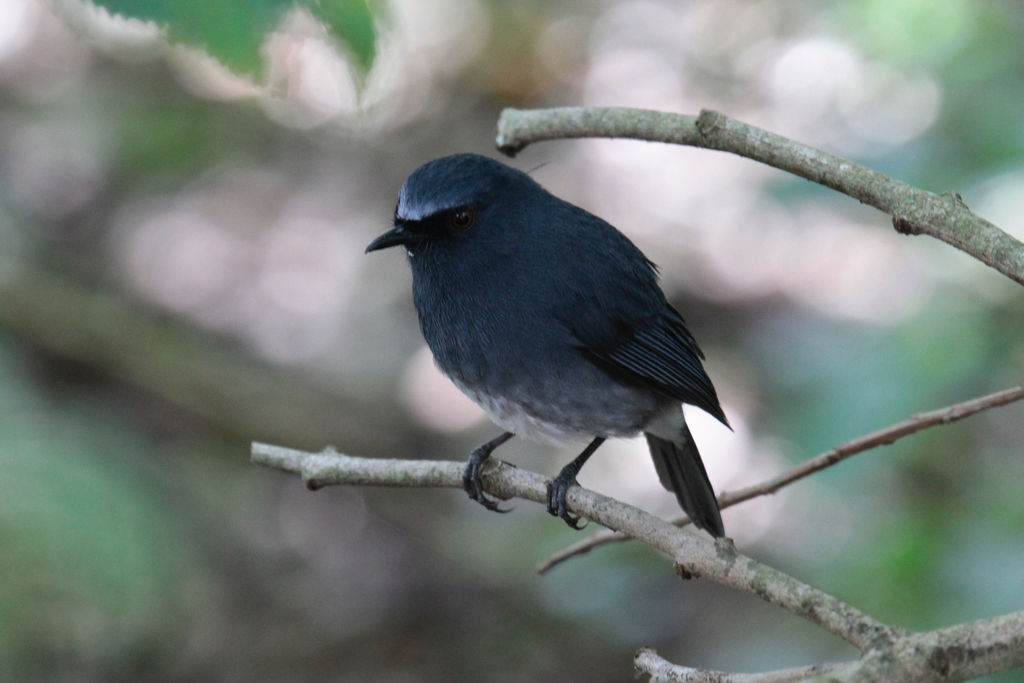
This chat-like bird is long-legged and appears chunky with its short tail and wing. Although sharing similar habits and shape, the two species differ in plumage and both may show slight sexual dimorphism. Differences in iris colour between the females have been suggested for S. albiventris. The white-bellied blue robin (S. albiventris) has a black face mask with a short whitish brow. The upperside and breast are slaty blue grading to grey on the flanks. The centre of the belly and vent is white. This can appear somewhat like the male of the syntopic white-bellied blue flycatcher (Cyornis pallipes) but can be distinguished by behaviour apart from the longer legs and greyer colouration. Although the plumage is identical between males and females, males are slightly longer winged and have longer tarsi.
Range & habitat
The natural habitat of the white-bellied blue robin is forest patches in the valleys of high altitude grasslands known as sholas. The species has been found to occur only above 1200 m altitude in the higher hill ranges of southern India. These forest patches are highly restricted in size and the species is thus threatened by habitat loss. Populations are mainly in the Anaimalai and Cardamom Hills, both south of the Palghat gap. The population in the Ashambu hills has been described as a new species Ashambu blue robin (Sholicola ashambuensis) which differs slightly in coloration and is estimated to have diverged from a common ancestor about 1.24 - 0.49 million years ago.
Wikipedia: “Habitat and distribution”
What it does
These birds are found in dense forest in the dark lower canopy and forest floor. They are skulking but can be confiding. They call frequently with tit-like notes and harsh rattles. The song of S. albiventris is said to have a higher pitched and more musical song. Birds have been noted to moult their tail feathers in the beginning of June. Little is known of their dispersal, longevity and other aspects of life history although more than 133 birds have been ringed. Two greyish green and brown-marked eggs are laid during the breeding season that varies from April to June, after the rains. The nest is placed in a tree hole or placed on a bank and is made of moss and fibrous roots and placed low over the ground.
Wikipedia: “Behaviour and ecology”
Listen
Looking for field recordings…
Where it lives
Recorded sightings
—
geo-referenced records in GBIF, from museums, herbaria and field observers.
Drag the globe to turn it. Dots are where records exist, not a range map; darker means more records.
In the stacks
Searching the stacks…
Every page naming Sholicola albiventris in the Biodiversity Heritage Library →
This page is assembled live from iNaturalist, GBIF, Wikipedia, the Source Library and the Internet Archive. It is not yet part of the hand-edited codex. iNaturalist taxon 558545.